
Where to see the Black Darter in the Netherlands
With luck 🪰 Dragonfly
Where and when do you see a Black Darter? With some luck you can see this species, from May to October.
How do you recognise a Black Darter?
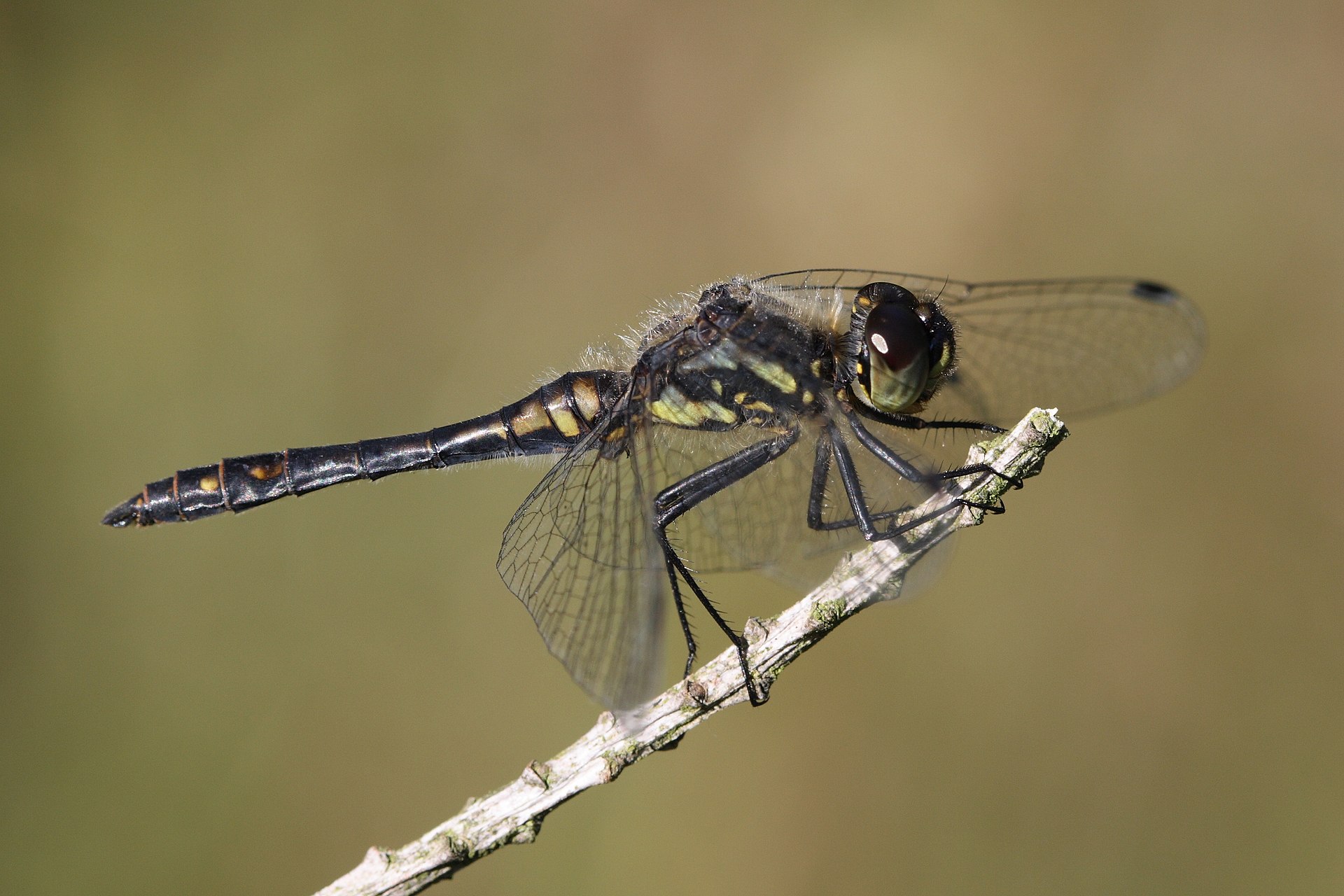
Our smallest darter, 29 to 34 millimetres. The fully coloured male has a largely black abdomen and becomes almost entirely black with age; the female is yellower with a dark underside. Characteristic are the black triangle on the thorax behind the head, the black band on the side of the thorax with three small yellow spots, and entirely black legs.
Where do you see this species in the Netherlands?
Formerly common in pool-rich sandy areas, now rare there; still present in the dunes and locally numerous in lowland peat areas.
📍 Nationaal Park Weerribben-Wieden
presence reported📍 Fochteloërveen
presence reported📍 Deelerwoude
presence reported📍 Nationaal Park Drents-Friese Wold
presence reported📍 Nationaal Park Dwingelderveld
presence reported📍 Nationaal Park De Hoge Veluwe
presence reported📍 Nationaal Park Utrechtse Heuvelrug
presence reported📍 Planken Wambuis
presence reported📍 Kampina & Oisterwijkse Vennen
presence reported📍 Strabrechtse Heide & Beuven
presence reportedThese links come straight from our database, with the chance, the source and the evidence level for each area.
When is the best time?
Green = present · orange = peak period. The bar is generated from our database.
Best period: Late May to October, with the peak from July to September.
Best time of day: The warm hours in the middle of the day.
Recent sightings
👁️ Where has this species been seen recently?
Check the current sightings on Waarneming.nl. A useful addition to our own verified information.
How to improve your chances
- Go on a warm, windless day between about ten and four, when they are active.
- Look for the place rather than the animal: flowery edges for butterflies, banks and open water for dragonflies.
- Move slowly and keep your shadow off the animal. It notices that before it notices you.
- Early in the morning they are still cold and motionless on a leaf. That is when you can get closest.
🎒 What you need for this
A macro lens or binoculars with a short focusing distance
Photography
It is not territorial and sits still a great deal on stems and bare ground, so you can approach it calmly. Sit low and use the dark pool bed as a background, or the black male disappears into a cluttered frame
🌿 Watching responsibly
Keep your distance, stay on the paths, and never lure animals with food or sound. Leave as soon as an animal becomes uneasy.
Status: Verified · Last checked: 2026-08-07