
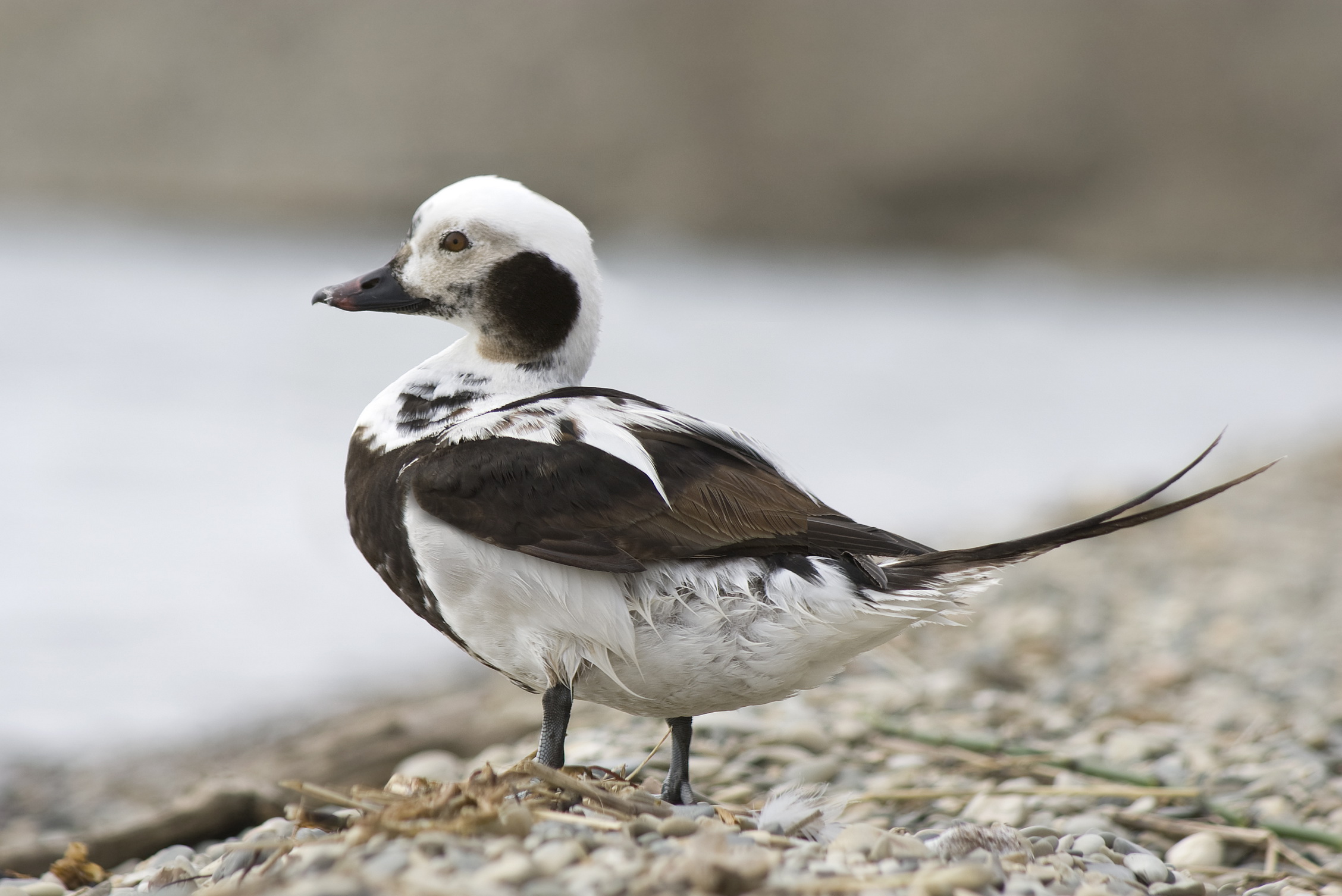
Where to see the Long-tailed Duck in the Netherlands
Rare 🦅 Bird
Where and when do you see a Long-tailed Duck? This species is rarely seen, from November to March.
How do you recognise a Long-tailed Duck?
A small, compact sea duck of 40 to 47 cm with a wingspan of 73 to 79 cm. The male in winter plumage is mostly white with a dark breast band, a grey patch on the cheek and two greatly elongated black tail feathers; from above a black Y shows on the back. The female is brown with a white head and a dark crown and cheek patch, and lacks the long tail. In all plumages the wings are entirely dark, with no speculum. It flies low and tilting over the water.
What does a Long-tailed Duck sound like?
Recording: Tony Phillips, CC BY 3.0, via Wikimedia Commons
Where do you see this species in the Netherlands?
A scarce winter visitor, with most records on the IJsselmeer, the Markermeer, the Wadden Sea and the Zeeland Delta. The national winter population is around 50 to 150 birds. In 2019 a breeding record was established in the Netherlands for the first time, on the Marker Wadden.
📍 Wadden Sea
presence reported📍 Marker Wadden
presence reported📍 Nationaal Park Zuid-Kennemerland
Very rare chance per source📍 Blauwe Kamer
presence reported📍 Schoorlse Duinen
presence reported📍 Haringvlietsluizen
presence reported📍 Vismigratierivier Afsluitdijk
presence reported📍 De Putten bij Camperduin
presence reportedThese links come straight from our database, with the chance, the source and the evidence level for each area.
When is the best time?
Green = present · orange = peak period. The bar is generated from our database.
Best period: A winter visitor from November through March, with the most birds in January and February.
Best time of day: During the day, preferably with little wind so that the swell does not push the birds out of view.
Recent sightings
👁️ Where has this species been seen recently?
Check the current sightings on Waarneming.nl. A useful addition to our own verified information.
How to improve your chances
- Learn the calls first. You will hear most birds before you see them.
- Go in the first hour after sunrise, when the song is at its peak and the wind is still down.
- Use a hide or natural cover. Sitting still gets you more than walking closer.
- Keep the sun behind you. Against the light you see a silhouette and no colour.
🎒 What you need for this
Telescope. The birds sit far out on the water and dive constantly, so you need magnification and patience.
Photography
Work from a dyke or pier where the birds come in close to the shore and photograph with the sun behind you. Wait for the moment the bird surfaces and shakes itself. Do not go after the flock in a boat: flushing them in midwinter costs them precious energy.
🌿 Watching responsibly
Keep your distance, stay on the paths, and never lure animals with food or sound. Leave as soon as an animal becomes uneasy.
Status: Verified · Last checked: 2026-08-08