Where to see the water spider in the Netherlands
Rare 🕷️ Spider
Where and when do you see a water spider? This species is rarely seen, all year round.
How do you recognise a water spider?
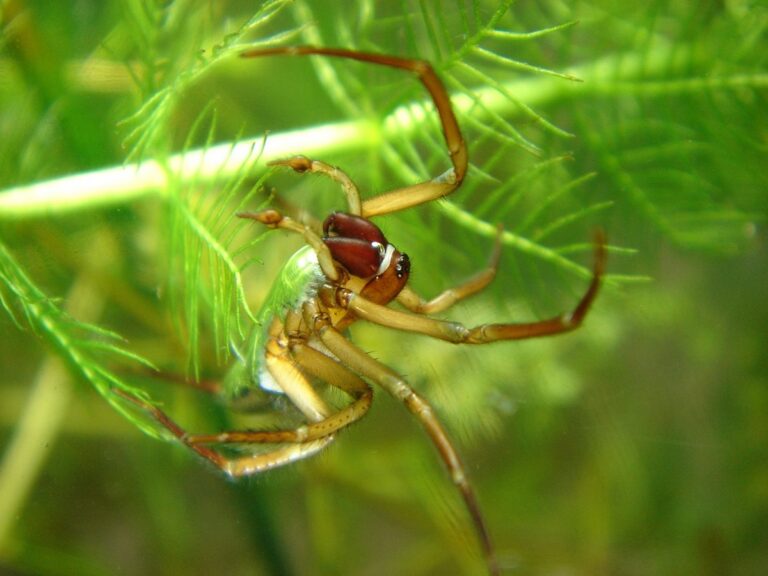
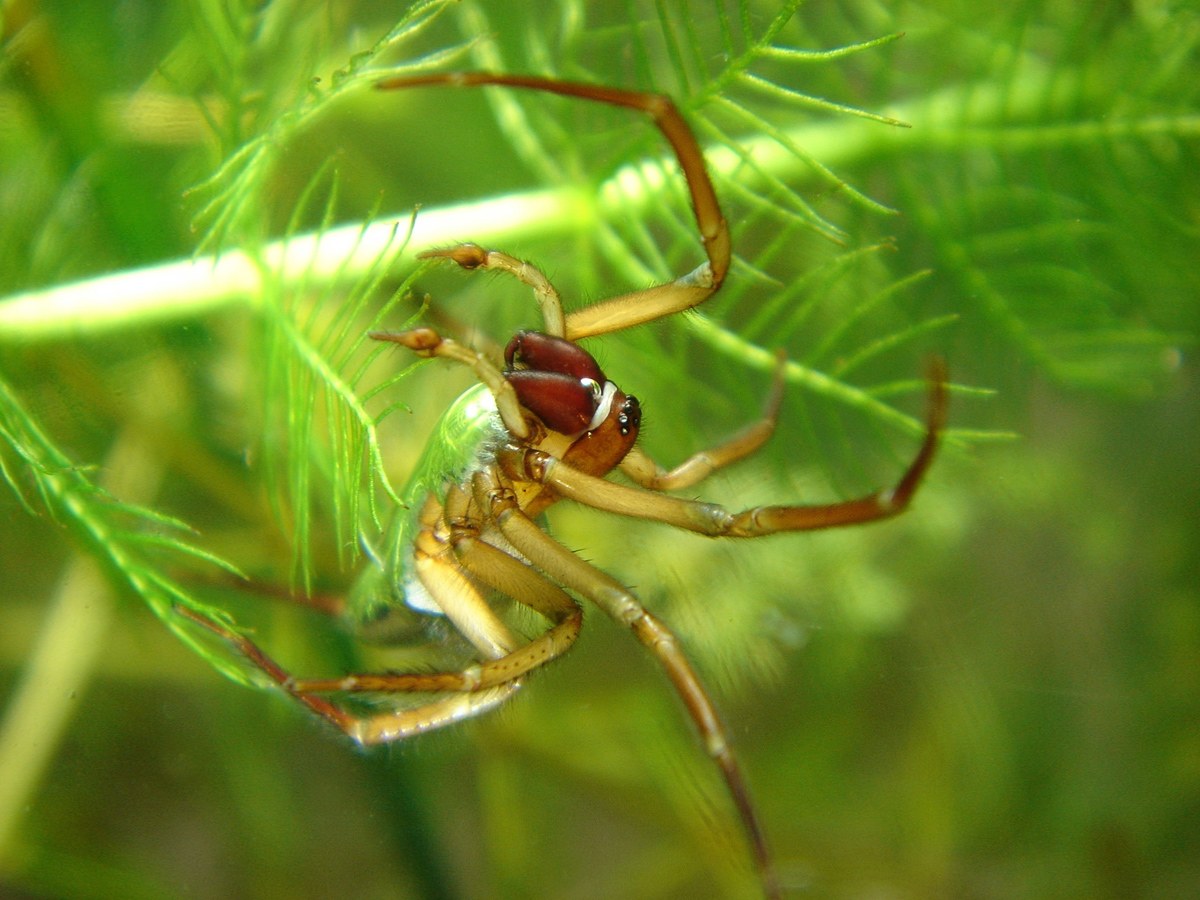
Underwater it has a silvery sheen from the layer of air around its body; out of the water it is greyish brown and inconspicuous. Exceptional among spiders: the male is larger than the female. Spiders of Europe gives 10 to 15 mm for the male and 8 to 9 mm for the female. NatureSpot differs from that with 8 to 15 mm (female) and 9 to 12 mm (male); so those sources contradict each other. The body lengths come from Spiders of Europe (Nentwig et al., araneae.nmbe.ch); those are European ranges, not Dutch measurements.
What can you confuse a water spider with?
Looks like: Raft spider
- None. The Wildlife Trusts: "The water spider is the only spider that spends its life underwater." As long as you see it underwater with its layer of air, confusion is ruled out.
- Raft spider: that one walks on the water and dives only when threatened — it does not live there.
Where do you see this species in the Netherlands?
In clean, plant-rich standing water throughout the country. Dutch distribution and trend figures for spiders could not be obtained from a primary source.
📍 Noordhollands Duinreservaat
presence reportedThese links come straight from our database, with the chance, the source and the evidence level for each area.
When is the best time?
Green = present · orange = peak period. The bar is generated from our database.
Best period: Adults are present all year; NatureSpot writes "adult throughout the year but most active from spring to late summer". Note: the months come from British sources (the British Arachnological Society and NatureSpot). Dutch phenological data per spider species could not be consulted — waarneming.nl and the Dutch Species Register blocked automated access. The climate is comparable, but this is not a Dutch measurement.
Best time of day: By day, when light falls into the water — then you see the air bubble glinting. The spider hunts at night, but then you see nothing.
Recent sightings
👁️ Where has this species been seen recently?
Check the current sightings on Waarneming.nl. A useful addition to our own verified information.
How to improve your chances
- Go early, pick one spot, and let the animal come to you.
- Wear muted colours, skip the scent, and put your phone on silent.
- Look first for where one habitat turns into another. That is where most of the movement is.
- Be patient. Expect to come back more than once before it works.
🎒 What you need for this
A fine-mesh dip net and a white tray to inspect the catch in; or an underwater camera. Only do this where dip-netting is permitted.
Photography
The silver layer of air is the photograph. So shoot underwater, with backlight from above, so that the air bubble lights up against the dark plant tissue. Above water the spider looks utterly ordinary and the photo tells you nothing.
🌿 Watching responsibly
Keep your distance, stay on the paths, and never lure animals with food or sound. Leave as soon as an animal becomes uneasy.
Status: Verified · Last checked: 2026-10-28
More photos