Where to see the raft spider in the Netherlands
With luck 🕷️ Spider
Where and when do you see a raft spider? With some luck you can see this species, from May to August.
How do you recognise a raft spider?
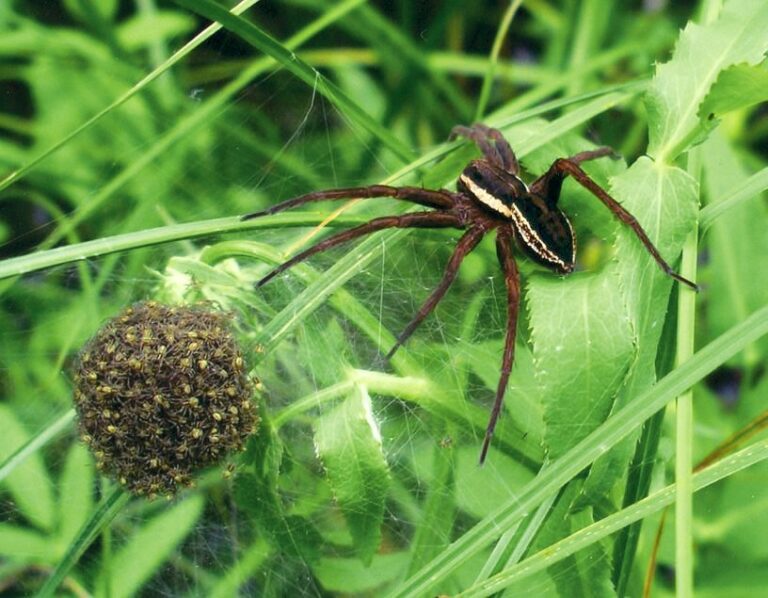
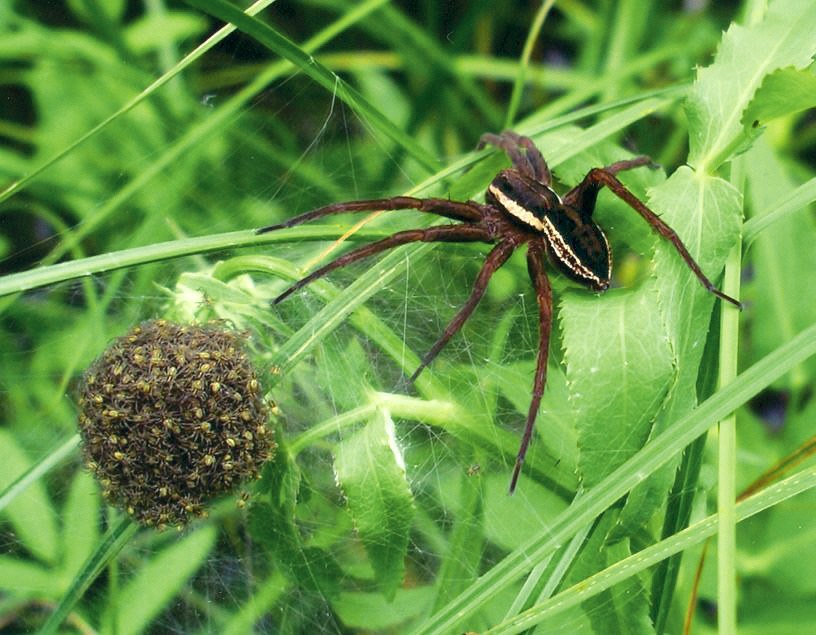
A large, chocolate-brown spider with a pale yellow lengthwise stripe along each side of the body. The Wildlife Trusts: "a large, chocolate-brown spider, with a pale yellow stripe running down each side of its body". Spiders of Europe gives 9 to 22 mm (female) and 9 to 15 mm (male). The body lengths come from Spiders of Europe (Nentwig et al., araneae.nmbe.ch); those are European ranges, not Dutch measurements.
What can you confuse a raft spider with?
- Fen raft spider (Dolomedes plantarius): this is the key point. Naturalis writes that it is barely smaller and not easily distinguished on appearance; reliable separation goes by the genitalia, which with some practice can be done in the field with a hand lens. The unbanded form occurs only in Dolomedes plantarius. Habitat helps: in lowland peat plantarius is more likely, on the higher sandy soils fimbriatus. On a photo you stop at Dolomedes.
Where do you see this species in the Netherlands?
This is the species of the higher grounds in the east and south; the fen raft spider (Dolomedes plantarius) is the species of the lowland peat areas. In the Netherlands the two have never been found together in the same place. We could not find Dutch trend figures for Dolomedes fimbriatus itself.
Habitat: Heath pools, peat pits, ditches and wet heath. Spiders of Europe: "In swampy areas, on still and slowly flowing waters, in alluvial forests, bog forests".
We have not yet recorded any areas for this species with enough evidence behind them, so we name the habitat type instead.
When is the best time?
Green = present · orange = peak period. The bar is generated from our database.
Best period: The Wildlife Trusts give May to August. Note: the months come from British sources (the British Arachnological Society and NatureSpot). Dutch phenological data per spider species could not be consulted — waarneming.nl and the Dutch Species Register blocked automated access. The climate is comparable, but this is not a Dutch measurement.
Best time of day: The sunny hours. The animal then sits at the waterside or on floating vegetation, with its front legs on the water surface to feel vibrations.
Recent sightings
👁️ Where has this species been seen recently?
Check the current sightings on Waarneming.nl. A useful addition to our own verified information.
How to improve your chances
- Go early, pick one spot, and let the animal come to you.
- Wear muted colours, skip the scent, and put your phone on silent.
- Look first for where one habitat turns into another. That is where most of the movement is.
- Be patient. Expect to come back more than once before it works.
🎒 What you need for this
Boots or waders, and a lens with some working distance — on approach the animal dives under.
Photography
The photo that tells the story is the spider on the water surface with its front legs spread and its reflection beneath it. Get low, just above the water. Approach slowly: at a sudden movement it disappears under water and stays there for minutes.
🌿 Watching responsibly
Keep your distance, stay on the paths, and never lure animals with food or sound. Leave as soon as an animal becomes uneasy.
Status: Verified · Last checked: 2026-10-28
More photos