
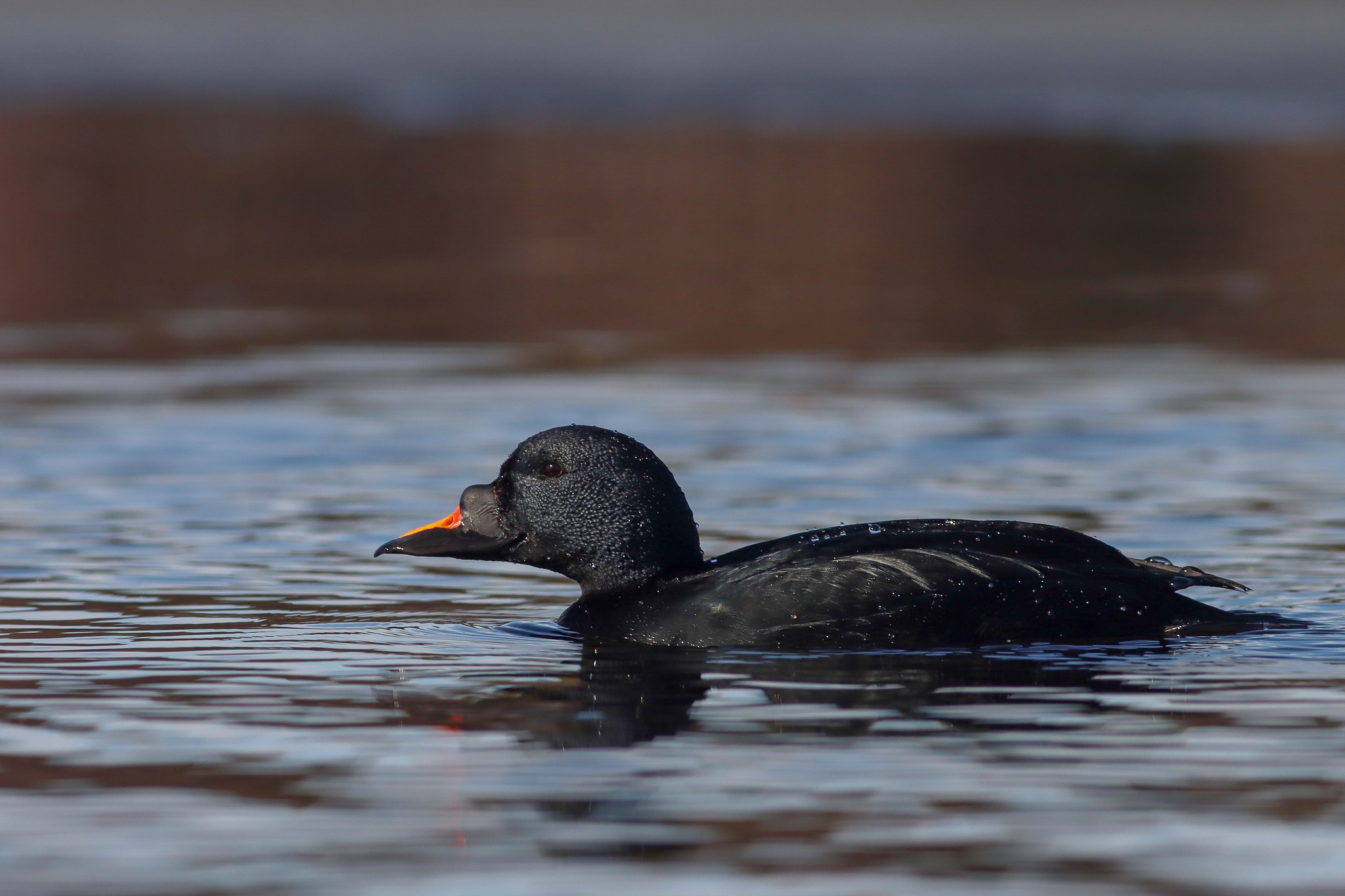
Where to see the Common Scoter in the Netherlands
With luck 🦅 Bird
Where and when do you see a Common Scoter? With some luck you can see this species, from October to May.
How do you recognise a Common Scoter?
A compact sea duck of 44 to 54 cm with a wingspan of 79 to 90 cm. The male is entirely jet black with a yellow patch on the upper bill as its only colour, above a black knob. The female is dark brown with a strikingly pale cheek and throat that stand out against the dark crown. In all plumages there is no white in the wing, which is the main difference from the Velvet Scoter. It dives with a short upward leap and flies in long, constantly shifting strings low over the waves.
Where do you see this species in the Netherlands?
A winter visitor and passage migrant on the North Sea, with concentrations off the Holland coast and above the Wadden islands. Numbers fluctuate strongly: counts produce 890 to 80,300 birds, depending on where the shellfish beds lie. It does not breed in the Netherlands.
📍 Noordhollands Duinreservaat
presence reported📍 Meijendel & Berkheide
presence reported📍 Schoorlse Duinen
presence reported📍 De Putten bij Camperduin
presence reportedThese links come straight from our database, with the chance, the source and the evidence level for each area.
When is the best time?
Green = present · orange = peak period. The bar is generated from our database.
Best period: Present from October through May, with the highest numbers from January to April.
Best time of day: Early morning, when flocks move along the coast.
Recent sightings
👁️ Where has this species been seen recently?
Check the current sightings on Waarneming.nl. A useful addition to our own verified information.
How to improve your chances
- Learn the calls first. You will hear most birds before you see them.
- Go in the first hour after sunrise, when the song is at its peak and the wind is still down.
- Use a hide or natural cover. Sitting still gets you more than walking closer.
- Keep the sun behind you. Against the light you see a silhouette and no colour.
🎒 What you need for this
A telescope on a tripod, plus a spot out of the wind behind a groyne or a dune slope. Without a telescope the flocks cannot be identified.
Photography
Pick a pier or groyne the birds pass and photograph low to the ground, with the wave as a background. For sharp flight images go for a shutter speed of at least 1/1600. Never sail into a floating flock.
🌿 Watching responsibly
Keep your distance, stay on the paths, and never lure animals with food or sound. Leave as soon as an animal becomes uneasy.
Status: Verified · Last checked: 2026-08-08