Where to see the Grey Bush-cricket in the Netherlands
With luck 🦗 Grasshopper
Where and when do you see a Grey Bush-cricket? With some luck you can see this species, from July to October.
How do you recognise a Grey Bush-cricket?
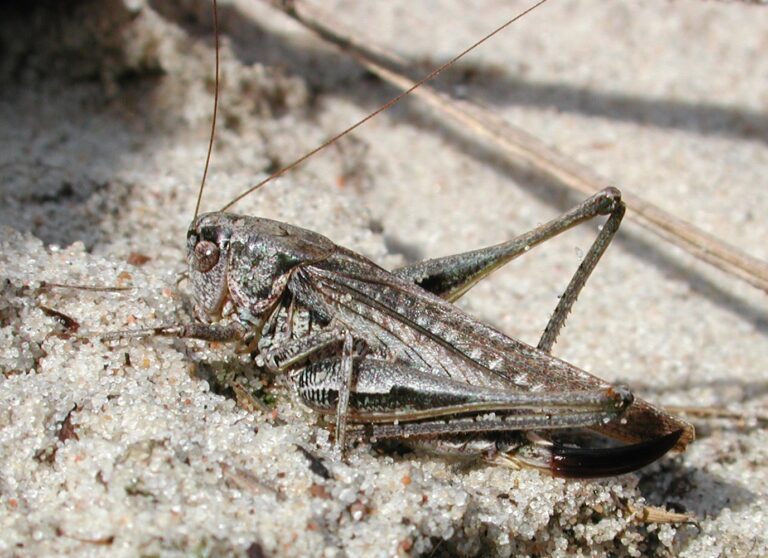
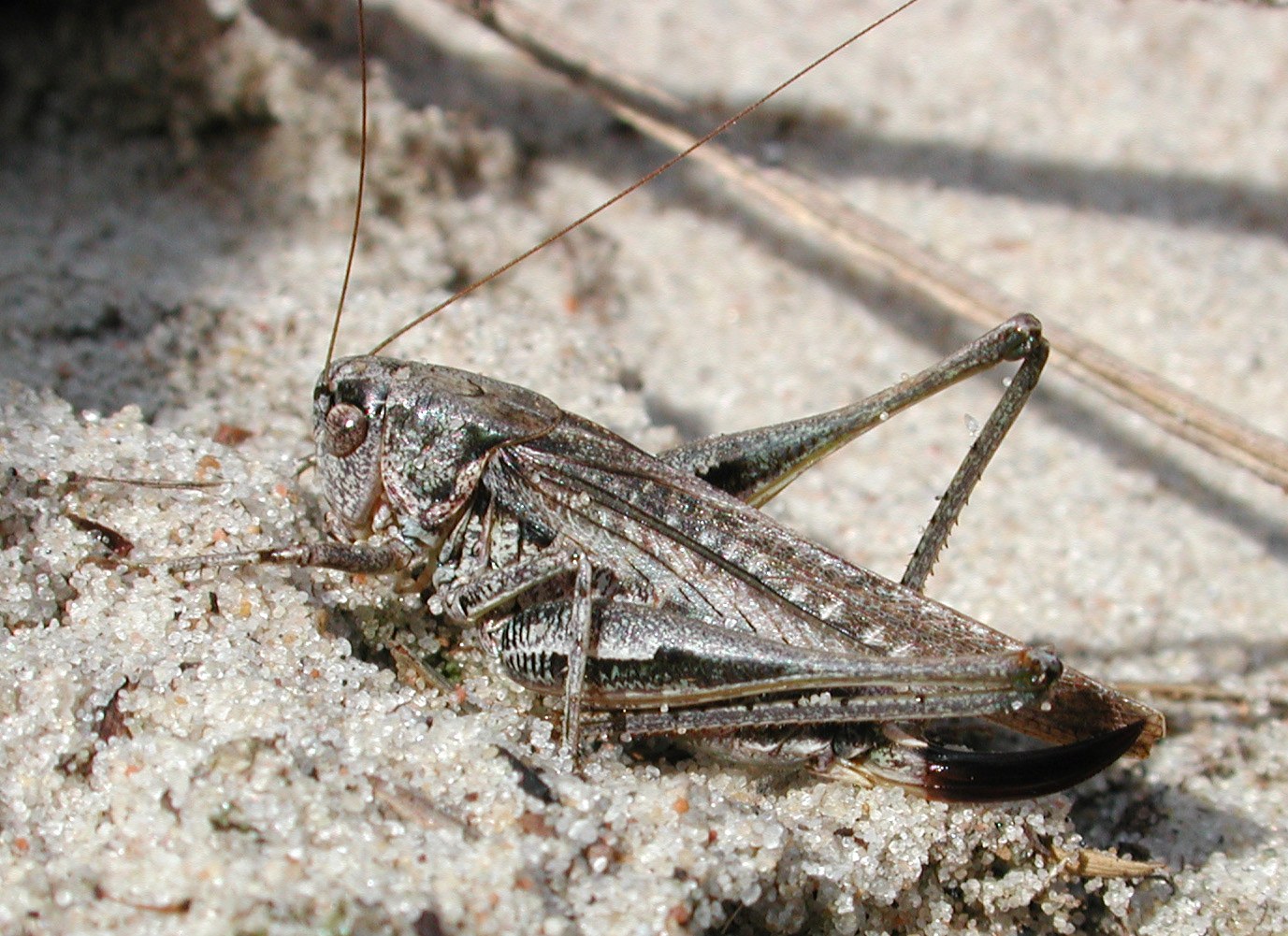
A medium-sized bush-cricket with a marbled grey-brown colour on the legs. Forewing length 15.0 to 23.0 mm, the female's ovipositor 9.0 to 12.0 mm. All measurements and status data come from Kleukers et al., De sprinkhanen en krekels van Nederland (Nederlandse Fauna 1, 1997). Those figures are now almost thirty years old. In the digital version of that source the symbols for male and female do not render, so it cannot be established with certainty which range belongs to which sex; we therefore give the combined range. The source gave no body length for this species.
What can you confuse a Grey Bush-cricket with?
Looks like: Great Green Bush-cricket
- Kleukers et al.: confusable only with Platycleis tessellata, which is not native. Besides that, long-winged forms of Metrioptera species can cause confusion.
- Great Green Bush-cricket: much larger and bright green, hardly confusable.
Where do you see this species in the Netherlands?
Kleukers et al. describe the distribution as virtually continuous from Zeeuws-Vlaanderen up to Ameland, with gaps on Goeree and Voorne.
📍 Amsterdamse Waterleidingduinen
presence reported📍 Noordhollands Duinreservaat
presence reported📍 Wormer- en Jisperveld
presence reported📍 Meijendel & Berkheide
presence reported📍 Schoorlse Duinen
presence reportedThese links come straight from our database, with the chance, the source and the evidence level for each area.
When is the best time?
Green = present · orange = peak period. The bar is generated from our database.
Best period: According to Kleukers et al. the animals are found mainly from mid-July to early October.
Best time of day: Warm, sunny hours in the middle of the day and in the early afternoon. The sound is soft, so look for a dune valley out of the wind.
Recent sightings
👁️ Where has this species been seen recently?
Check the current sightings on Waarneming.nl. A useful addition to our own verified information.
How to improve your chances
- Listen first. Almost every species gives itself away by singing before you spot it.
- Go on a warm, windless afternoon. In cold or wind they fall silent.
- Walk slowly and note where the sound stops. That is where it sits, usually low in the vegetation.
- A bat detector makes audible the species that sing too high for human ears.
🎒 What you need for this
Macro lens or a phone with a macro mode. Stay on the paths: dunes are fragile and much dune vegetation is protected.
Photography
The camouflage is the subject. Photograph the animal in the sand rather than against a neutral background — a Grey Bush-cricket that half disappears against the ground tells you more than a crisply cut-out portrait. With a female: take the whole ovipositor into the frame.
🌿 Watching responsibly
Keep your distance, stay on the paths, and never lure animals with food or sound. Leave as soon as an animal becomes uneasy.
Status: Verified · Last checked: 2026-10-28
More photos