
Where to see the European Serin in the Netherlands
Very rare 🦅 Bird Sensitive species · R4
🛡️ No exact locations, on purpose
This is a sensitive species. We deliberately give no roosting or wintering gathering places. Why we do that.
Where and when do you see a European Serin? This species is very rarely seen, from March to October.
How do you recognise a European Serin?
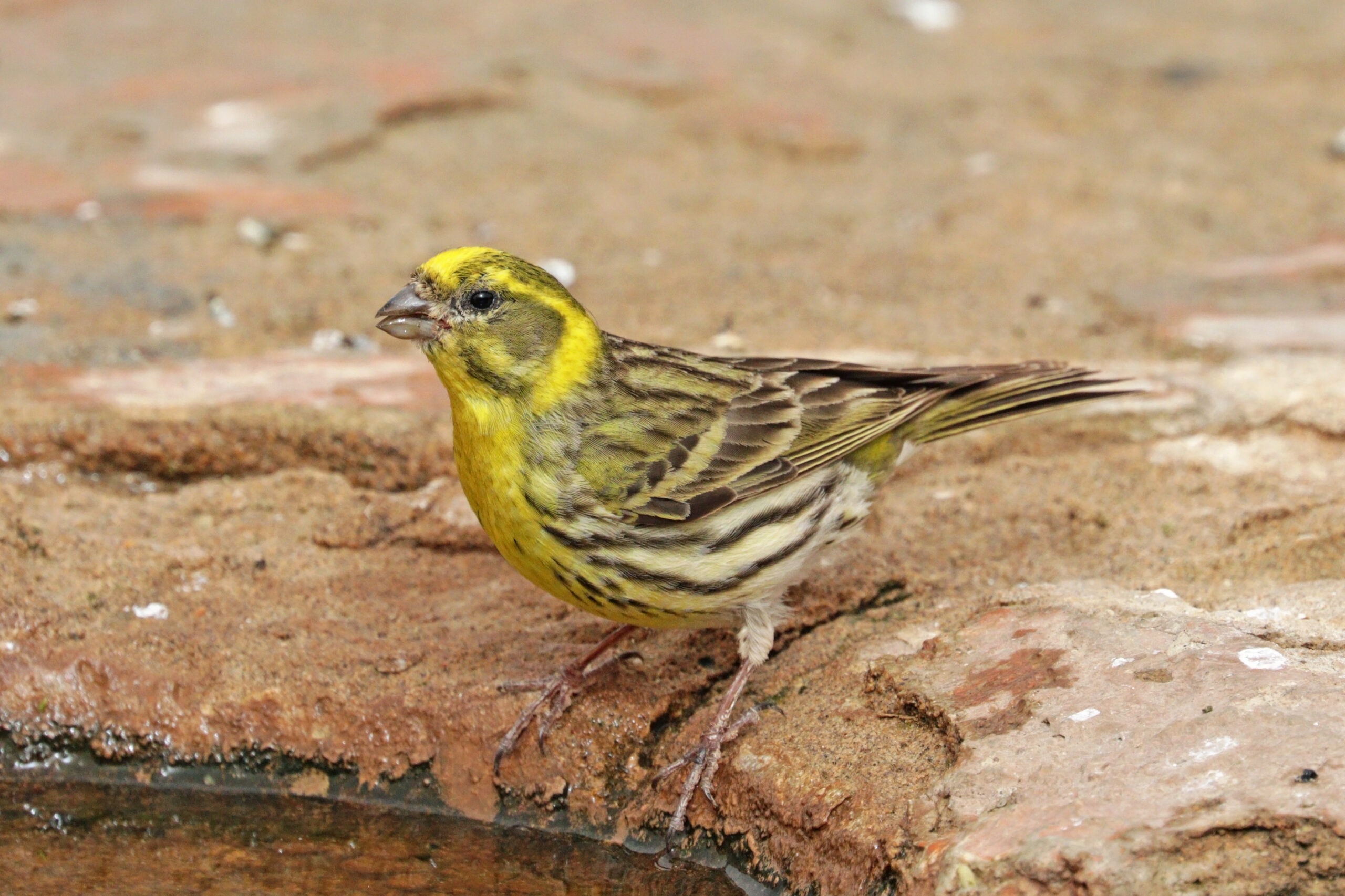
A very small finch of 11 to 12 cm with a short tail and a strikingly short, thick grey bill. The male has lemon yellow on forehead, eyebrow, cheek, breast and rump; on the female those are a pale yellowish white. The back and flanks are heavily streaked in both. Young birds lack the yellow entirely. The song is a sustained, racing string of rattles and trills that recalls breaking glass.
What does a European Serin sound like?
Recording: Ljud: Jonn Leffmann, CC BY 3.0, via Wikimedia Commons
Where do you see this species in the Netherlands?
A very rare breeding bird: 10 to 20 pairs in the period 2018 to 2020, confined to northern Limburg around Venlo. In 1978 and 1979 it still involved hundreds of pairs. Besides that a scarce passage migrant, with peaks in March and April and in September and October.
📍 Blauwe Kamer
presence reported📍 Noordhollands Duinreservaat
presence reported📍 Ilperveld
presence reported📍 Meijendel & Berkheide
presence reported📍 Vismigratierivier Afsluitdijk
presence reportedThese links come straight from our database, with the chance, the source and the evidence level for each area.
When is the best time?
Green = present · orange = peak period. The bar is generated from our database.
Best period: A breeding bird from April through August; on passage in March and April and again in September and October.
Best time of day: The morning in April and May, when the male announces where he is from a high song post or in song flight.
Recent sightings
👁️ Where has this species been seen recently?
Check the current sightings on Waarneming.nl. A useful addition to our own verified information.
Current sightings on Waarneming.nl →
Note: for sensitive species the source already blurs or withholds sightings. We do not reproduce exact locations.
How to improve your chances
- Learn the calls first. You will hear most birds before you see them.
- Go in the first hour after sunrise, when the song is at its peak and the wind is still down.
- Use a hide or natural cover. Sitting still gets you more than walking closer.
- Keep the sun behind you. Against the light you see a silhouette and no colour.
🎒 What you need for this
Above all your ears. The song is the only practical way to find it: it sounds like breaking glass and carries far, while the bird itself is small and inconspicuous.
Photography
Find a singing male on a high song post — a church tower, a conifer, a telephone wire — and photograph from below against a plain sky. Stay on the street or the path; the breeding sites lie in built-up areas and the bird is very scarce there.
🌿 Watching responsibly
Keep your distance, stay on the paths, and never lure animals with food or sound. Leave as soon as an animal becomes uneasy. This is a sensitive species. We deliberately give no roosting or wintering gathering places.
Status: Verified · Last checked: 2026-08-08