
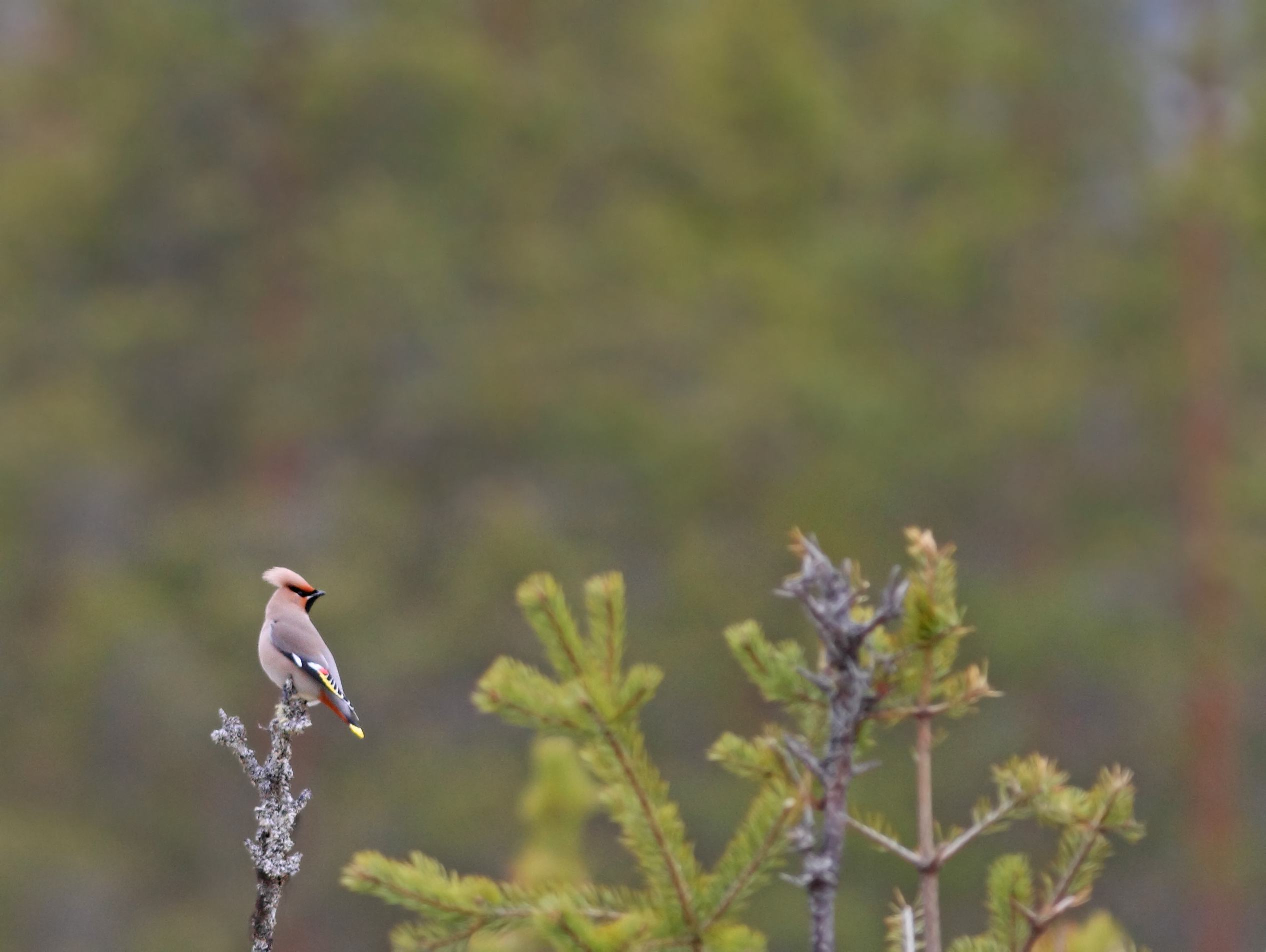
Where to see the Bohemian Waxwing in the Netherlands
Rare 🦅 Bird
Where and when do you see a Bohemian Waxwing? This species is rarely seen, from October to April.
How do you recognise a Bohemian Waxwing?
A starling-sized bird of 18 to 21 cm with a russet beige-brown plumage and a striking crest. The broad tail tip and the tips of the primaries are bright yellow; on the secondaries sit red, sealing-wax-like appendages from which the English name waxwing is taken. Males have a broader yellow tail band and more red waxy tips. Young birds show less white on the primaries. In flight it looks much like a Common Starling.
Wingspan: 34 cm an indication from Wikidata; it varies by individual, sex and subspecies · compare all birds (in Dutch)
What does a Bohemian Waxwing sound like?
Recording: Bushman, CC BY-SA 3.0, via Wikimedia Commons
Where do you see this species in the Netherlands?
A winter visitor with no breeding pairs. In the winters of 2012/13 to 2014/15 it involved 100 to 1,200 wintering birds; in the period 2007/08 to 2011/12, 2,000 to 10,000 passage migrants were counted. The numbers vary greatly from year to year.
Habitat: It breeds in the dense taiga of northern Russia and Scandinavia. In the Netherlands it is found in built-up areas instead: by berry-bearing shrubs in gardens, parks, public planting and along car parks. It eats berries of hawthorn, rowan, guelder rose and cotoneaster; in the breeding season it catches insects in the air, which has occasionally been seen here too on warm April days.
This is a common, widespread species: you can come across it in far more places than the areas listed below. Treat that list as a starting point rather than a full survey.
📍 Noordhollands Duinreservaat
presence reported📍 Zuidlaardermeergebied en Hunzedal
presence reportedThese links come straight from our database, with the chance, the source and the evidence level for each area.
When is the best time?
Green = present · orange = peak period. The bar is generated from our database.
Best period: A winter visitor from October through April, most numerous in November and December; departure from February to April.
Best time of day: During the day, as long as the berry-bearing shrub is still full.
Recent sightings
👁️ Where has this species been seen recently?
Check the current sightings on Waarneming.nl. A useful addition to our own verified information.
How to improve your chances
- Learn the calls first. You will hear most birds before you see them.
- Go in the first hour after sunrise, when the song is at its peak and the wind is still down.
- Use a hide or natural cover. Sitting still gets you more than walking closer.
- Keep the sun behind you. Against the light you see a silhouette and no colour.
🎒 What you need for this
Binoculars are enough; the birds let you come close. For photographs 300 to 400 mm is ample.
Photography
Find a full rowan or cotoneaster with good light and wait there. Waxwings eat in short, hectic bursts and are strikingly tame while they do. Choose a position where the red berries fall next to the yellow tail tip.
🌿 Watching responsibly
Keep your distance, stay on the paths, and never lure animals with food or sound. Leave as soon as an animal becomes uneasy.
Status: Verified · Last checked: 2026-08-08