
The White-tailed Eagle in the Netherlands: where it breeds and where to see it
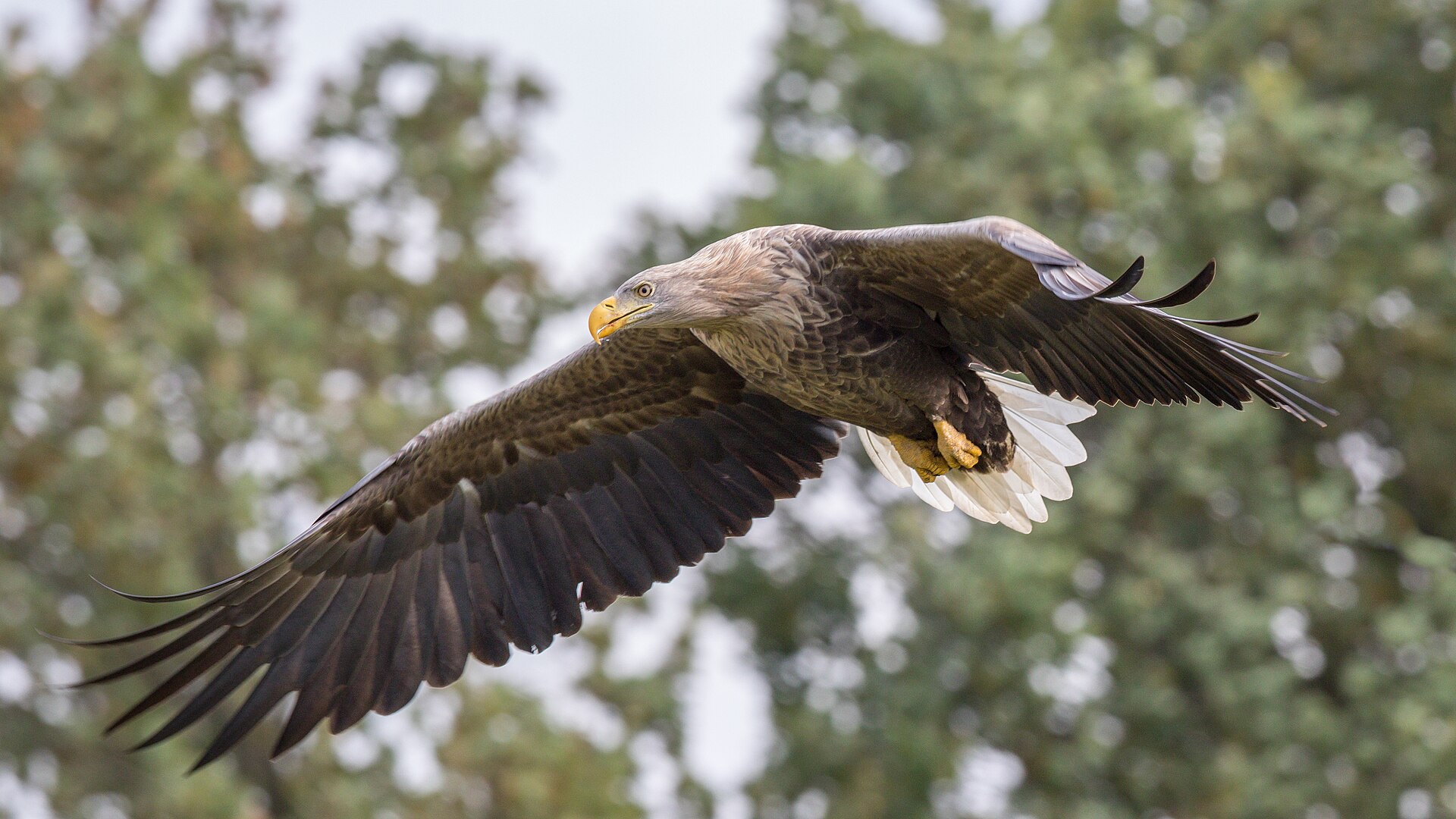
There is no bird in the Netherlands that looks so little like a bird. A White-tailed Eagle gliding low over a marsh has the outline of a tabletop, flies on dead-straight, stiff wings, and sets thousands of geese moving at once. Rangers call it the flying door, and not without reason.
Twenty years ago it was not a breeding bird here. In 2025 Sovon counted 45 breeding pairs. Below is where it occurs, when your chances are best, how to tell it from a buzzard or an Osprey, and why we name no nest locations.

How the White-tailed Eagle came back
Bone remains show that White-tailed Eagles were already present here between 5500 and 2000 BC. Whether they also bred then, nobody knows. What is certain is that the species disappeared from large parts of Western Europe in the twentieth century through persecution, habitat loss and pesticides — DDT above all, which made eggshells so thin that clutches failed.
The recovery began in Germany and Eastern Europe, and spread westwards. In 2004 a pair settled in the Oostvaardersplassen; in 2006 it raised the first young there. That was an outpost: a good 200 kilometres from the nearest German breeding attempt.
One detail sums up the whole story. The female of that first Dutch pair had been ringed in Germany in 2003. So the Dutch population is not a fluke but a direct offshoot of the German recovery — which itself was made possible by the DDT ban and the end of persecution.
Rijkswaterstaat adds another layer beneath that: the return is connected with improved water quality and ecology, and is attributed to measures under Natura 2000 and the Water Framework Directive. A White-tailed Eagle needs plenty of fish and plenty of waterbirds; until well into the last century there simply weren’t enough of either.
The growth curve
| Year | Breeding pairs in the Netherlands |
|---|---|
| 2006 | 1 (Oostvaardersplassen) |
| 2013 | 4 |
| 2014 | 5 |
| 2017 | 12 |
| 2018 | 14 |
| 2022/2023 | 30 |
| 2025 | 45 |
Sovon describes a significant increase of more than 5 per cent a year, both since 1980 and over the last twelve years, and notes that the species now also breeds outside nature reserves.
Breeding birds, winter visitors and wanderers
For your chances of finding one it matters to know that there are three different groups of White-tailed Eagles in the Netherlands.
- Our own breeding birds. Site-faithful. Adult birds stay near their territory all year, in winter too.
- Winter visitors from northern and eastern Europe. Sovon puts the winter maximum at 90 to 160 birds. That is three to four times the number of breeding pairs.
- Roaming young birds. Those take five years before they settle. Natuurmonumenten calls the Oostvaardersplassen their “social meeting point”.
That last point is precisely why you stand a chance in the Oostvaardersplassen all year round, and why you sometimes see several eagles there at once.
Where do you see one?
Oostvaardersplassen
The classic, and not without reason: a marsh full of waterbirds, plus the carcasses of large grazers. Staatsbosbeheer has seventeen viewing points there, including a bird hide literally called De Zeearend (The White-tailed Eagle): two-storey and wheelchair accessible, about twenty minutes’ walk from the visitor centre. It lies on the 5 km Zeearend walking route.
Note: the route through the Driehoek is closed from January to mid-May for management and quiet. That is precisely the display period. Plan around it, or join an excursion — Staatsbosbeheer runs “Birds of prey of the Oostvaardersplassen” among others.
The Biesbosch
In the Biesbosch the White-tailed Eagle has bred since 2012. In 2025 a third territory was added: alongside the Brabant and Dordrecht Biesbosch, now the Sliedrecht one too. Staatsbosbeheer itself names the Noordwaard and the Tongplaat as the best viewing areas, and the Laarzenpad from the Biesbosch MuseumEiland as a good route.
Once a year there is Eagle Day, a whole day devoted to Osprey and White-tailed Eagle with a boat trip, a walk and a lecture led by rangers. Staatsbosbeheer adds honestly that sightings are not guaranteed.
Lauwersmeer
In the Lauwersmeer the White-tailed Eagle has bred since 2009; Staatsbosbeheer calls it “the ranger’s pride”. There are nine viewpoints, including the Achter de Zwarten and De Baak towers, the Vlinderbalg sky platform and the Jaap Deensgat bird hide. In winter some ten thousand geese winter there — which is also the menu.
The Zwarte Meer and surroundings
In 2024 four pairs bred around the Zwarte Meer. Ranger Tim Kreetz of Natuurmonumenten called that “very unique”: normally there is one or two pairs per area. The reason he gives is simple — enough food and enough quiet. There is a viewpoint on the Zwartemeerdijk.
Alde Feanen
In De Alde Feanen National Park a pair is breeding in 2026 for the tenth year in a row. It Fryske Gea runs excursions there with the boat De Blaustirns, and there is a nest cam that can be followed via Vogelbescherming’s Beleef de Lente. In 2026 the first egg was laid on 17 March, the young hatched on 15 and 16 April and fledged on 1 and 3 July.
Gelderse Poort
Since 2023 the White-tailed Eagle has nested in the Millingerwaard — the first case along the Waal. Staatsbosbeheer and Werkgroep Zeearend Nederland temporarily closed part of the area, and said emphatically that the specific nest location remains unnamed for safety reasons.
Zeeland
At present no pair breeds in Zeeland itself; the former pair at the Slikken van de Heen moved across the provincial boundary to the Volkerak. There is a regular chance all the same, and Het Zeeuwse Landschap names seven viewing areas: the Verdronken Land van Saeftinghe, the Oosterschelde, the Westerschelde, the Veerse Meer, Waterdunen, the Grevelingen and the Volkerak. Best chance in autumn and winter.
What not quite to believe
Two corrections to what you read elsewhere. Natuurmonumenten does not name the White-tailed Eagle on its page about birdwatching on the Marker Wadden. And for Weerribben-Wieden we have not been able to find a single site manager’s page linking the species to the area. The adjoining areas around the Zwarte Meer, by contrast, are well documented.
When are the chances best?
Sovon: most records fall between September and March, with passage peaks in September to November and in February and March. The winter maximum is 90 to 160 birds.
In practice something else comes on top that no count measures: in winter the trees are bare, and a White-tailed Eagle sitting motionless in a dead tree is then visible instead of hidden. Besides, waterbirds concentrate, so the eagle concentrates with them.
The strongest window is therefore February and March: display flights, still-bare trees, and plenty of winter visitors that haven’t left yet. Do take account of the area closures that are already running by then.
The breeding cycle, because it governs the closures
- Late February, early March — the eggs are laid, usually two.
- About 38 days of incubation per egg, starting after the first egg.
- April — the young hatch.
- After 70 to 90 days they fledge, and after that they are fed for at least another month.
Site managers therefore work with buffer zones and temporary path closures. At Staatsbosbeheer those sometimes run from October onwards into the spring. Natuurmonumenten asks for quiet around the Zwarte Meer from 15 March to 15 July.
How to find one
The advice that pays off most is not “look up” but “look at the other birds”.
When a White-tailed Eagle appears, noticeable panic breaks out among the waterbirds. Thousands of geese and ducks taking off at once is often the first sign.
That is exactly what Staatsbosbeheer describes in the story about the Biesbosch eagles. If you see a marsh suddenly explode, scan the edge of the panic.
Beyond that: White-tailed Eagles spend a large part of the day sitting motionless on a lookout perch, usually in a dead tree. They don’t hunt all day; they wait. So scan the dead trees along the waterside systematically instead of staring at the sky. Binoculars are no luxury here.
On time of day, weather and wind the official sources say nothing specific for this species. So we name no rule about it either — unlike with red deer, where site managers do give explicit advice.
Identification: how do I know for sure that was one?
At 74 to 92 cm long with a wingspan of 193 to 244 cm, the White-tailed Eagle is Europe’s largest bird of prey. But size is notoriously hard to judge in the air. So watch the shape and the attitude.
The three features that count
- Stiff, straight wings. Vogelbescherming says it explicitly: the White-tailed Eagle “flies with stiff wings and does not hold them in a V”. A circling Common Buzzard holds its wings in a shallow V. This is the most useful distinction there is, because it works at great distance too.
- The rectangular silhouette. Broad, deeply fingered wings held straight out to the side — the “door”.
- The white tail and the yellow bill in adult birds, plus a strikingly pale head.
Buzzard or White-tailed Eagle?
The Common Buzzard is 40 to 52 cm long with a wingspan of 109 to 136 cm — about half a White-tailed Eagle. It has a fairly short, rounded tail and a broad head that doesn’t project far beyond the body, and its wingbeat is fairly quick, shallow and somewhat stiff. The buzzard is also extremely variable in colour, from deep brown to almost white; it is precisely those pale individuals that often get taken for something special.
Osprey or White-tailed Eagle?
The Osprey is 55 to 58 cm long with a wingspan of 127 to 174 cm: clearly smaller and far slimmer. It has long, kinked wings, a contrasting white underside with black carpal patches and a broad black stripe across the white head. At a distance it looks more like a large gull than an eagle.
The sharpest distinction is behaviour. An Osprey dives into the water and eats nothing but fish. A White-tailed Eagle takes fish from just below the surface, without diving. And if the Osprey does better, the White-tailed Eagle simply takes the fish off it — kleptoparasitism, or as Natuurmonumenten puts it: “a fine word for theft”.
Juvenile or adult?
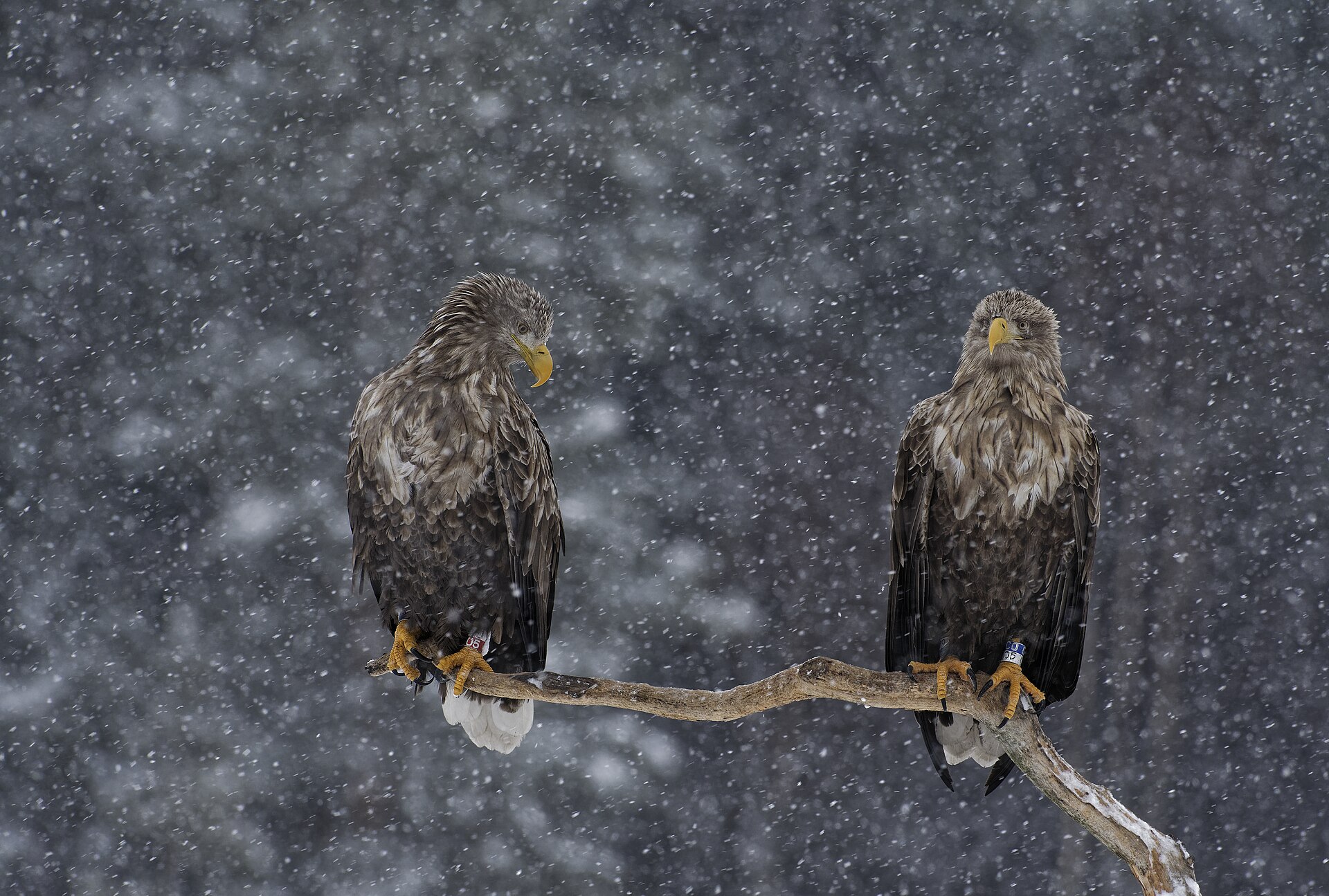
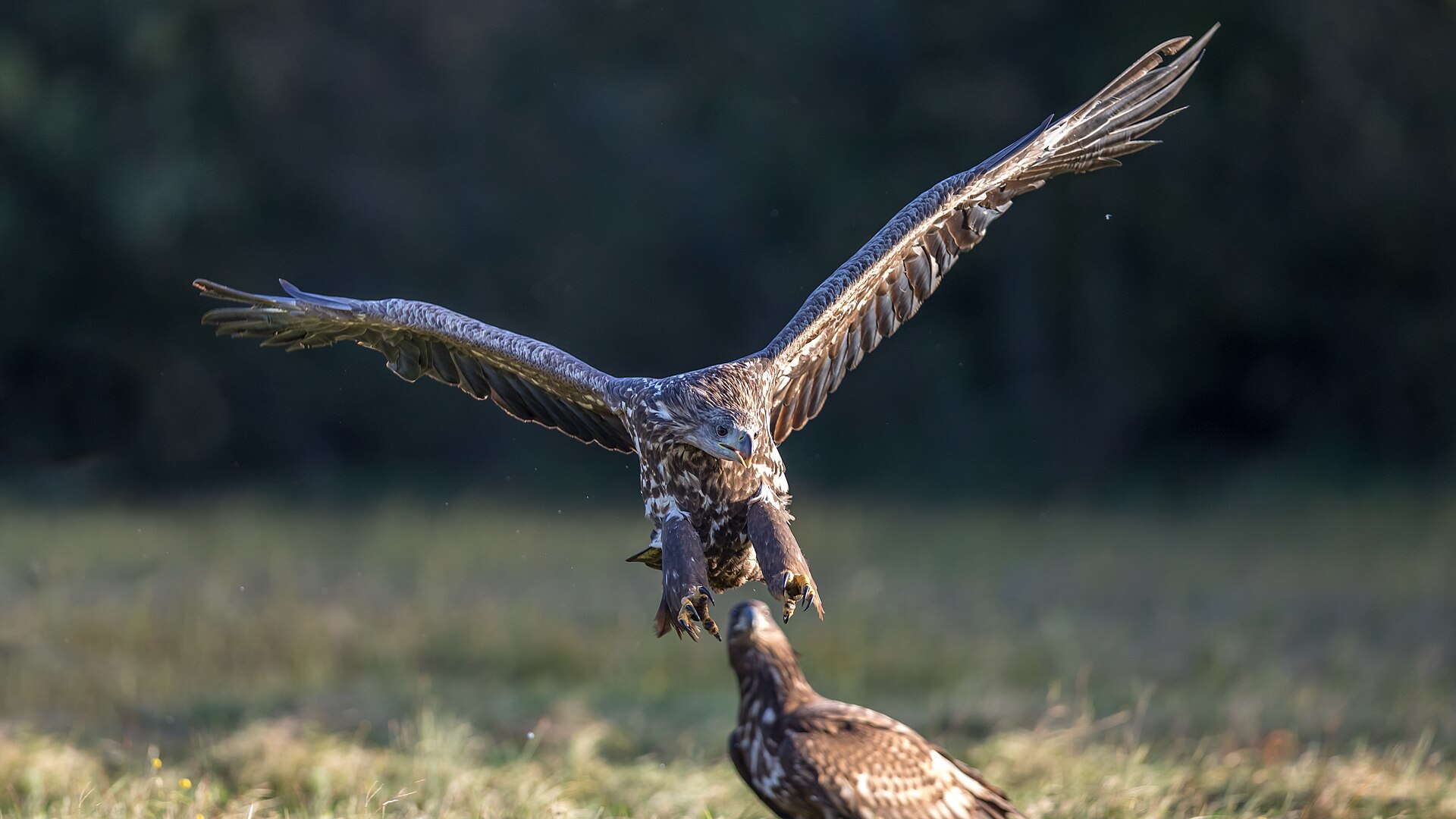
This is where most mistakes arise: a young White-tailed Eagle has no white tail and no yellow bill, and at a distance looks like a large dark bird of prey. Werkgroep Zeearend Nederland has a complete ageing key for it:
- 1st plumage (1–2 years) — dark at a distance; pale axillaries, two to three pale bars across the underwing. Head dark brown, bill black with a yellow gape.
- 2nd plumage (2–3 years) — clearly paler breast and belly contrasting with the dark head; the trailing edge of the wing becomes irregular through moult.
- 3rd plumage (3–4 years) — head and neck lighten markedly, the bill becomes yellower with a black tip.
- 4th plumage (4–5 years) — resembles an adult, but usually retains black markings in the tail feathers; iris brownish-yellow.
- Adult (5 years and older) — tail entirely white, iris pure yellow, head pale brown to sandy. Full colouring only comes at six to seven years of age.
And the sound?
That is the biggest anticlimax in the Dutch bird world. Vogelbescherming describes the call of Europe’s largest bird of prey as “high-pitched yelping, almost gull-like”. Anyone expecting an eagle’s scream from a film will be disappointed.
What does it eat?
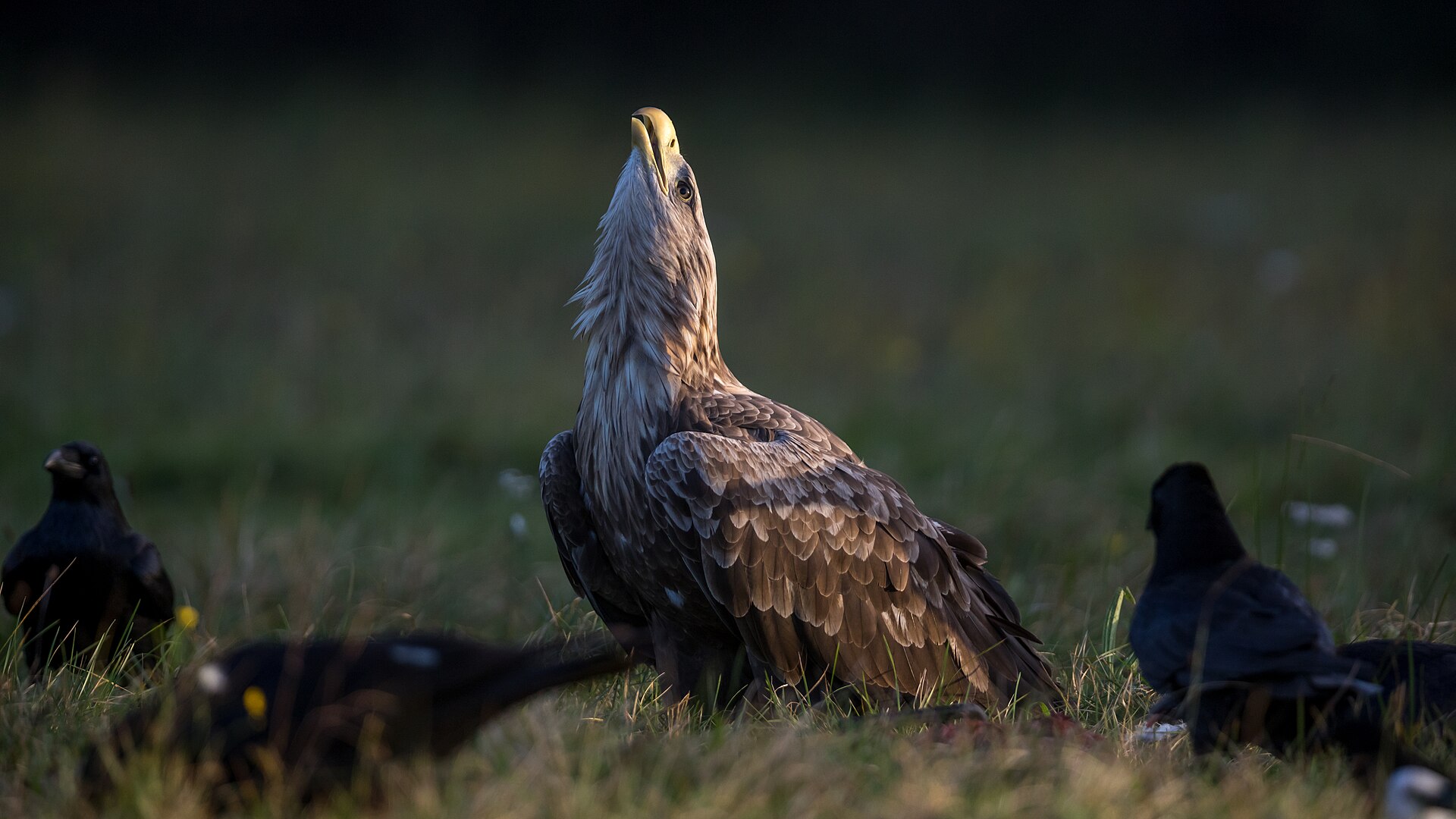
White-tailed Eagles are opportunists. In the Netherlands the diet consists, according to Werkgroep Zeearend Nederland, mainly of Greylag Geese in the Oostvaardersplassen and the Lauwersmeer, of Eurasian Coots in the IJssel mouth, plus a substantial share of fish, mammals and carrion. That regional difference is striking: the share of Greylag Geese is enormous in the Oostvaardersplassen and zero in the IJssel mouth.
In winter carrion is added, especially when the water freezes over. Pairs hunt together — for the third Biesbosch territory Staatsbosbeheer describes how the pair fly into the polder “separately but simultaneously”.
The nest is reused for years on end and built up further each time. Natuurmonumenten gives weights of up to 900 kilos.
How they are really doing
Forty-five breeding pairs sounds like a success story, and it is one. But there is a second set of figures that doesn’t fit alongside it.
Between 2019 and 2021 Werkgroep Zeearend Nederland and Wageningen Environmental Research fitted fifteen young White-tailed Eagles with a GPS transmitter. Of those fifteen, seven were dead — 47 per cent — at the last report.
The causes of death in the first four years of life: two wind turbines, one train collision, one deliberate poisoning with alphachloralose, and one conflict with another of its own kind. In the adult phase another two died, both in Germany: one wind turbine and one conflict.
Other figures to set alongside. In European research lead poisoning accounts for 17 to 27 per cent of mortality — eagles eat carrion containing lead shot. Wind turbines and power lines stand at 3 to 36 per cent. In the Dutch tagged sample, incidentally, lead did not occur; so treat it as a real European risk, not as a proven main Dutch cause.
There is deliberate persecution too. On 26 March 2023 a tagged White-tailed Eagle died at Weidum in Friesland from alphachloralose. The researchers point to “a long history of illegal raptor persecution, including poisoning” in the Netherlands.
And something is being done. Windpark Krammer has an automatic shutdown facility to prevent collisions with White-tailed Eagles and other large birds. Vogelbescherming supports wind energy provided the effects on birds are minimised, and names careful siting, shutdown facilities and wire and rotor markings as the solutions.
The formal status: on the Red List the White-tailed Eagle is listed as Sensitive, while the national conservation status is favourable. It is designated as a non-breeding bird in four Natura 2000 sites: Lauwersmeer, Oostvaardersplassen, Biesbosch and Westerschelde & Saeftinghe.
Why we name no nest locations
On this site we deliberately publish no exact locations for sensitive species. With the White-tailed Eagle that is not theoretical caution.
Vogelbescherming describes a drone incident that caused disturbance during the breeding season, with a risk of nest abandonment. For the third Biesbosch territory Staatsbosbeheer closed the Katsegat to vessels. At the Millingerwaard, Staatsbosbeheer and Werkgroep Zeearend closed part of the area and explicitly kept the nest location secret. Werkgroep Zeearend also describes how shy behaviour by a pair increases the risk of predation by the pine marten — so disturbance carries on working long after the disturber has gone.
We therefore name areas, not nests. If you do want to look at a nest: you can, and it is exactly the way the site managers themselves facilitate — via the Beleef de Lente nest cam.
Legally, incidentally, it is not optional either. Since the Nature Conservation Act was absorbed into the Environment and Planning Act, there is a prohibition on, among other things, deliberately disturbing birds and destroying nests and resting places. Breaching it is an economic offence.
Frequently asked questions
How many White-tailed Eagles are there in the Netherlands?
In 2025 Sovon counted 45 breeding pairs. In addition, according to Sovon, 90 to 160 birds from northern and eastern Europe winter here, and young birds roam around that only take up a territory after five years.
Where is the best place to see a White-tailed Eagle?
The Oostvaardersplassen, the Biesbosch (Noordwaard and Tongplaat), the Lauwersmeer and the surroundings of the Zwarte Meer. In Zeeland the chance is greatest in autumn and winter, including at Saeftinghe, the Oosterschelde and the Volkerak.
In which months are my chances best?
September through March. February and March are practically the strongest: display flights, bare trees and plenty of winter visitors. Do take account of area closures — the Driehoek in the Oostvaardersplassen is shut from January to mid-May.
How do I tell the difference from a buzzard?
By the wing attitude. A White-tailed Eagle holds its wings dead straight and stiff; a circling buzzard holds them in a shallow V. Beyond that the buzzard is about half the size and has a short, rounded tail.
Why does that White-tailed Eagle have no white tail?
Then you are looking at a young bird. The fully white tail and the yellow bill only come at five to six years of age; the full adult colouring not until around six or seven.
Is the White-tailed Eagle a coastal bird?
No, despite its Dutch name (“sea eagle”). Staatsbosbeheer describes its requirement as large, undisturbed natural areas with fresh water, plenty of quiet and a stable food supply. The Dutch breeding areas are accordingly mostly inland.
What does a White-tailed Eagle sound like?
High-pitched yelping and almost gull-like — not imposing. Vogelbescherming has a sound recording on its species page.
What is a “flying door”?
The White-tailed Eagle’s nickname, after its rectangular silhouette: broad wings spread straight out to the sides, with a wingspan of up to 2.5 metres.
May I go and find or photograph a nest?
No. Deliberately disturbing birds and destroying or disturbing nests and resting places is prohibited under the Environment and Planning Act, and breaching it is an economic offence. Site managers close paths and even waterways around known nests. Use the nest cam.
Does a White-tailed Eagle eat only fish?
No. In the Netherlands waterbirds — especially Greylag Geese and coots — are a large part of the menu, alongside fish, mammals and, in winter, carrion.
Further reading at the source
- Sovon — Zeearend, species page: the official figures, trend, Red List status and Natura 2000 designations. In Dutch.
- Vogelbescherming — bird guide: Zeearend: measurements, sound recording, food and breeding biology. In Dutch.
- Werkgroep Zeearend Nederland — Leeftijdsbepaling: plumage by plumage, how to read the age. In Dutch.
- Werkgroep Zeearend Nederland — GPS-onderzoek: with a live map of tagged eagles. In Dutch.
- Staatsbosbeheer — Wandelroute Zeearend: 5 km to the wheelchair-accessible hide, with the closure period. In Dutch.
- Staatsbosbeheer — Biesboschbewoner: de zeearend: a ranger’s account with the best viewing areas. In Dutch.
- Staatsbosbeheer — Arenddag in de Biesbosch. In Dutch.
- Staatsbosbeheer — Vogels kijken rond het Lauwersmeer: all nine viewpoints. In Dutch.
- Natuurmonumenten — Zeearend: species portrait with kleptoparasitism and current breeding areas. In Dutch.
- Vogelbescherming — Beleef de Lente: White-tailed Eagle nest cam: watching at the nest without disturbing. In Dutch.
- Het Zeeuwse Landschap — Zeearend in Zeeland: seven Zeeland viewing areas. In Dutch.
- Vogelbescherming — Juridische bescherming van vogelsoorten: what the Environment and Planning Act prohibits. In Dutch.
- Responsible wildlife watching — why we don’t publish nest locations.
- All areas — or go straight to the Oostvaardersplassen.
- Wildlife calendar — what there is to see this month.
- Seeing red deer and the rut and crane migration.