
Where to see the sunbleak in the Netherlands
Easy 🐟 Fish
Where and when do you see a sunbleak? This species is easy to see, all year round.
How do you recognise a sunbleak?
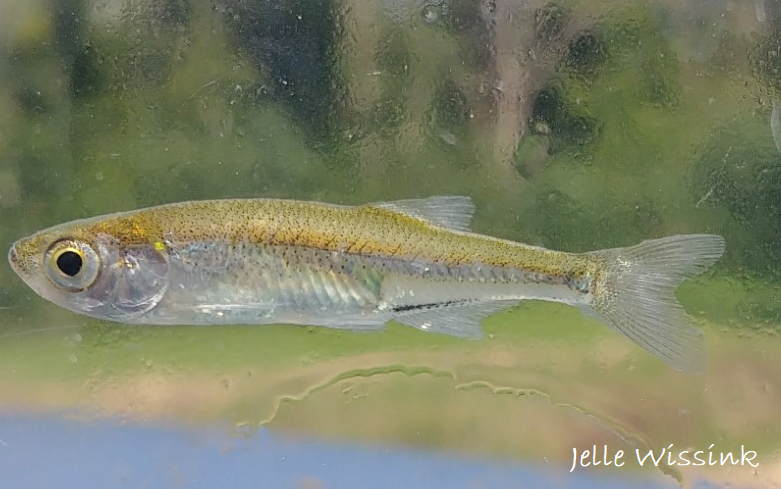
A small, slender fish of up to about 8 centimetres, flattened sideways with silvery flanks and an upturned mouth. The decisive feature is the lateral line: it is incomplete and runs only to just behind the pectoral fins, where in related species it continues all the way.
Where do you see this species in the Netherlands?
Common in most plant-rich waters in the country.
Habitat: Still to slow-flowing waters with plenty of water plants; a pioneer species that turns up quickly in newly dug water.
This is a common, widespread species: you can come across it in far more places than the areas listed below. Treat that list as a starting point rather than a full survey.
📍 Westerschelde & Saeftinghe
presence reported📍 IJssel-uiterwaarden
presence reported📍 Zouweboezem
presence reported📍 Oostelijke Vechtplassen
presence reported📍 Wormer- en Jisperveld
presence reported📍 Ilperveld
presence reported📍 Kampina & Oisterwijkse Vennen
presence reported📍 Strabrechtse Heide & Beuven
presence reportedThese links come straight from our database, with the chance, the source and the evidence level for each area.
When is the best time?
Green = present · orange = peak period. The bar is generated from our database.
Best period: All year; spawning from April to June in several rounds.
Best time of day: During the day, in clear water.
Recent sightings
👁️ Where has this species been seen recently?
Check the current sightings on Waarneming.nl. A useful addition to our own verified information.
How to improve your chances
- Look for clear, shallow water and watch from a bridge, a jetty or a high bank.
- Polarising sunglasses take the reflection off the surface and show you what is swimming underneath.
- Stay low and move slowly. Fish are very good at seeing movement above the water.
- Early morning gives the calmest water and the best visibility.
🎒 What you need for this
Polarising sunglasses; a viewing box helps
Photography
They hunt midges and zooplankton at the surface, which makes rings and small jumps; photograph that surface behaviour with a polarising filter rather than the fish underwater
🌿 Watching responsibly
Keep your distance, stay on the paths, and never lure animals with food or sound. Leave as soon as an animal becomes uneasy.
Status: Verified · Last checked: 2026-08-07