
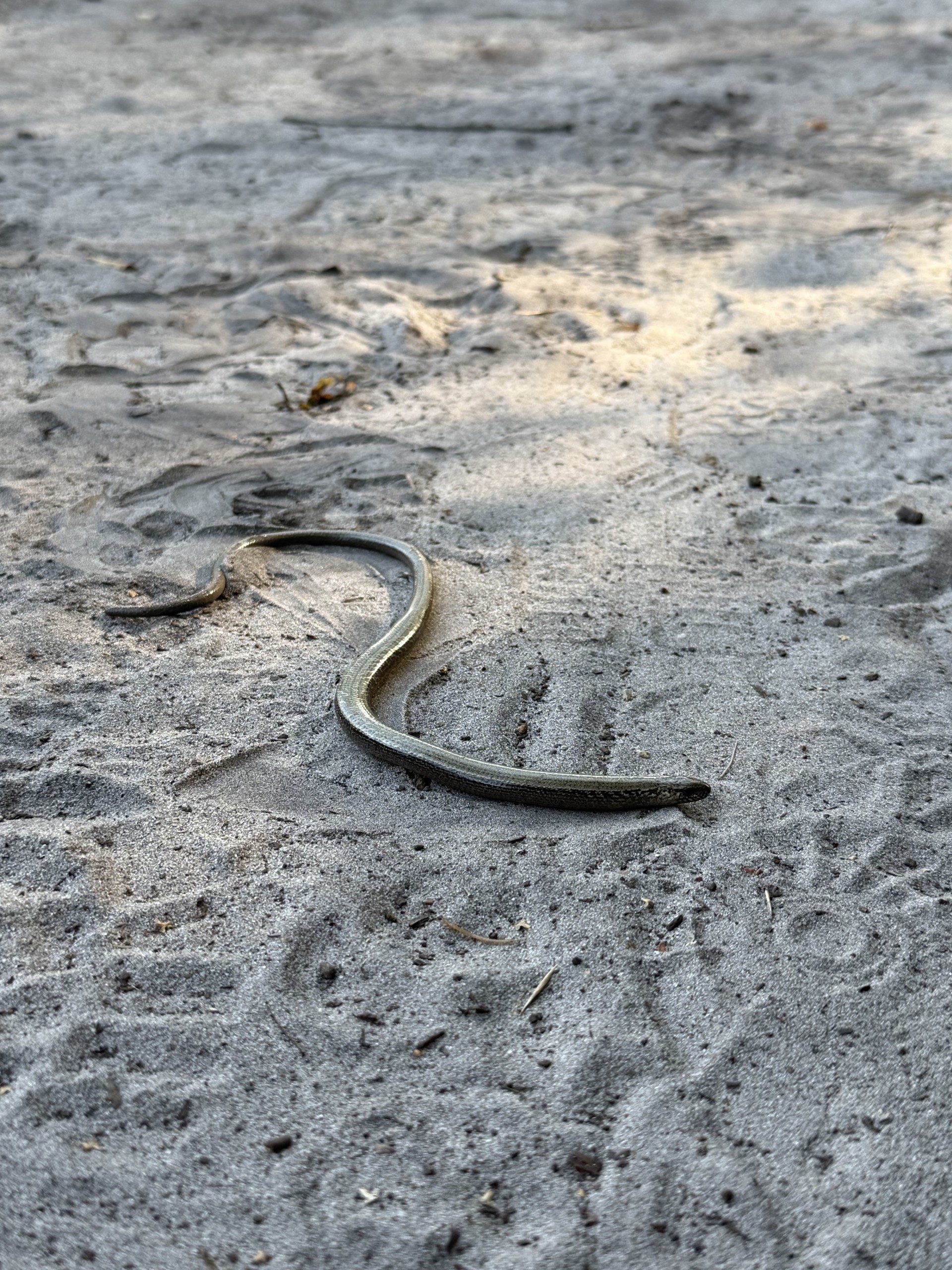
Slow worm with a glossy bronze back and dark flanks, in an S-curve on a sandy path
📷 Bas de Bruin — De Stulp, Lage Vuursche

Where to see the slow worm in the Netherlands

Anguis fragilis · Slow worm

Rare 🦎 Reptile

Where and when do you see a slow worm? This species is rarely seen, from April to September.

How do you recognise a slow worm?

A legless lizard that looks like a snake but is not one: glossy brown to grey, smooth and even in thickness, with eyelids it can close, something no snake can do. Females often have a dark lengthwise stripe. It is at most half a metre long and moves slowly.

Where do you see this species in the Netherlands?

Above all the south and east of the country, along woodland edges, in hedgerows and in gardens. It is commoner than people think, but lives largely hidden.

How certain is this? verified chance per source presence reported Links that do not clear the bottom threshold are not published. How we decide that.

📍 Deelerwoude

Rare chance per source
NDFF open data, 584 records 2016-2026
Nationwide period: April to September. Outside those months it is underground in winter rest. You do not look for it in open sun but under sheets, planks and corrugated iron lying out warming in the sun.
NDFF open data, 848 records 2016-2026 · Natuurmonumenten
Nationwide period: April to September. Outside those months it is underground in winter rest. You do not look for it in open sun but under sheets, planks and corrugated iron lying out warming in the sun.
Staatsbosbeheer, which manages much of the Heuvelland
Nationwide period: April to September. Outside those months it is underground in winter rest. You do not look for it in open sun but under sheets, planks and corrugated iron lying out warming in the sun.

📍 Sint-Pietersberg & Zuid-Limburg

Rare chance per source
NDFF open data, 647 records 2016-2026
Nationwide period: April to September. Outside those months it is underground in winter rest. You do not look for it in open sun but under sheets, planks and corrugated iron lying out warming in the sun.
NDFF open data, 1.867 records 2016-2026
Nationwide period: April to September. Outside those months it is underground in winter rest. You do not look for it in open sun but under sheets, planks and corrugated iron lying out warming in the sun.
NDFF open data, 413 records 2016-2026
Nationwide period: April to September. Outside those months it is underground in winter rest. You do not look for it in open sun but under sheets, planks and corrugated iron lying out warming in the sun.
NDFF open data, 1.980 records 2016-2026 · the national park
Nationwide period: April to September. Outside those months it is underground in winter rest. You do not look for it in open sun but under sheets, planks and corrugated iron lying out warming in the sun.
NDFF open data, 883 records 2016-2026
Nationwide period: April to September. Outside those months it is underground in winter rest. You do not look for it in open sun but under sheets, planks and corrugated iron lying out warming in the sun.

📍 Nationaal Park De Meinweg

presence reported
NDFF open data, 1.103 records 2016-2026
Nationwide period: April to September. Outside those months it is underground in winter rest. You do not look for it in open sun but under sheets, planks and corrugated iron lying out warming in the sun.
NDFF open data, 1.895 records 2016-2026
Nationwide period: April to September. Outside those months it is underground in winter rest. You do not look for it in open sun but under sheets, planks and corrugated iron lying out warming in the sun.
NDFF open data, 115 records 2016-2026
Nationwide period: April to September. Outside those months it is underground in winter rest. You do not look for it in open sun but under sheets, planks and corrugated iron lying out warming in the sun.

📍 Kroondomein Het Loo

presence reported
NDFF open data, 668 records 2016-2026
Nationwide period: April to September. Outside those months it is underground in winter rest. You do not look for it in open sun but under sheets, planks and corrugated iron lying out warming in the sun.

📍 Planken Wambuis

With luck chance per source
Natuurmonumenten
Nationwide period: April to September. Outside those months it is underground in winter rest. You do not look for it in open sun but under sheets, planks and corrugated iron lying out warming in the sun.

📍 Blauwe Kamer

presence reported
NDFF open data
Nationwide period: April to September. Outside those months it is underground in winter rest. You do not look for it in open sun but under sheets, planks and corrugated iron lying out warming in the sun.

📍 Oostelijke Vechtplassen

presence reported
NDFF open data
Nationwide period: April to September. Outside those months it is underground in winter rest. You do not look for it in open sun but under sheets, planks and corrugated iron lying out warming in the sun.
NDFF open data
Nationwide period: April to September. Outside those months it is underground in winter rest. You do not look for it in open sun but under sheets, planks and corrugated iron lying out warming in the sun.
NDFF open data, 245 records 2016-2026
Nationwide period: April to September. Outside those months it is underground in winter rest. You do not look for it in open sun but under sheets, planks and corrugated iron lying out warming in the sun.

📍 De Maashorst

presence reported
NDFF open data, 15 records 2016-2026
Nationwide period: April to September. Outside those months it is underground in winter rest. You do not look for it in open sun but under sheets, planks and corrugated iron lying out warming in the sun.

📍 Schoorlse Duinen

presence reported
NDFF open data, 11 records 2016-2026
Nationwide period: April to September. Outside those months it is underground in winter rest. You do not look for it in open sun but under sheets, planks and corrugated iron lying out warming in the sun.

These links come straight from our database, with the chance, the source and the evidence level for each area.

When is the best time?

Green = present · orange = peak period. The bar is generated from our database.

Best period: April to September. Outside those months it is underground in winter rest. You do not look for it in open sun but under sheets, planks and corrugated iron lying out warming in the sun.

Best time of day: During the day, and most promising in warm but damp weather. After a summer shower it comes out sooner than in bright sun.

Recent sightings

👁️ Where has this species been seen recently?

Check the current sightings on Waarneming.nl. A useful addition to our own verified information.

Current sightings on Waarneming.nl →

How to improve your chances

  • Go on a sunny morning, while they are warming up and still slow.
  • Look for the edges: woodland margins, heath paths, log piles, south-facing slopes.
  • Walk quietly. Reptiles feel vibration through the ground before they see you.
  • Look but do not touch. Picking one up is disturbance, and with protected species it is not allowed.

🎒 What you need for this

A macro or telephoto lens

🌿 Watching responsibly

Keep your distance, stay on the paths, and never lure animals with food or sound. Leave as soon as an animal becomes uneasy.

Sources: RAVON, soortpagina Hazelworm
Status: Verified · Last checked: 2026-08-08