
Where to see the Scarce Emerald Damselfly in the Netherlands
With luck 🪰 Dragonfly
Where and when do you see a Scarce Emerald Damselfly? With some luck you can see this species, from May to September.
How do you recognise a Scarce Emerald Damselfly?
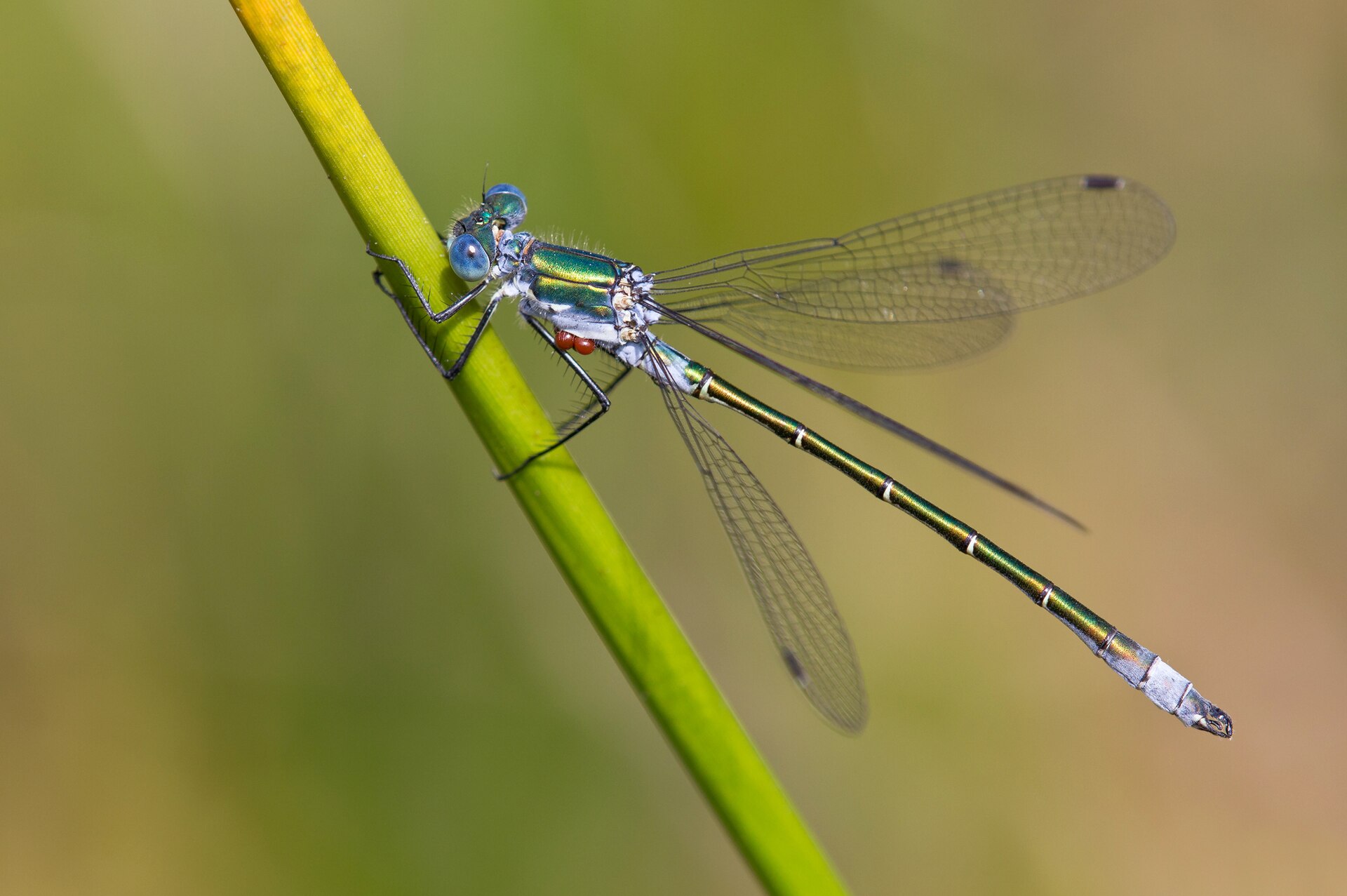
Length 35 to 40 millimetres. The most robust-looking emerald damselfly, metallic green in colour. The male has blue-grey frosting on segments 9 and 10 that is sharply bounded at the base. The female is immediately recognisable by a large, disproportionate ovipositor that projects beyond segment 10.
Where do you see this species in the Netherlands?
Above all the eastern half of the country on the high sandy soils; rare in the dunes, with a stable population on Voorne.
📍 Nationaal Park De Groote Peel
presence reported📍 Nationaal Park Dwingelderveld
presence reported📍 Nationaal Park Drents-Friese Wold
presence reported📍 Nationaal Park Utrechtse Heuvelrug
presence reported📍 Kampina & Oisterwijkse Vennen
presence reported📍 De Maashorst
presence reported📍 Strabrechtse Heide & Beuven
presence reportedThese links come straight from our database, with the chance, the source and the evidence level for each area.
When is the best time?
Green = present · orange = peak period. The bar is generated from our database.
Best period: Mid-May to the end of September, with the peak in July and August.
Best time of day: The warm hours in the middle of the day.
Recent sightings
👁️ Where has this species been seen recently?
Check the current sightings on Waarneming.nl. A useful addition to our own verified information.
How to improve your chances
- Go on a warm, windless day between about ten and four, when they are active.
- Look for the place rather than the animal: flowery edges for butterflies, banks and open water for dragonflies.
- Move slowly and keep your shadow off the animal. It notices that before it notices you.
- Early in the morning they are still cold and motionless on a leaf. That is when you can get closest.
🎒 What you need for this
A macro lens; the identification turns on the tip of the abdomen
Photography
Photograph the tip of the abdomen from the side: on the male you want to capture the sharp edge of the blue frosting, on the female the hefty ovipositor. Without that close-up it stays guesswork between this and the Emerald Damselfly
🌿 Watching responsibly
Keep your distance, stay on the paths, and never lure animals with food or sound. Leave as soon as an animal becomes uneasy.
Status: Verified · Last checked: 2026-08-07