
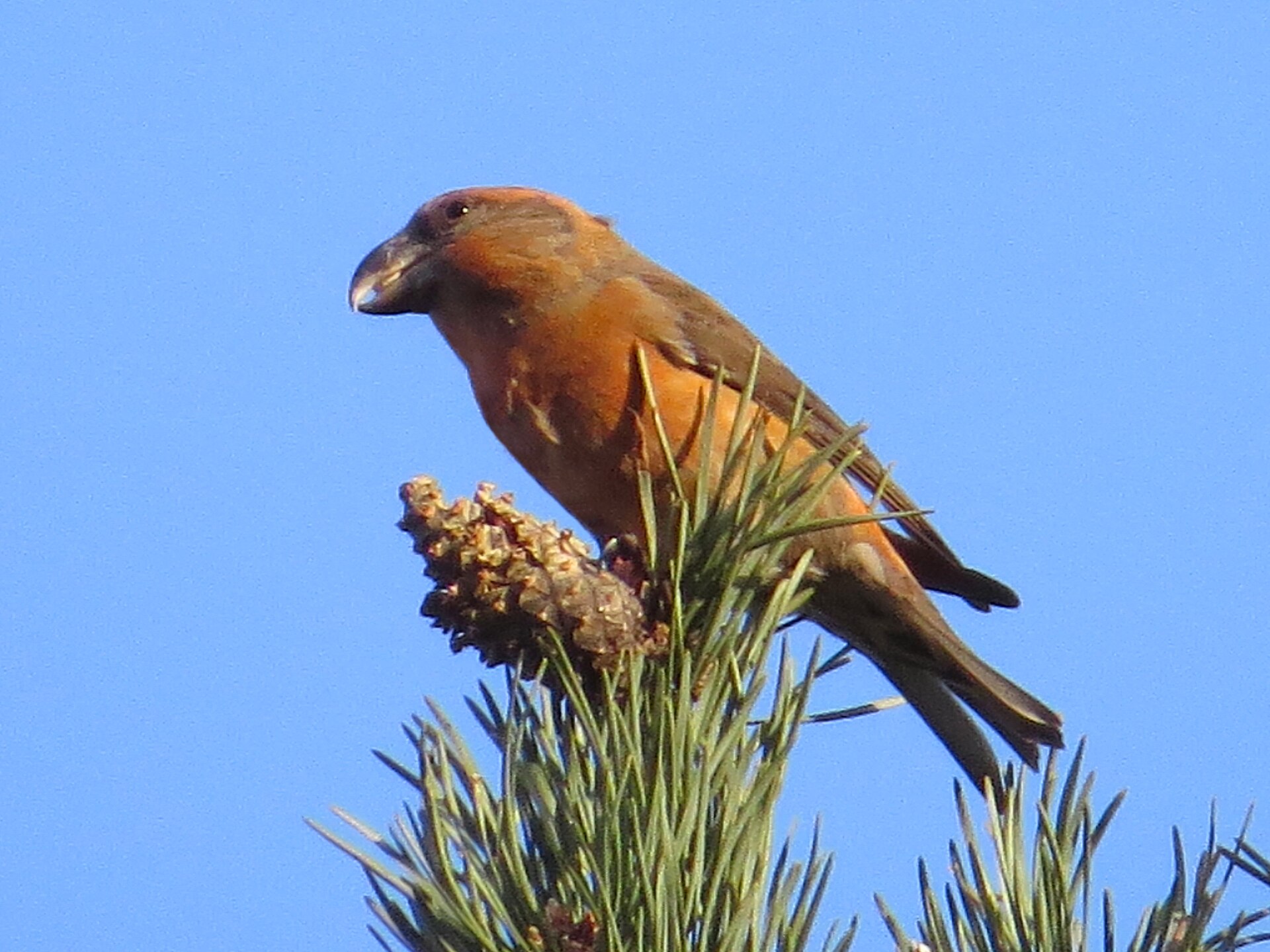
Where to see the Parrot Crossbill in the Netherlands
Very rare 🦅 Bird Sensitive species · R4
🛡️ No exact locations, on purpose
This is a sensitive species. We deliberately give no roosting or wintering gathering places. Why we do that.
Where and when do you see a Parrot Crossbill? This species is very rarely seen, from October to April.
How do you recognise a Parrot Crossbill?
Length 16 to 18 cm. Like the common crossbill, but more heavily built, with a strikingly stout, deep bill and a thicker head and neck. The male is brick red, the female green-yellow. The difference lies almost entirely in the bill shape: deeper than it is long, with a less protruding crossing.
Wingspan: 32 cm an indication from Wikidata; it varies by individual, sex and subspecies · compare all birds (in Dutch)
Where do you see this species in the Netherlands?
No fixed distribution; it appears in influx years, above all on the Veluwe and the sandy soils of the north and east of the Netherlands.
Habitat: Forests with Scots pine; it is specialised on the heavy cones of that tree.
We have not yet recorded any areas for this species with enough evidence behind them, so we name the habitat type instead.
When is the best time?
Green = present · orange = peak period. The bar is generated from our database.
Best period: In influx years from autumn into spring.
Best time of day: During the day.
Recent sightings
👁️ Where has this species been seen recently?
Check the current sightings on Waarneming.nl. A useful addition to our own verified information.
Current sightings on Waarneming.nl →
Note: for sensitive species the source already blurs or withholds sightings. We do not reproduce exact locations.
How to improve your chances
- Learn the calls first. You will hear most birds before you see them.
- Go in the first hour after sunrise, when the song is at its peak and the wind is still down.
- Use a hide or natural cover. Sitting still gets you more than walking closer.
- Keep the sun behind you. Against the light you see a silhouette and no colour.
🎒 What you need for this
Telephoto lens or telescope; the bill shape is the only hard feature
Photography
Photograph the head strictly from the side — only then can the depth of the bill be judged, and that is the one thing that separates it from the common crossbill. A photo taken at an angle from the front is useless
🌿 Watching responsibly
Keep your distance, stay on the paths, and never lure animals with food or sound. Leave as soon as an animal becomes uneasy. This is a sensitive species. We deliberately give no roosting or wintering gathering places.
Status: Verified · Last checked: 2026-08-07