
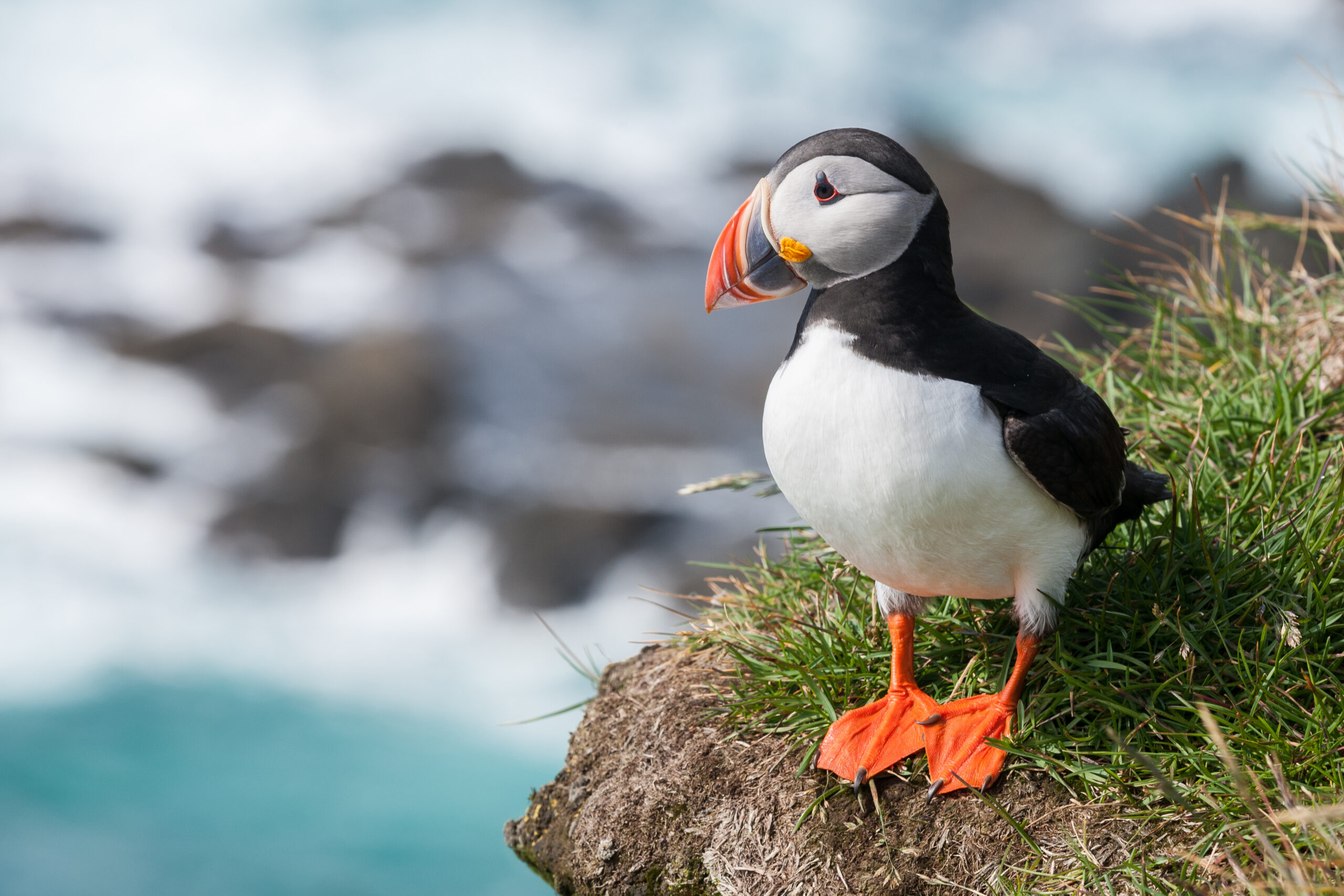
Where to see the Atlantic Puffin in the Netherlands
Rare 🦅 Bird
Where and when do you see an Atlantic Puffin? This species is rarely seen, from October to March.
How do you recognise an Atlantic Puffin?
An auk of 26 to 36 cm with a wingspan of 47 to 63 cm, mostly white below and black above, with a black neck band and a pale grey face with a dark eye-ring. The famous feature is the deep bill with its red, blue-grey and yellow markings — but those horny plates are shed after the breeding season. The birds that are here in winter therefore have a much smaller, dull bill and a darker grey face. In flight narrow wings with no white trailing edge.
What does an Atlantic Puffin sound like?
Recording: British Library, CC BY-SA 4.0, via Wikimedia Commons
Where do you see this species in the Netherlands?
A winter visitor on the North Sea, estimated at 460 to 6,900 birds in the winters of 2016/17 to 2020/21. There is no Dutch breeding population. The nearest colonies lie on rocky islands from France to Scandinavia and on the British Isles.
Habitat: Outside the breeding season the open sea, rarely close inshore. It breeds colonially on vegetated steep slopes and in rock crevices, where it digs burrows of one to two metres or uses existing crevices. It eats mainly fish, supplemented in winter with invertebrates.
We have not yet recorded any areas for this species with enough evidence behind them, so we name the habitat type instead.
When is the best time?
Green = present · orange = peak period. The bar is generated from our database.
Best period: A winter visitor, mainly from October through March.
Best time of day: During and after a storm from the west or north-west.
Recent sightings
👁️ Where has this species been seen recently?
Check the current sightings on Waarneming.nl. A useful addition to our own verified information.
How to improve your chances
- Learn the calls first. You will hear most birds before you see them.
- Go in the first hour after sunrise, when the song is at its peak and the wind is still down.
- Use a hide or natural cover. Sitting still gets you more than walking closer.
- Keep the sun behind you. Against the light you see a silhouette and no colour.
🎒 What you need for this
A telescope and a seawatching point. A puffin on the North Sea is a small, fast, low-flying black-and-white dot.
Photography
Do not count on taking the photo with the colourful bill here: those horny plates are shed outside the breeding season. For that image you have to go to a colony in Scotland, Iceland or Norway in spring. Here it is a matter of flight shots from a pier in a strong wind.
🌿 Watching responsibly
Keep your distance, stay on the paths, and never lure animals with food or sound. Leave as soon as an animal becomes uneasy.
Status: Verified · Last checked: 2026-08-08