Where to see the lesser garden spider in the Netherlands
Easy 🕷️ Spider
Where and when do you see a lesser garden spider? This species is easy to see, all year round.
How do you recognise a lesser garden spider?
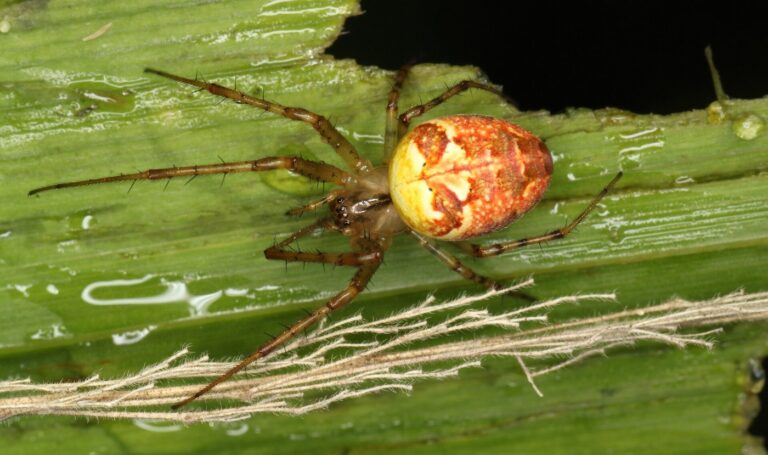
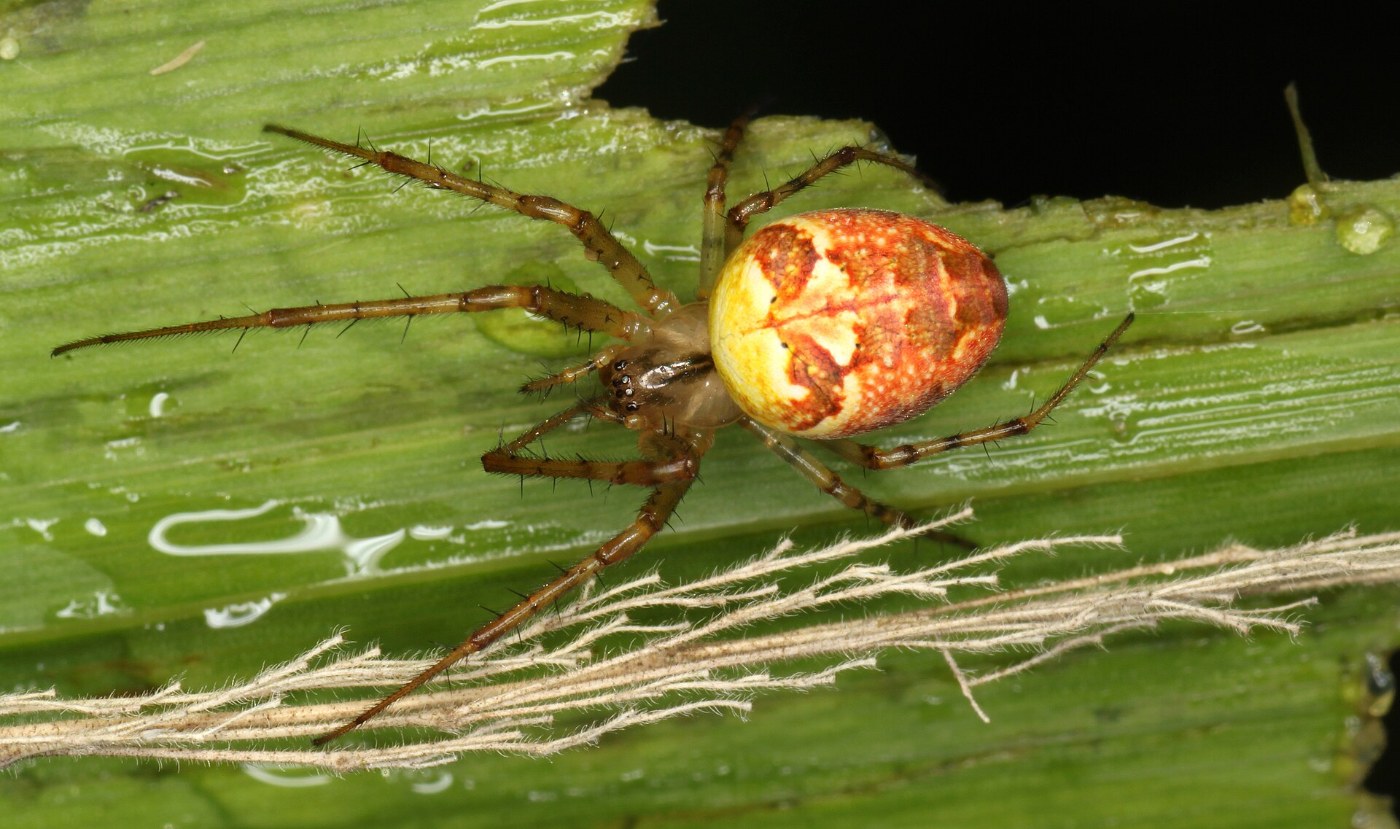
A slender orb-web spider with strikingly long legs and an abdomen in yellow, red and orange tones; on the carapace there is a dark, tuning-fork-shaped marking. The British Arachnological Society sets it against the garden spider: "smaller, slimmer and has longer legs than the typical Garden Spider". Spiders of Europe gives 6.5 to 9 mm (female) and 5 to 7.5 mm (male). The body lengths come from Spiders of Europe (Nentwig et al., araneae.nmbe.ch); those are European ranges, not Dutch measurements.
What can you confuse a lesser garden spider with?
Looks like: Garden spider
- Metellina mengei: this is the key point. NatureSpot states: "the only reliable means of definite identification of these two species is by examination of the genitalia." Season does not help reliably: Metellina mengei dominates in spring and early summer, Metellina segmentata in late summer and autumn, but some mengei hold on into that late period. On a photo you therefore stop at Metellina.
- Garden spider: larger, sturdier, with shorter legs and a clear white cross.
Where do you see this species in the Netherlands?
Common throughout the country. Dutch trend figures are lacking.
Habitat: Woodland edges, gardens and rough ground — anywhere it can spin a small orb web between vegetation or on a structure.
We have not yet recorded any areas for this species with enough evidence behind them, so we name the habitat type instead.
When is the best time?
Green = present · orange = peak period. The bar is generated from our database.
Best period: Present all year, but by far the most numerous from summer into autumn — hence its Dutch name, herfstspin, autumn spider. Note: the months come from British sources (the British Arachnological Society and NatureSpot). Dutch phenological data per spider species could not be consulted — waarneming.nl and the Dutch Species Register blocked automated access. The climate is comparable, but this is not a Dutch measurement.
Best time of day: Morning, with dew in the web. The spider often hangs in the middle of the hub, head down.
Recent sightings
👁️ Where has this species been seen recently?
Check the current sightings on Waarneming.nl. A useful addition to our own verified information.
How to improve your chances
- Go early, pick one spot, and let the animal come to you.
- Wear muted colours, skip the scent, and put your phone on silent.
- Look first for where one habitat turns into another. That is where most of the movement is.
- Be patient. Expect to come back more than once before it works.
🎒 What you need for this
A macro lens; the animals are small and the legs thin, so as much light as possible.
Photography
Photograph obliquely from below against the sky, so that the web becomes visible and the orange abdomen lights up. Because the species cannot be identified from a photo, it is worth getting the whole animal sharply in frame including the underside of the abdomen — that is the feature specialists look at.
🌿 Watching responsibly
Keep your distance, stay on the paths, and never lure animals with food or sound. Leave as soon as an animal becomes uneasy.
Status: Verified · Last checked: 2026-10-28
More photos