
Where to see the Green Hawker in the Netherlands
Rare 🪰 Dragonfly
Where and when do you see a Green Hawker? This species is rarely seen, from June to September.
How do you recognise a Green Hawker?
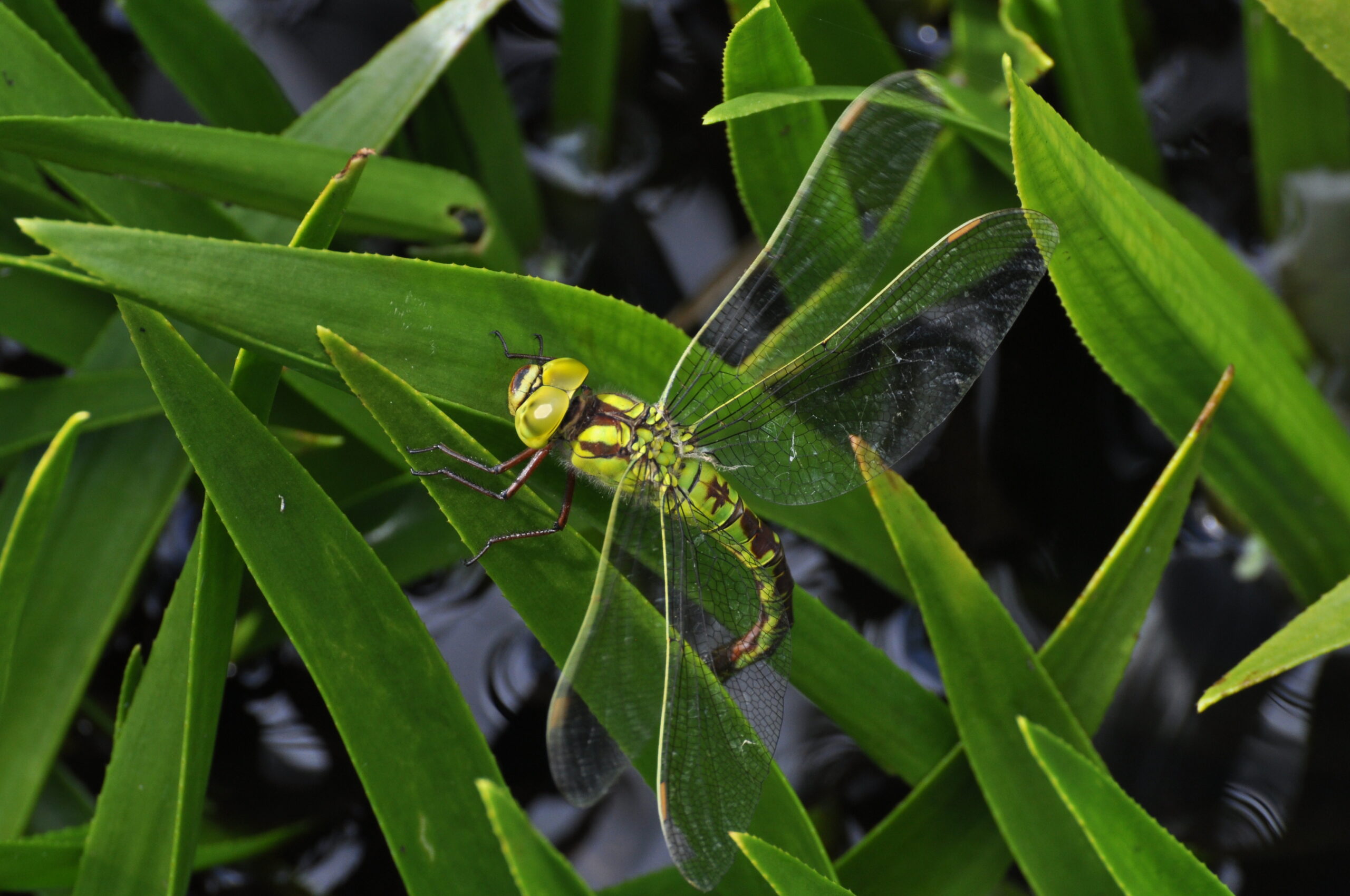
Length 65 to 75 millimetres. The abdomen is dark with a mosaic pattern of pale spots. Decisive is the side of the thorax: it is entirely green, with only very thin black suture lines. In the male the eyes and the abdominal spots are blue; in the female all the pale parts are green and segment 2 of the abdomen carries a waisted dark spot.
Where do you see this species in the Netherlands?
Its strongholds are the lowland peat areas of north-west Overijssel, Friesland and Drenthe, the Vechtplassen area and the peat meadow district in South Holland and Utrecht. Beyond that it is scattered through the meadow areas of Groningen and Friesland. The species used to occur in North Brabant and Limburg as well.
Habitat: Standing waters with dense beds of water soldier: pools, ditches and peat cuttings in lowland peat areas.
This is a common, widespread species: you can come across it in far more places than the areas listed below. Treat that list as a starting point rather than a full survey.
📍 Nationaal Park De Alde Feanen
presence reported📍 Onlanden & Leekstermeer
presence reported📍 Nationaal Park Weerribben-Wieden
presence reported📍 Oostelijke Vechtplassen
presence reportedThese links come straight from our database, with the chance, the source and the evidence level for each area.
When is the best time?
Green = present · orange = peak period. The bar is generated from our database.
Best period: Late June to late September, with the largest numbers in August.
Best time of day: Afternoon, and on warm evenings until after sunset.
Recent sightings
👁️ Where has this species been seen recently?
Check the current sightings on Waarneming.nl. A useful addition to our own verified information.
How to improve your chances
- Go on a warm, windless day between about ten and four, when they are active.
- Look for the place rather than the animal: flowery edges for butterflies, banks and open water for dragonflies.
- Move slowly and keep your shadow off the animal. It notices that before it notices you.
- Early in the morning they are still cold and motionless on a leaf. That is when you can get closest.
🎒 What you need for this
Binoculars. The species flies a great deal and settles little, so you need to be able to follow it in flight.
Photography
Wait by a bed of water soldier until a male repeats his round — hawkers fly fixed patterns. Focus on a fixed point along that route instead of following the animal.
🌿 Watching responsibly
Keep your distance, stay on the paths, and never lure animals with food or sound. Leave as soon as an animal becomes uneasy.
Status: Verified · Last checked: 2026-08-07