
Where to see the Blue-eye in the Netherlands
With luck 🪰 Dragonfly
Where and when do you see a Blue-eye? With some luck you can see this species, from May to September.
How do you recognise a Blue-eye?
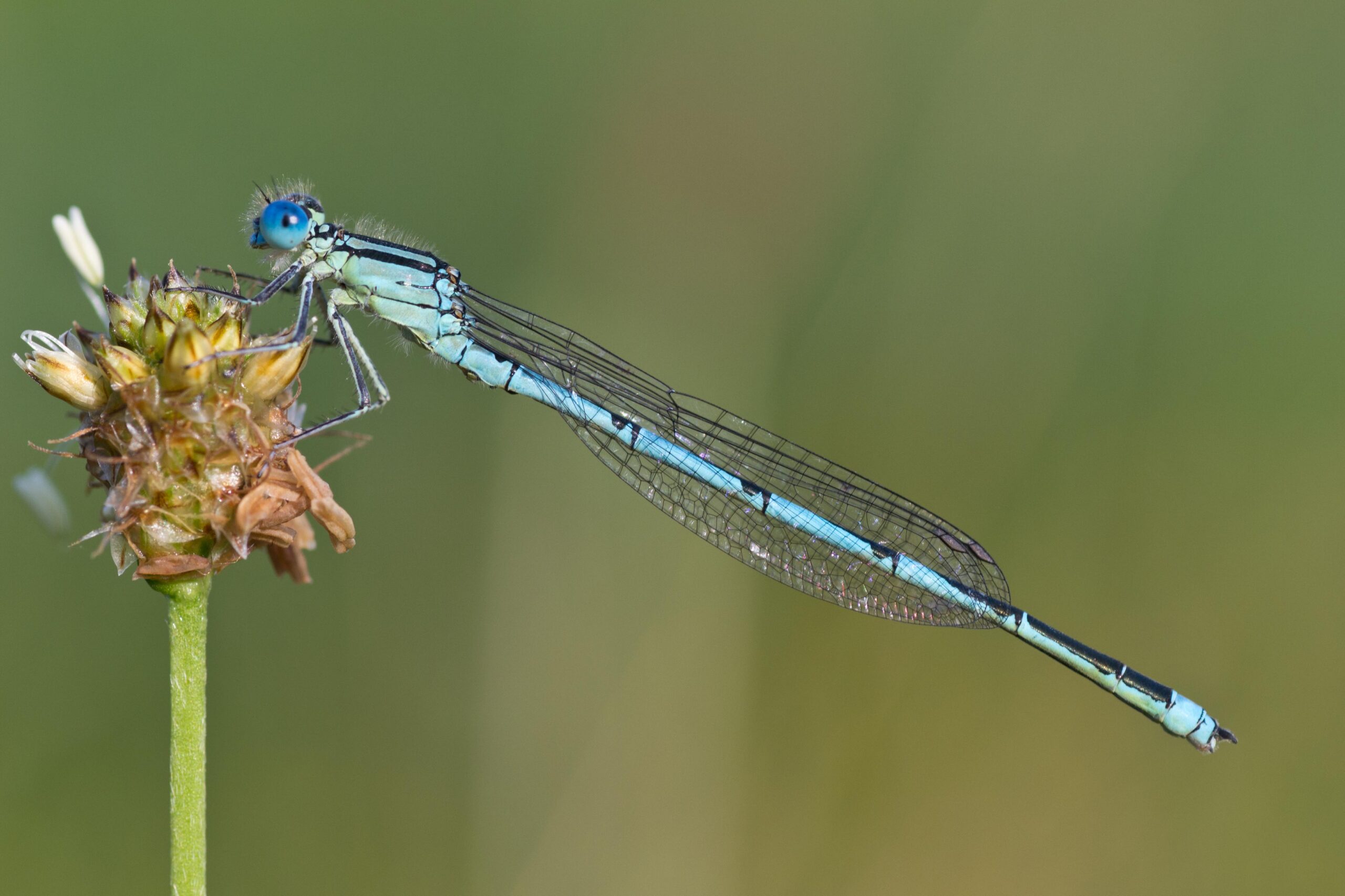
A small damselfly of 30 to 36 millimetres. In the male the eyes are deep blue all over, without the dark cap on top that other blue damselflies have. On the abdomen black figures stand on segments 3 to 6; segment 8 is black and segments 9 and 10 are blue. The upper abdominal appendages are long and pointed. The female is three-coloured: thorax and the start of the abdomen yellowish, greenish or brownish, the middle part pale blue and the tip pale brown.
Where do you see this species in the Netherlands?
Limburg, eastern North Brabant, the Achterhoek and Twente, with scattered records elsewhere. The species is slowly expanding northwards; the Netherlands and northern Germany form the northern limit of its range.
Habitat: Slow-flowing stretches of streams and rivers, canals and sand pits.
This is a common, widespread species: you can come across it in far more places than the areas listed below. Treat that list as a starting point rather than a full survey.
📍 Sint-Pietersberg & Zuid-Limburg
presence reported📍 Nationaal Park De Groote Peel
presence reported📍 Nationaal Park De Meinweg
presence reported📍 Nationaal Park De Biesbosch
presence reported📍 Kampina & Oisterwijkse Vennen
presence reportedThese links come straight from our database, with the chance, the source and the evidence level for each area.
When is the best time?
Green = present · orange = peak period. The bar is generated from our database.
Best period: Mid-May into September, peaking in July and the first half of August.
Best time of day: The sunny hours in the middle of the day.
Recent sightings
👁️ Where has this species been seen recently?
Check the current sightings on Waarneming.nl. A useful addition to our own verified information.
How to improve your chances
- Go on a warm, windless day between about ten and four, when they are active.
- Look for the place rather than the animal: flowery edges for butterflies, banks and open water for dragonflies.
- Move slowly and keep your shadow off the animal. It notices that before it notices you.
- Early in the morning they are still cold and motionless on a leaf. That is when you can get closest.
🎒 What you need for this
Binoculars with a short focusing distance. With blue damselflies you need to be able to count the markings on the abdominal segments.
Photography
It likes to perch on isolated little plants just above the water surface. Sit low by the water and wait — it will come back to the same stem of its own accord.
🌿 Watching responsibly
Keep your distance, stay on the paths, and never lure animals with food or sound. Leave as soon as an animal becomes uneasy.
Status: Verified · Last checked: 2026-08-07