
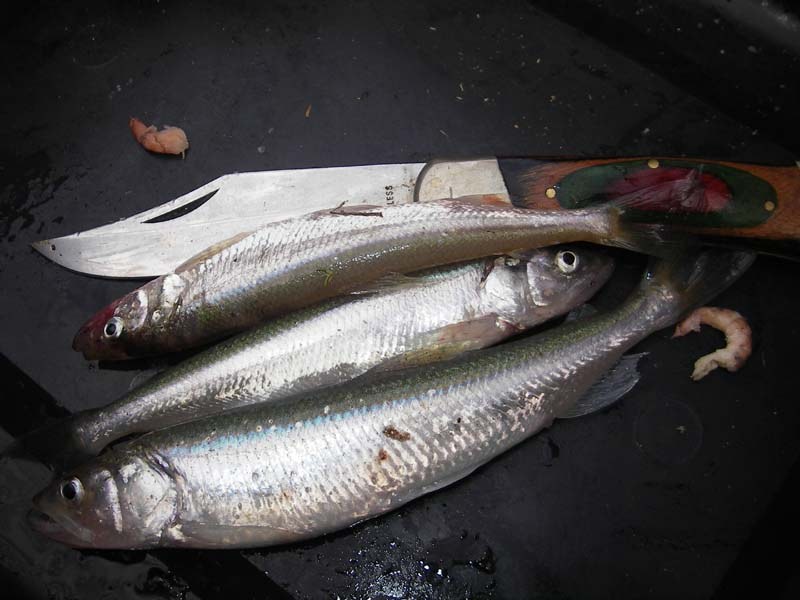
Where to see the European smelt in the Netherlands
With luck 🐟 Fish
Where and when do you see a European smelt? With some luck you can see this species, all year round.
How do you recognise a European smelt?
Silver flanks, elongated, with a relatively large upturned mouth with small teeth; young fish are almost transparent. Between the tail fin and the dorsal fin there is an adipose fin. And a feature no other fish has: smelt smells of cucumber. The freshwater form stays around fifteen centimetres; the sea-living smelt can grow to as much as 45 centimetres.
What can you confuse a European smelt with?
- Bleak and roofblei: look similar but lack the adipose fin between dorsal and tail fin.
- Houting: also has an adipose fin, but a pointed snout, while in smelt the dorsal fin stands straight above it.
Where do you see this species in the Netherlands?
Freshwater populations remain in the IJsselmeer, Friesland and the Haringvliet. After the Afsluitdijk and the Haringvliet dam were built, the large migrating smelt populations disappeared.
📍 Grevelingenmeer
presence reported📍 Ilperveld
presence reported📍 Voornes Duin
presence reported📍 Haringvlietsluizen
presence reportedThese links come straight from our database, with the chance, the source and the evidence level for each area.
When is the best time?
Green = present · orange = peak period. The bar is generated from our database.
Best period: Spawning takes place from February to April in the bankside zone of rivers or lakes. Millions of sticky eggs are then laid at once, in shoals.
Best time of day: By day in the spawning season, along the bankside zone of lakes and rivers.
Recent sightings
👁️ Where has this species been seen recently?
Check the current sightings on Waarneming.nl. A useful addition to our own verified information.
How to improve your chances
- Look for clear, shallow water and watch from a bridge, a jetty or a high bank.
- Polarising sunglasses take the reflection off the surface and show you what is swimming underneath.
- Stay low and move slowly. Fish are very good at seeing movement above the water.
- Early morning gives the calmest water and the best visibility.
🎒 What you need for this
Polarising glasses; watching along the bankside zone in the spawning season
Photography
Smell it. That does not sound like a photography tip, but with this species the cucumber smell is the quickest identification feature there is — and it saves you counting fins on a blurred photo.
🌿 Watching responsibly
Keep your distance, stay on the paths, and never lure animals with food or sound. Leave as soon as an animal becomes uneasy.
Status: Verified · Last checked: 2026-10-28