
Where to see the allis shad in the Netherlands
Very rare 🐟 Fish
Where and when do you see an allis shad? This species is very rarely seen, all year round.
How do you recognise an allis shad?
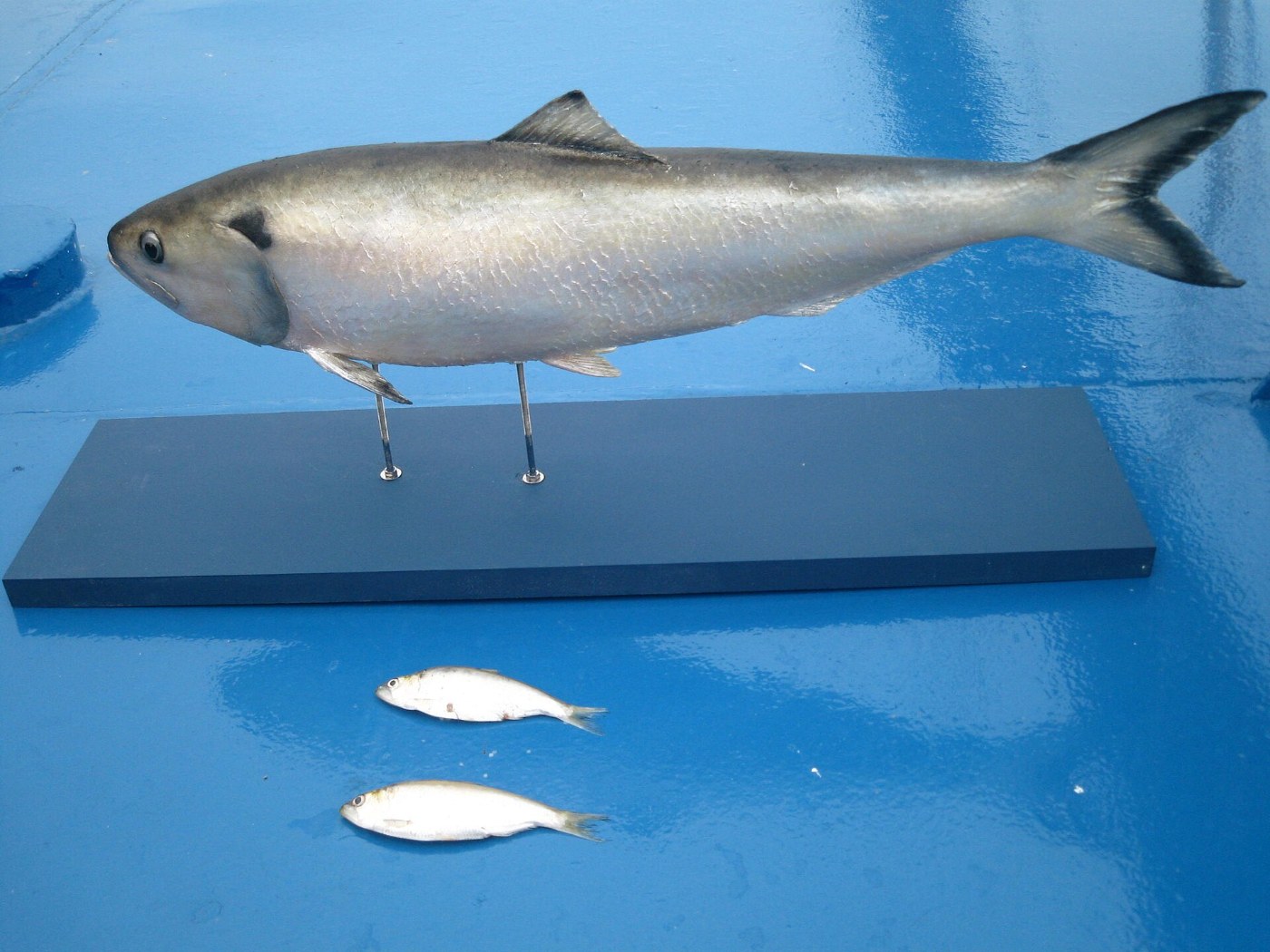
Deep-bodied and torpedo-shaped, silver with a dark blue to brown back. Usually one large dark spot behind the gill cover and one to three smaller flank spots; one short dorsal fin. The spots are very variable and age-dependent. RAVON gives up to 62 centimetres, the Natura 2000 profile "more than 80 cm" — the sources differ.
What can you confuse an allis shad with?
Looks like: Twaite shad
- Twaite shad: the only real confusion species, and it is not straightforward. RAVON: "Zekere determinatie moet op basis van genetica." The classic feature is the number of gill rakers on the first gill arch — 90 to 155 on the allis shad, 35 to 60 on the twaite shad.
- Herring: smaller, without the dark spot behind the gill cover.
Where do you see this species in the Netherlands?
Extinct in the Netherlands around the nineteen-thirties. Since 2008 recorded only occasionally, probably wanderers from other river systems. Between 1969 and 1993 there were only four catches in fresh water.
Habitat: Adults live in shoals on the open sea, in coastal zones and estuaries. The species needs well-functioning estuaries and freshwater tidal area as nursery grounds — precisely what was largely lost through the Delta Works.
We have not yet recorded any areas for this species with enough evidence behind them, so we name the habitat type instead.
When is the best time?
Green = present · orange = peak period. The bar is generated from our database.
Best period: It moves towards the coast at the end of winter; around May and June the fish run up the rivers to spawn over gravel banks.
Best time of day: Not applicable.
Recent sightings
👁️ Where has this species been seen recently?
Check the current sightings on Waarneming.nl. A useful addition to our own verified information.
How to improve your chances
- Look for clear, shallow water and watch from a bridge, a jetty or a high bank.
- Polarising sunglasses take the reflection off the surface and show you what is swimming underneath.
- Stay low and move slowly. Fish are very good at seeing movement above the water.
- Early morning gives the calmest water and the best visibility.
🎒 What you need for this
Not applicable
Photography
Should you ever have one in your hands during monitoring: photograph the first gill arch. The number of gill rakers on it — 90 to 155 on the allis shad, 35 to 60 on the twaite shad — is the classic distinction, although RAVON advises genetics for certain identification.
🌿 Watching responsibly
Keep your distance, stay on the paths, and never lure animals with food or sound. Leave as soon as an animal becomes uneasy.
Status: Verified · Last checked: 2026-10-28