
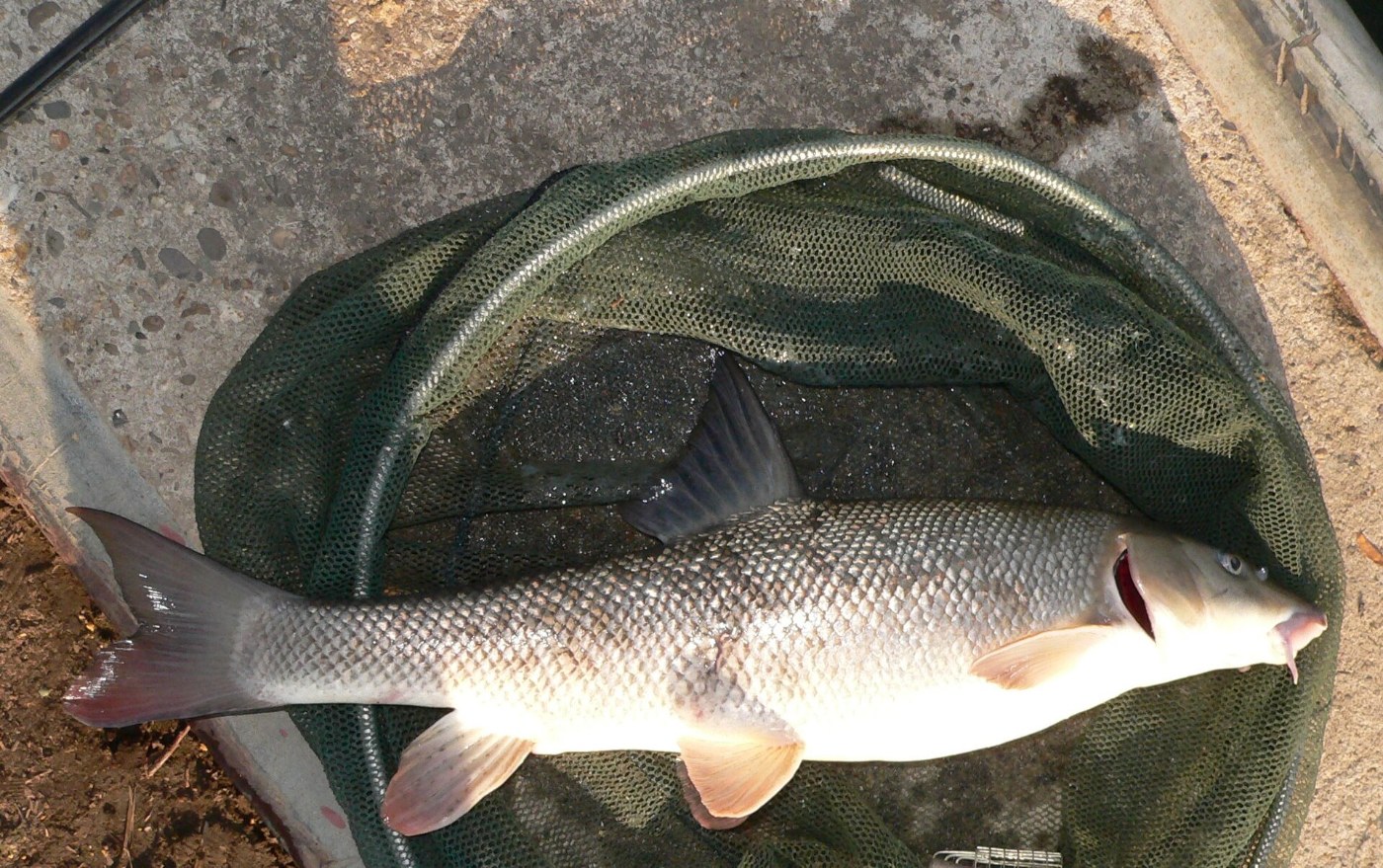
Where to see the barbel in the Netherlands
Rare 🐟 Fish
Where and when do you see a barbel? This species is rarely seen, all year round.
How do you recognise a barbel?
A flattened head with a protrusible mouth and four barbels. Adults are brown to greenish brown on the back with silvery flanks and small dark spots; young fish are more beige. The species can reach a length of 120 centimetres.
What can you confuse a barbel with?
Looks like: Gudgeon, Stone loach
- Gudgeon: similar in build to a young barbel but has two barbels instead of four.
- Stone loach: has six barbels and stays much smaller.
- Whitefin gudgeon: two barbels, and keeled scales on neck and back.
Where do you see this species in the Netherlands?
Rare, with the Grensmaas and the Rhine branches as its most important waters. Since 2011 there has been a renewed decline in both. Threats are large water-level fluctuations in the Grensmaas caused by the hydroelectric plant at Lixhe, reduced flow from weirs, drier summers and possibly introduced gobies and Wels catfish.
Habitat: Strictly current-loving: rivers and large streams with a moderate to fast flow. Adults lie in deeper places where fast flow turns into slower water; young fish prefer very fast-flowing stretches.
We have not yet recorded any areas for this species with enough evidence behind them, so we name the habitat type instead.
When is the best time?
Green = present · orange = peak period. The bar is generated from our database.
Best period: Spawning runs from late April through July, when the fish move to gravel banks in shallow fast-flowing water.
Best time of day: Dusk and night. The barbel forages at night and searches the bottom with its barbels for invertebrates and small fish.
Recent sightings
👁️ Where has this species been seen recently?
Check the current sightings on Waarneming.nl. A useful addition to our own verified information.
How to improve your chances
- Look for clear, shallow water and watch from a bridge, a jetty or a high bank.
- Polarising sunglasses take the reflection off the surface and show you what is swimming underneath.
- Stay low and move slowly. Fish are very good at seeing movement above the water.
- Early morning gives the calmest water and the best visibility.
🎒 What you need for this
Polarising glasses during the spawning run; otherwise above all fish passes and fish lifts, where the species is recorded
Photography
Go to a fish pass rather than to the river itself. There the fish go by at a fixed point and in shallow water, and with a night-active bottom fish that is the only moment photography is realistic.
🌿 Watching responsibly
Keep your distance, stay on the paths, and never lure animals with food or sound. Leave as soon as an animal becomes uneasy.
Status: Verified · Last checked: 2026-10-28