
Where to see the Dainty Bluet in the Netherlands
With luck 🪰 Dragonfly
Where and when do you see a Dainty Bluet? With some luck you can see this species, from May to July.
How do you recognise a Dainty Bluet?
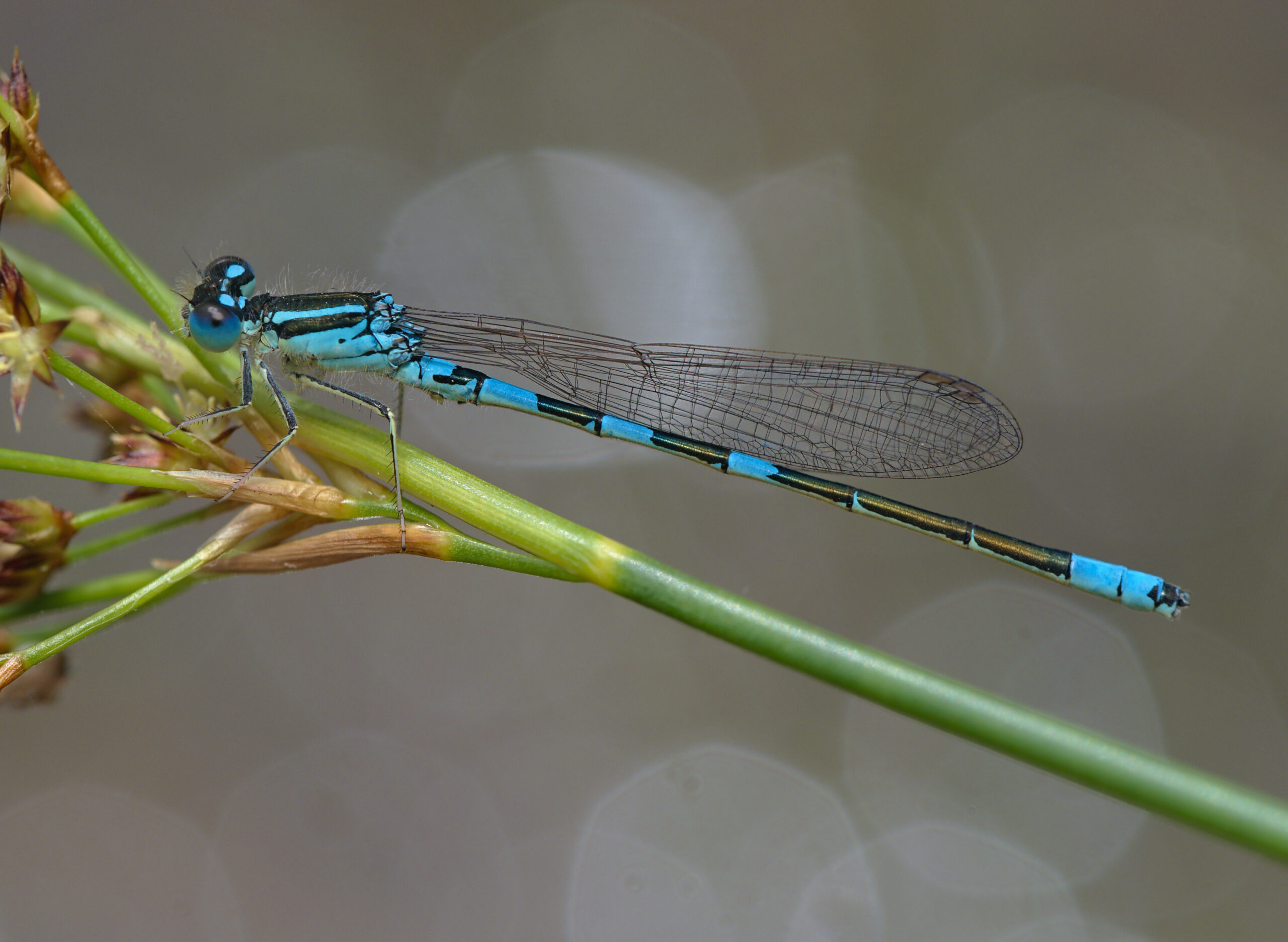
Length 30 to 33 millimetres. The male has a characteristic division of blue and black: segments 3 to 5 are about half blue, 6 and 7 almost entirely black and 8 and 9 largely blue. On segment 2 there is usually a fork-shaped black marking joined to the rear edge — which gives the species its Dutch name. The eyes are usually green underneath and the upper abdominal appendages are longer than the lower ones in side view. The female has fairly extensive pale markings on the abdomen, especially on segments 2 to 5, and a deeply brace-shaped rear edge to the pronotum with a narrow projection in the middle.
Where do you see this species in the Netherlands?
Discovered in Zeeuws-Vlaanderen in 2007, slowly expanding northwards since 2010 and now present in a large part of the Netherlands, as far as Drenthe.
Habitat: Standing and slowly flowing water in the sun with plenty of water and bankside plants: streams, dune pools, lakes, ponds, ditches and heath pools.
This is a common, widespread species: you can come across it in far more places than the areas listed below. Treat that list as a starting point rather than a full survey.
📍 Zwin & Zeeuws-Vlaanderen
presence reported📍 Nationaal Park Zuid-Limburg (in formation)
presence reported📍 Sint-Pietersberg & Zuid-Limburg
presence reported📍 Nationaal Park Utrechtse Heuvelrug
presence reported📍 Nationaal Park De Meinweg
presence reported📍 Meijendel & Berkheide
presence reported📍 Kampina & Oisterwijkse Vennen
presence reported📍 Strabrechtse Heide & Beuven
presence reportedThese links come straight from our database, with the chance, the source and the evidence level for each area.
When is the best time?
Green = present · orange = peak period. The bar is generated from our database.
Best period: Probably from late May to mid-July; the flight period in the Netherlands is not yet well known.
Best time of day: The sunny hours in the middle of the day.
Recent sightings
👁️ Where has this species been seen recently?
Check the current sightings on Waarneming.nl. A useful addition to our own verified information.
How to improve your chances
- Go on a warm, windless day between about ten and four, when they are active.
- Look for the place rather than the animal: flowery edges for butterflies, banks and open water for dragonflies.
- Move slowly and keep your shadow off the animal. It notices that before it notices you.
- Early in the morning they are still cold and motionless on a leaf. That is when you can get closest.
🎒 What you need for this
Binoculars with a short focusing distance. The pattern on segments 6 and 7 is the quickest feature in the field.
Photography
Get the whole abdomen in focus, not just the head. In this species the proof lies in the division of blue and black across segments 3 to 9.
🌿 Watching responsibly
Keep your distance, stay on the paths, and never lure animals with food or sound. Leave as soon as an animal becomes uneasy.
Status: Verified · Last checked: 2026-08-07