
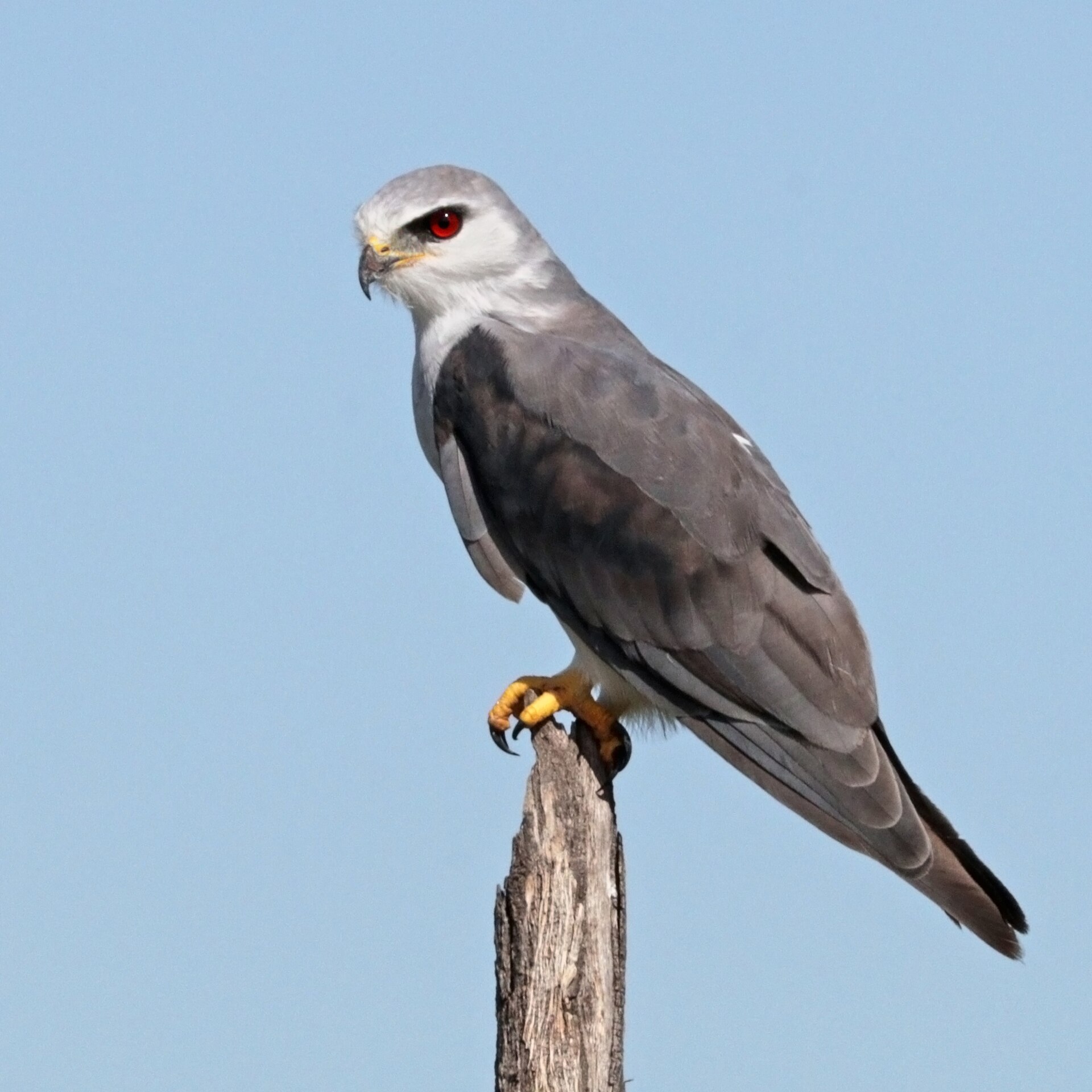
Where to see the Black-winged Kite in the Netherlands
Very rare 🦅 Bird
Where and when do you see a Black-winged Kite? This species is very rarely seen, all year round.
How do you recognise a Black-winged Kite?
Length 30 to 37 cm, wingspan 77 to 92 cm. A small, compact raptor the size of a Common Kestrel: pale grey above and pure white below, with jet-black shoulder patches and strikingly large, deep red eyes. It flies on pointed wings and hovers a great deal, with its wings held high in a V.
What does a Black-winged Kite sound like?
Recording: JMK, CC BY-SA 4.0, via Wikimedia Commons
Where do you see this species in the Netherlands?
No fixed distribution; records come from open arable and grassland country, often from the same spot for days or weeks.
📍 Onlanden & Leekstermeer
presence reported📍 Fochteloërveen
presence reportedThese links come straight from our database, with the chance, the source and the evidence level for each area.
When is the best time?
Green = present · orange = peak period. The bar is generated from our database.
Best period: No fixed pattern; records throughout the year, slightly more often in autumn and winter.
Best time of day: During the day, especially the late afternoon.
Recent sightings
👁️ Where has this species been seen recently?
Check the current sightings on Waarneming.nl. A useful addition to our own verified information.
How to improve your chances
- Learn the calls first. You will hear most birds before you see them.
- Go in the first hour after sunrise, when the song is at its peak and the wind is still down.
- Use a hide or natural cover. Sitting still gets you more than walking closer.
- Keep the sun behind you. Against the light you see a silhouette and no colour.
🎒 What you need for this
Binoculars; a telescope if it is sitting on a distant post
Photography
It hovers over the same spot for a long time and then drops with its wings raised — that is the shot. The red eyes against the white head call for a head-on frame with a long lens
🌿 Watching responsibly
Keep your distance, stay on the paths, and never lure animals with food or sound. Leave as soon as an animal becomes uneasy.
Status: Verified · Last checked: 2026-08-07