

Seeing a starling murmuration in the Netherlands: where, when and why
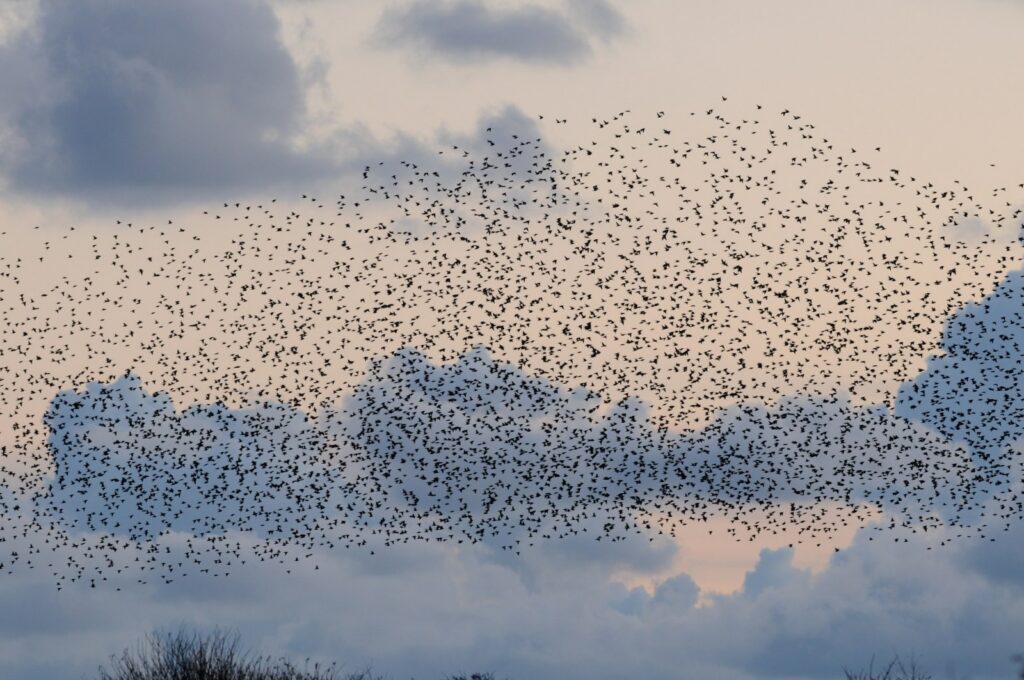
A starling murmuration is one of the few natural spectacles in the Netherlands you don’t have to travel far for and still end up watching open-mouthed. Tens of thousands of birds turn at once, collapse into a dark ball, stretch out into a ribbon and then drop into the reeds in one go. It lasts twenty minutes or so, just before dark, and the season is coming up now. Below: where to be, what time to be standing there, and what is happening inside such a flock — because far more is known about that than people think, thanks to the last fifteen years.
What is a starling murmuration, actually?
A murmuration is neither a migration phenomenon nor a courtship dance. It is what happens in the last half hour before starlings go to sleep. By day they roam over meadows, fields and city parks in smaller groups. Vogelbescherming Nederland: “At the end of the day all those small bands of starlings seek each other out.” They come together above a fixed roost, and only once there are enough birds does the turning, surging whole arise that English calls a murmuration.
That distinction matters practically: you are not watching birds going somewhere, but birds that are already there and waiting. As a result it plays out at one fixed place, evening after evening. Vogelbescherming: “Starling roosts are sometimes used for years on end.” Find one and you have it for the whole season.
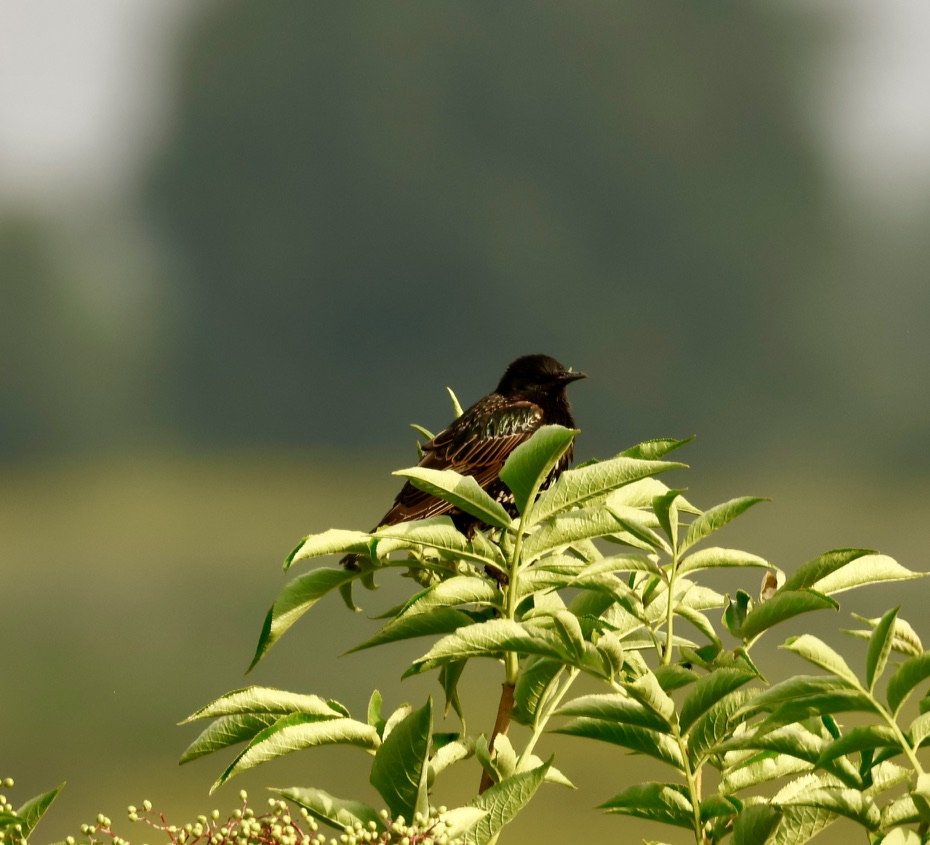
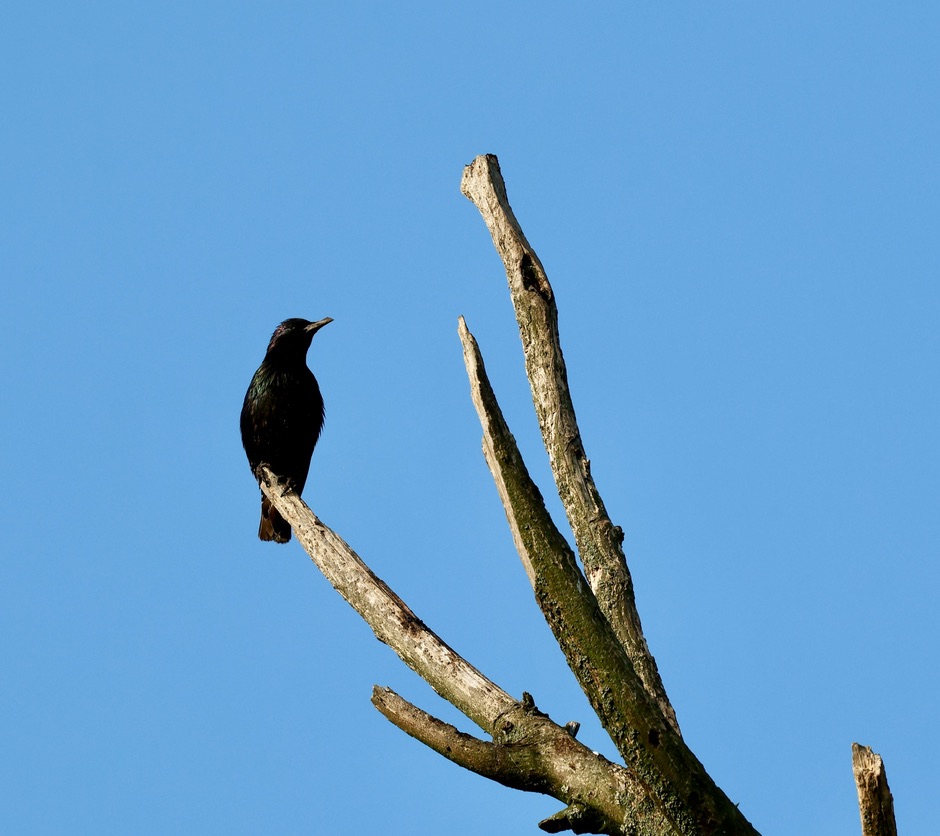
The Common Starling itself is nineteen to twenty-two centimetres, in winter black with a purple-green gloss and white speckles. At a distance, against a pale evening sky, you see none of those colours. Then every starling is a dot — and that is precisely why the flock works the way it does.
When your chances of a murmuration are best
The season runs roughly from late September into March, with the centre of gravity in autumn and early winter. The best Dutch reference point is the national roost count Sovon organised in the Year of the Starling: it was deliberately held on the weekend of 25 and 26 October 2014, because numbers are at their highest then. British research using citizen observations, published in PLOS ONE in 2017, found the same pattern: numbers peaked “significantly from October to early February”, followed by a decline until late March.
- Late September to mid-October: the flocks are building. Smaller, but the evenings are more pleasant and the light is usable for longer.
- Mid-October to early February: the peak, and the best chance of impressive numbers.
- February and March: it tails off. The flocks get smaller, but according to that same research they actually last a bit longer again — just as at the start of the season.
Weather matters less than people think. Windless and dry is more comfortable to watch, but wind actually makes the flock more restless and sometimes more spectacular. Only in heavy rain do the birds go into the reeds quickly and without ceremony.
The right time: count back from sunset
This is where most first attempts go wrong: people arrive at seven because that seems a normal time, and are either an hour early or twenty minutes late. The rule is simple: count back from sunset. Sovon has its counters start “an hour before sunset”; Natuurmonumenten describes the spectacle as something that takes place “shortly before sunset” and lasts about half an hour. The British research puts a figure on it: an average of 26 minutes. That is your entire performance.
For orientation, sunset in the middle of the country (Utrecht; elsewhere it differs by a few minutes):
- 7 September: 8.12 pm
- 1 October: 7.16 pm
- 15 October: 6.45 pm
- 24 October: 6.26 pm
- 26 October: 5.22 pm — the clocks go back an hour on the night of Saturday 24 to Sunday 25 October
- 15 November: 4.47 pm
- 15 December: 4.27 pm
That clock change is the classic miss, precisely because it falls in the week when the flocks are at their largest. From November onwards a murmuration is therefore a late-afternoon phenomenon rather than an evening one — which makes it much easier to drop by after work. Do be on time, but not too early: an hour beforehand there is nothing to see yet. The birds come in in little waves in the last half hour, and that building-up is exactly what’s worth watching.

Where to look: reed and open water
One habitat feature stands out everywhere. Sovon-Nieuws summarised the outcome of the national count like this: “Of genuinely large roosts, with at least 10,000 starlings, 70% are in reed.”
So anyone looking for a murmuration is first and foremost looking for an extensive reedbed, preferably with open water around it — the same combination Natuurmonumenten names. The remaining thirty per cent, according to Sovon, is in willow coppice, in bushes and trees (often in cities) and in elephant grass.
Why reed? It stands in water, and that is a barrier to foxes, martens and cats. Reed stems also move when something walks through them, which gives away any approaching predator.
Areas where that combination is present on a large scale in the Netherlands:
- Lauwersmeer — large-scale reed and open water, and one of the four places that produced hundreds of thousands of birds in the national count.
- Oostvaardersplassen — the marsh section is exactly the kind of reed marsh in question.
- Fochteloërveen — bog with reedy edges, and in the evening one of the better places in the country anyway.
Beyond those there are dozens of smaller reedbeds along lakes and polder ditches where a few thousand starlings sleep in winter. Natuurmonumenten is honest about it: “It is difficult to name exact locations.” A place that was full last year can be empty this year.
What the national roost count produced
On the weekend of 25 and 26 October 2014, Dutch volunteers counted starling roosts on a large scale for the first time, and the outcome was bigger than expected. The published figures for the exact total do differ, incidentally. Vogelbescherming reported “128 counts in total” with “1,221,623 starlings” between them; Sovon-Nieuws, in the report that followed, arrived at 1,821,640 individuals, probably including counts that came in later. However you count it: in one weekend more than a million sleeping starlings were recorded, and the Dollard hadn’t even been counted yet.
Four roosts stood out, all four in the north: Tetjehorn (Groningen), the Bokkumermar (Friesland), the Bargerveen (Drenthe) and the Lauwersmeer — each with hundreds of thousands of birds, around a million between them. The largest single roost held, according to Vogelbescherming, “the unimaginable number of 400,000 starlings”.
How many birds are in one flock?
Almost nobody can estimate that well by eye; which is why there is software for it. Vogelbescherming ran a flock photograph through a counting program: “The number of starlings in the photograph above was estimated by the software at 18,800, with a margin of 200.” So what looks in a photograph like an impenetrable black cloud is of the order of twenty thousand birds.
Vogelbescherming also notes that there can “sometimes be as many as a hundred thousand starlings in one flock”. The British research gives the spread: the average reported flock consisted of more than 30,000 birds, with an outlier of 750,000. Count on an ordinary good evening producing a few thousand to tens of thousands of birds — more than enough for the effect.
Why they do this — and why nobody knows for certain
Modesty is in order here: there are several explanations, they don’t exclude one another, and science hasn’t settled it. Natuurmonumenten sets the two best-known side by side without choosing: is it “because they feel safer in a group and can protect themselves better against birds of prey?” Or “to be able to make the journey to the wintering area in Belgium, northern France or southern England together?”
The first has the most support. The 2017 PLOS ONE study found birds of prey at 29.6 per cent of flocks — nearly one in three. The Eurasian Sparrowhawk was by far the most frequently recorded species, followed by Common Buzzard, harriers and Peregrine Falcon.
More important than the presence was the effect. If a raptor was there, the flock significantly more often ended with all the birds diving into the reeds at once. And its presence explained 40 per cent of the variation in flock size and 26 per cent of that in duration — considerably more than temperature.
That is not conclusive proof that the flock exists because of birds of prey; it shows that birds of prey strongly determine what it looks like and how long it lasts. Vogelbescherming sums up the other side in one sentence: “Sleeping together is just safer.” One starling in a mass of twenty thousand has a negligible chance of being taken, and a sparrowhawk struggles to keep hold of a single target in a turning cloud.

How thousands of birds turn at once: seven neighbours
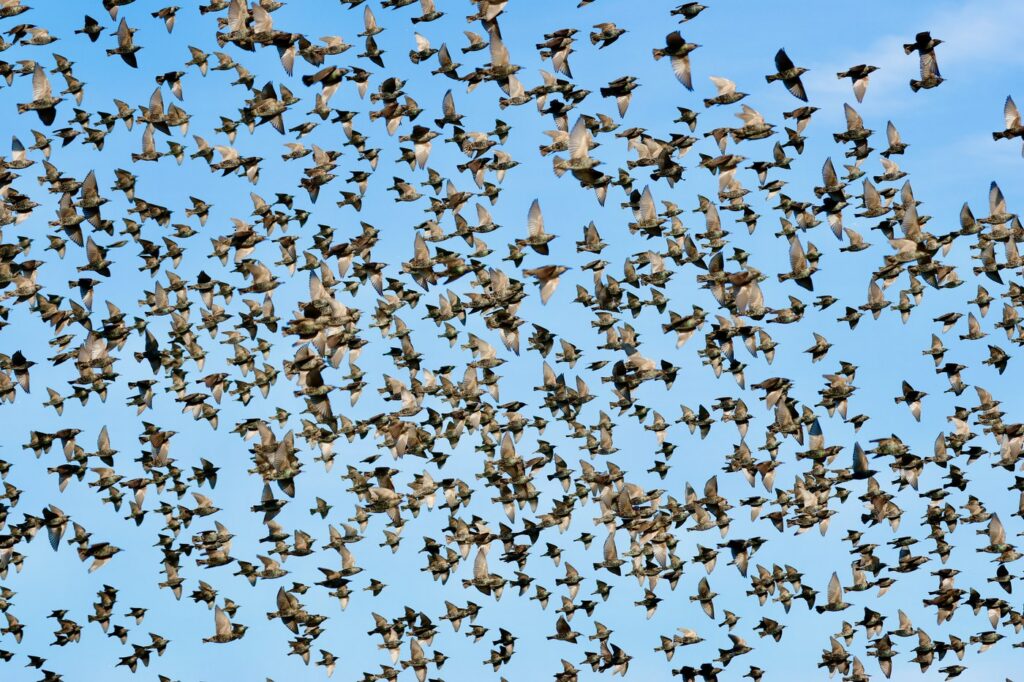
This is the most frequently asked question: how can tens of thousands of birds make the same turn within a fraction of a second, without collisions and without a leader?
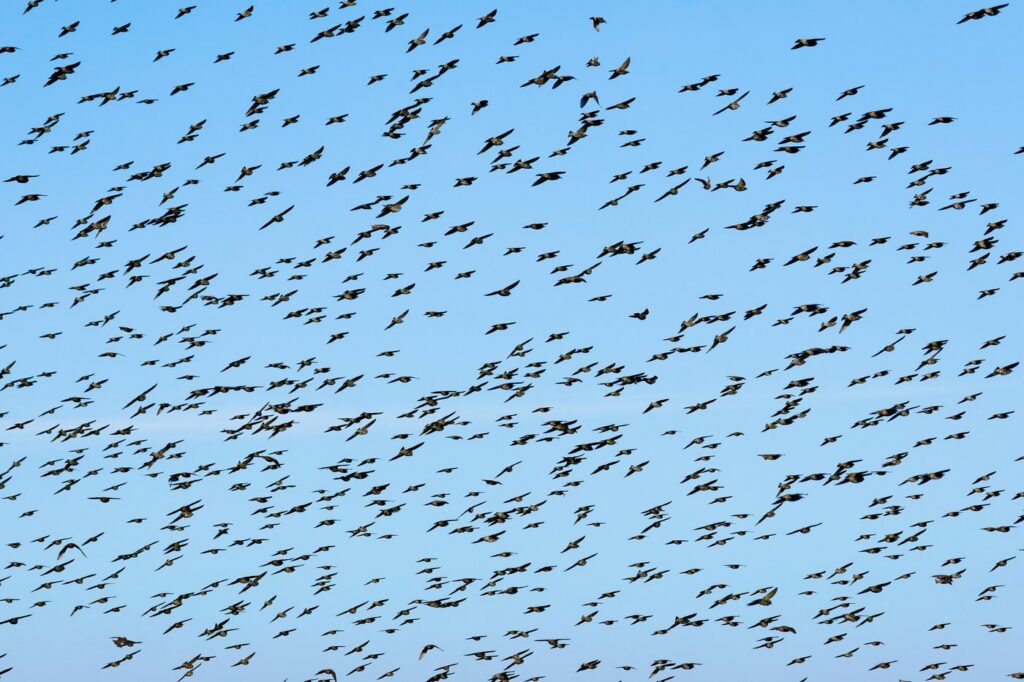
There is no leader, and no starling keeps track of the whole flock. Each bird watches a small, fixed number of neighbours. Researchers from Princeton, the University of Toronto and the Sapienza University in Rome arrived in 2013 at a surprisingly precise number: seven. In Princeton’s words: “When starlings coordinate with their seven nearest neighbors, they form their characteristic flocks with the least effort.”
Why seven? The team — Naomi Leonard, George Young, Luca Scardovi, Andrea Cavagna and Irene Giardina — modelled the cost of tracking neighbours. More neighbours gives better coordination, but also more effort and more noise. Seven turned out to be the point where coordination is maximal and effort minimal.
On top of that tracking sit three simple behavioural rules: align, attract and avoid. Fly the same way as your neighbours, stay near them, don’t collide with them. From those three rules — and nothing else — comes all the complexity you see from the ground.
Waves through the flock: research from Groningen
The Netherlands plays a role of its own in this field. Charlotte Hemelrijk of the University of Groningen developed the computer models that explain how the behaviour of individual birds produces the shape of the whole flock. Her group uses, among other things, a robot falcon to present starlings with a threat and measure their escape behaviour.
Those dark waves that travel through the flock like a ripple — the most spectacular thing you see from the ground — arise because birds taking evasive action turn their wings differently towards you. The density barely changes; the light they reflect does. Such a wave propagates faster than a single bird can fly, because each bird is already responding to what its neighbours are starting to do. That is why a flock of fifty thousand birds turns just as sharply as one of five hundred.
Where the winter starlings come from
The birds in the flock you see in November are largely not the birds that were in your nest box in June. Vogelbescherming describes the movement in two directions: “large numbers of starlings pass through the Netherlands from northern and eastern regions of Europe, a large part of which winter in our country.” At the same time some of our own breeding birds leave for Belgium, north-west France and southern England.
That exchange explains the figures. Sovon puts the breeding population at 400,000 to 700,000 pairs (2018–2020), but the winter maximum at one to three million birds. That is why the flocks grow so fast in autumn.
The starling is also one of the most conspicuous species of the autumn migration. At the Euro Birdwatch of 4 October 2014 it was, according to Sovon, “by far the most observed species”, with nearly 500,000 individuals. That outlier is not representative — more recently Vogelbescherming counted 77,000 (2023), 131,383 (2024) and 6,555 in the quiet year 2025 — but the starling was number one in all those years. What else passes over in the same weeks is covered in our article on bird migration in September.
Millions in winter, and still in trouble
This is the contradiction this article cannot avoid: you are looking at tens of thousands of birds at once, and at the same time the starling is not doing well. Since 1990 Sovon has measured a “significant decrease” in the breeding population, amounting over the whole period to a fall of about sixty per cent. For 1984–2012 Vogelbescherming gives an average decline of four per cent a year and writes bluntly: “The number of starlings in our country has fallen dramatically.” Sovon rates the conservation status of the breeding birds as “very unfavourable”, and of the non-breeding birds as “moderately unfavourable”.
One clarification, because it often gets copied wrongly: the starling is not on the Red List of Dutch breeding birds, but on the Orange list — and on two of them at that: the one for breeding birds and the one for passage migrants and winterers. That list is intended for species declining fast but still too numerous for the Red List. Which is the starling exactly.
The cause probably lies not with the adult birds but with the young: Sovon points to reduced annual survival of young birds, linked to the decreased quality and area of grassland. Starlings look for leatherjackets and other soil insects in short, herb-rich grass; tightly managed ryegrass barely provides that. Over the last twelve years there has, according to Sovon, been “no significant change in numbers” — the fall appears to have levelled off, at a substantially lower level.
Practicalities: what to take and how to stand
Watching a murmuration is surprisingly undemanding. You don’t need binoculars — in fact they work against you, because then you see part of the flock instead of the whole. What does help:
- Arrive half an hour before sunset and find a spot first. Arriving when it has already started costs you half of it.
- Work with the sky, not into the sun. Make sure the flock stands out against the brightest part of the sky, usually west to south-west. Against a dark woodland edge you see virtually nothing.
- Keep your distance from the reeds. A hundred metres is ample. Too close to the roost and you drive the birds away before it gets interesting.
- Dress warmer than you think. You are standing still, often by water, at the coldest moment of the day.
- Bring a torch — it’s dark when you walk back, and little dykes along reedbeds are rarely surfaced.
- No hurry. Stay another five minutes after the flock has dropped in; often it comes up one more time.
Disturbance is the one thing you really must watch. Starlings that are repeatedly flushed abandon a roost, and then it is over for the whole season — for whoever comes after you, too. Keep to paths, keep dogs on the lead, use no drone and no sound to flush birds. Our guidelines for responsible wildlife watching go into this further.
You can also help count: Sovon and Vogelbescherming organise roost counts, and during Euro Birdwatch in the first weekend of October counting happens across the country. Sovon’s counting instruction is simple enough to follow yourself: “Count the birds already present, supplemented by the birds flying in.”
Photographing a murmuration
Photographically this is a difficult subject that looks easy. Three things determine whether it comes off.
Little light, lots of movement. If you want sharp dots, you are soon at 1/1000 of a second and therefore at a high ISO. If you want to show the movement, do the opposite: 1/15 or longer, camera on a tripod, let the flock smear into streaks. The second more often yields a good picture.
Wide-angle works better than telephoto. With a telephoto lens you photograph part of the cloud without context. A 24–70 or even your phone, with reedbed and horizon included, tells the story better.
The background is the subject. A flock against a grey sky is a grey photo; against an orange evening sky it is immediately a picture. So choose your position for the sky, not for the birds.
And the most important thing: watch the first evening without a camera. You learn where the flock arrives, hangs and drops in — the second evening you’ll be standing in the right place.
Frequently asked questions
What time does a starling murmuration start?
In the last half hour before sunset, with the climax around or just after sunset. Count on about half an hour: the British research arrived at an average duration of 26 minutes.
In which months do you see murmurations in the Netherlands?
Roughly from late September into March, with the highest numbers from mid-October to early February. The national roost count was not held in late October by accident.
How many starlings are in a flock?
Usually thousands to tens of thousands. Vogelbescherming had a flock photograph counted by software and arrived at 18,800 birds. Outliers of a hundred thousand or more do occur; the largest Dutch roost held around 400,000.
Why do starlings fly in clouds like this?
Probably above all for safety: sleeping together and flying together reduces the chance of being taken yourself. Birds of prey were present at nearly one in three flocks and explained a large part of the differences in size and duration. Conclusive proof is lacking.
Do starlings never collide?
Virtually never. Each bird keeps track of about seven nearest neighbours and follows three rules: align, attract and avoid. Because everyone responds to their immediate neighbours, a turn propagates through the flock at great speed without any need for a leader.
Where is the best place to see a starling murmuration?
Look for a large reedbed with open water around it; seventy per cent of the large roosts are in reed. The Lauwersmeer, the Oostvaardersplassen and the Fochteloërveen have that combination on a large scale. Roosts do shift from year to year.
Are these the same starlings that breed here?
Largely not. Some of our breeding birds migrate away to Belgium, north-west France and southern England, while large numbers of starlings arrive from northern and eastern Europe. As a result there are one to three million starlings in the Netherlands in winter, against 400,000 to 700,000 breeding pairs in summer.
Further reading at the source
- Sovon, species page Spreeuw — population estimates, trends, conservation status. stats.sovon.nl. In Dutch.
- Sovon, roost counting instruction — the advice to start an hour before sunset. sovon.nl. In Dutch.
- Sovon-Nieuws 28 (2015) no. 3 — the national roost count: 1,821,640 birds, 70% in reed (pdf). pub.sovon.nl. In Dutch.
- Vogelbescherming, bird guide Spreeuw — numbers, Orange list, features, migration. vogelbescherming.nl. In Dutch.
- Vogelbescherming, “In de wolken met spreeuwen” — roosts and the gathering at the end of the day. vogelbescherming.nl. In Dutch.
- Vogelbescherming, “Hoeveel spreeuwen vliegen er in een wolk?” — the software count of 18,800 birds. vogelbescherming.nl. In Dutch.
- Vogelbescherming, Euro Birdwatch — the annual count results. vogelbescherming.nl. In Dutch.
- Natuurmonumenten, “Spreeuwenwolken, spectaculaire luchtshows in het najaar” — timing and habitat. natuurmonumenten.nl. In Dutch.
- Goodenough et al., PLOS ONE (2017) — the 26 minutes and the figures on birds of prey. journals.plos.org
- Princeton University (2013) — the seven-neighbours research by Leonard, Young, Scardovi, Cavagna and Giardina. princeton.edu
- National Geographic Nederland — the modelling work of Charlotte Hemelrijk (University of Groningen), the three behavioural rules, the robot falcon. nationalgeographic.nl. In Dutch.
- Common Starling — identification, sound and occurrence through the year.
- Eurasian Sparrowhawk — the bird of prey that turns up most often at a murmuration.
- Peregrine Falcon and Common Buzzard — the other hunters above a roost.
- Western Marsh Harrier — hunts low over the same reedbeds.
- Bearded Reedling — in that same reed by day.
- Lauwersmeer, Oostvaardersplassen and Fochteloërveen — reed and open water on a large scale.
- Bird migration in September — what passes over in the same weeks.
- Common Crane — the other autumn species where the weather decides whether you see it.
- Responsible wildlife watching — watching without disturbing.