
Where to see the yellow-necked mouse in the Netherlands
Rare 🦌 Mammal (land)
Where and when do you see a yellow-necked mouse? This species is rarely seen, all year round.
How do you recognise a yellow-necked mouse?
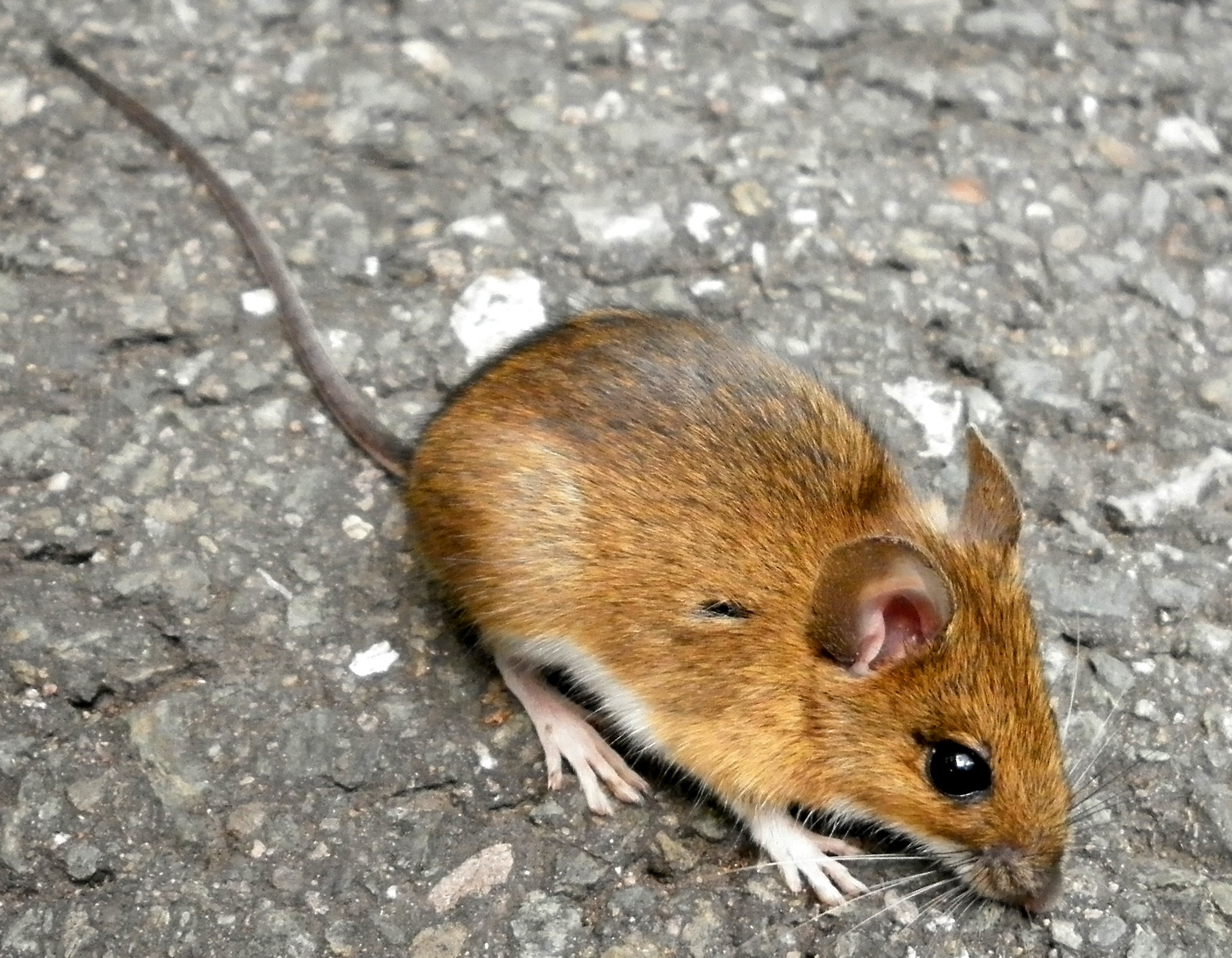
Large eyes and ears and a pointed snout. The upperside is rust brown to chestnut brown, the underside pure white, with a sharp boundary between the two. Decisive is the yellow breast patch, which extends as a broad collar across the neck towards the back. Head and body 87 to 130 millimetres, tail 90 to 135 millimetres, 18 to 45 grams; the hind feet are always longer than 23 millimetres.
What can you confuse a yellow-necked mouse with?
Looks like: Wood mouse
- Wood mouse: smaller and without the yellow breast band.
What tracks does a yellow-necked mouse leave?
Print: the fore foot is 12 mm long and 15 mm wide with four toes, the hind foot 23 mm long and 19 mm wide with five toes, making it the largest mouse print in the Netherlands. Trail: much of it in a bounding gallop, with the hind feet landing on or in front of the fore feet; a tail drag often runs through it. Droppings: 4 to 6.5 mm long and 2 to 3.5 mm thick, dark and with blunter ends than those of other true mice. Feeding signs: on spruce cones, hazelnuts, beech nuts, acorns and brambles, but hardly distinguishable from those of other rodents.
Where do you see this species in the Netherlands?
Only in Limburg and in the east of the country, between Groningen and Winterswijk.
Habitat: Old, open oak and beech woodland with an extensive shrub layer and little undergrowth. It avoids wet terrain, dense grassy vegetation and open meadows.
This is a common, widespread species: you can come across it in far more places than the areas listed below. Treat that list as a starting point rather than a full survey.
📍 Nationaal Park Dwingelderveld
presence reported📍 Nationaal Park Drents-Friese Wold
presence reported📍 Fochteloërveen
presence reported📍 Nationaal Park Zuid-Limburg (in formation)
presence reported📍 Zuidlaardermeergebied en Hunzedal
presence reported📍 Landgoed Ennemaborg
presence reportedThese links come straight from our database, with the chance, the source and the evidence level for each area.
When is the best time?
Green = present · orange = peak period. The bar is generated from our database.
Best period: Active all year; breeding runs from March to October.
Best time of day: Night, especially after two o'clock.
Recent sightings
👁️ Where has this species been seen recently?
Check the current sightings on Waarneming.nl. A useful addition to our own verified information.
How to improve your chances
- Keep the wind in your face. Most mammals will smell you long before they see you.
- Arrive before sunrise and then stay put. Sitting still beats walking about.
- Wear muted colours, skip the scent, and put your phone on silent.
- Be patient. Expect to come back more than once before it works.
🎒 What you need for this
A trail camera at a small feeding table in old deciduous woodland. It is active deep in the night, so watching gets you little.
Photography
Aim at the breast, not the back: only when the full collar is visible can you separate it with certainty from the Wood mouse. A photo from above does not help.
🌿 Watching responsibly
Keep your distance, stay on the paths, and never lure animals with food or sound. Leave as soon as an animal becomes uneasy.
Status: Verified · Last checked: 2026-08-08