
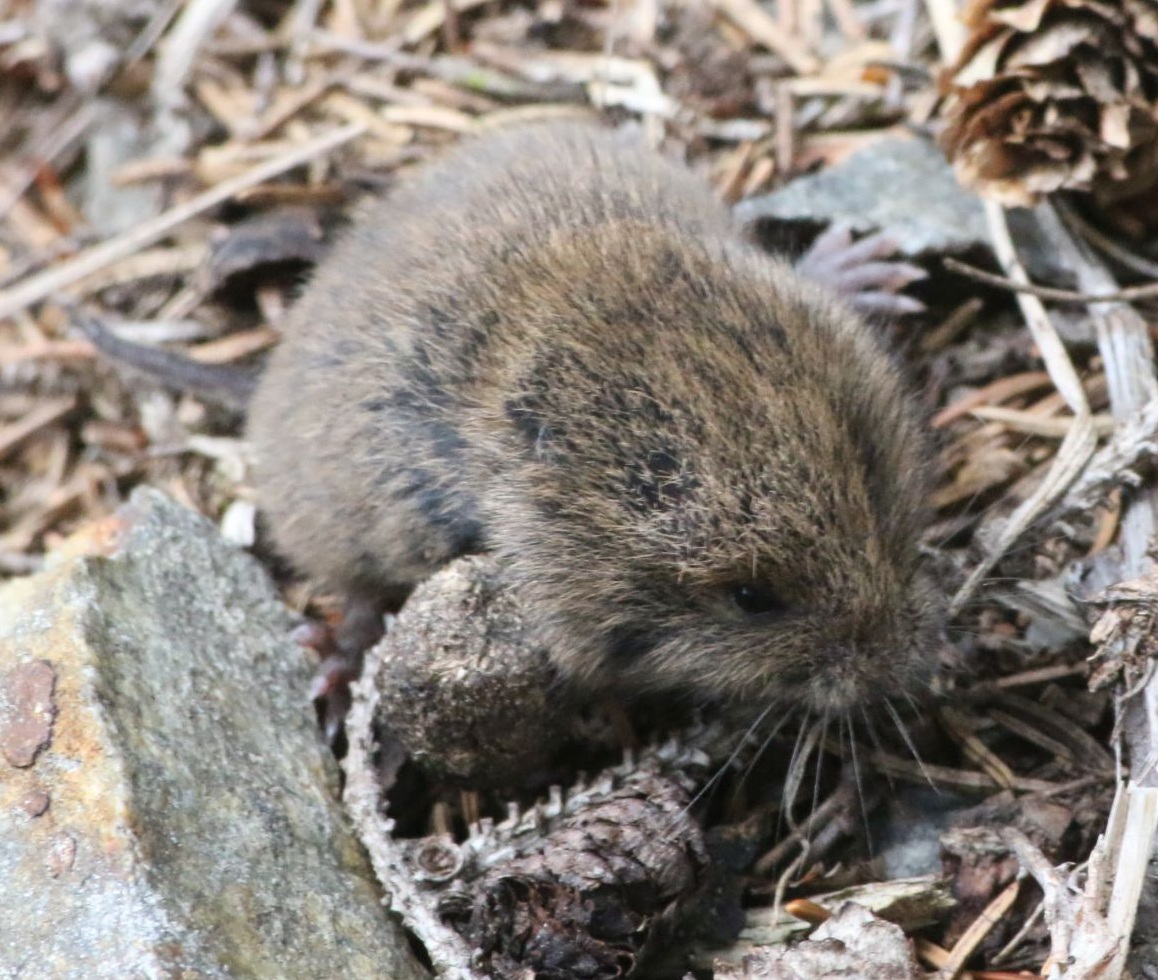
Where to see the common pine vole in the Netherlands
Rare 🦌 Mammal (land)
Where and when do you see a common pine vole? This species is rarely seen, all year round.
How do you recognise a common pine vole?
A small vole with very small eyes and a dense, soft coat that is dark brown to grey on the upperside. One detail is decisive: it has five pads under the hind foot, where all other Dutch voles have six. Head and body 75 to 110 millimetres, tail 23 to 39 millimetres, 11 to 24 grams.
What tracks does a common pine vole leave?
Print: the hind foot is 13.8 to 15.2 mm; beyond that no usable print measurements exist, and the trail cannot be separated from that of other voles. Tunnels: about 3 cm across and up to 40 cm deep in the grass or litter layer, with the first stretch running almost straight down. Droppings: 4 to 7 mm long and 2 to 3 mm thick with blunt ends, green to brown and greyish green when dried out. Feeding signs: gnaw marks 1 to 2 mm wide, grazed rushes with the white pith left standing, and plants eaten away from below.
Where do you see this species in the Netherlands?
Only in the southern Netherlands — Zeeland, North Brabant and Limburg — and locally in the Achterhoek around Winterswijk.
Habitat: Small-scale farmed landscape with a dense layer of grass or herbs and fringe vegetation such as verges and tree lines. Also arable country, deciduous woodland and gardens; coniferous woodland it seldom uses.
This is a common, widespread species: you can come across it in far more places than the areas listed below. Treat that list as a starting point rather than a full survey.
📍 Nationaal Park De Groote Peel
presence reported📍 Nationaal Park De Maasduinen
presence reported📍 Nationaal Park Zuid-Limburg (in formation)
presence reported📍 Zwin & Zeeuws-Vlaanderen
presence reported📍 Kampina & Oisterwijkse Vennen
presence reported📍 Strabrechtse Heide & Beuven
presence reportedThese links come straight from our database, with the chance, the source and the evidence level for each area.
When is the best time?
Green = present · orange = peak period. The bar is generated from our database.
Best period: Active all year; it does not hibernate.
Best time of day: By day and by night, about every three to four hours.
Recent sightings
👁️ Where has this species been seen recently?
Check the current sightings on Waarneming.nl. A useful addition to our own verified information.
How to improve your chances
- Keep the wind in your face. Most mammals will smell you long before they see you.
- Arrive before sunrise and then stay put. Sitting still beats walking about.
- Wear muted colours, skip the scent, and put your phone on silent.
- Be patient. Expect to come back more than once before it works.
🎒 What you need for this
Patience along a dense verge. It lives mainly underground and comes up only briefly.
Photography
Look for the entrances to tunnel systems along verges and tree lines. It digs down to forty centimetres and comes above ground only briefly, so a camera low at a tunnel entrance works better than searching.
🌿 Watching responsibly
Keep your distance, stay on the paths, and never lure animals with food or sound. Leave as soon as an animal becomes uneasy.
Status: Verified · Last checked: 2026-08-08