
Where to see the Spearhead Bluet in the Netherlands
Very rare 🪰 Dragonfly Sensitive species · R1
🛡️ No exact locations, on purpose
This is a sensitive species. We deliberately give no exact locations. If an area is named below, that is because the site manager publishes the species there themselves, and the source is given with it. That way we do our bit for the protection of the species. Why we do that.
Where and when do you see a Spearhead Bluet? This species is very rarely seen, from May to July.
How do you recognise a Spearhead Bluet?
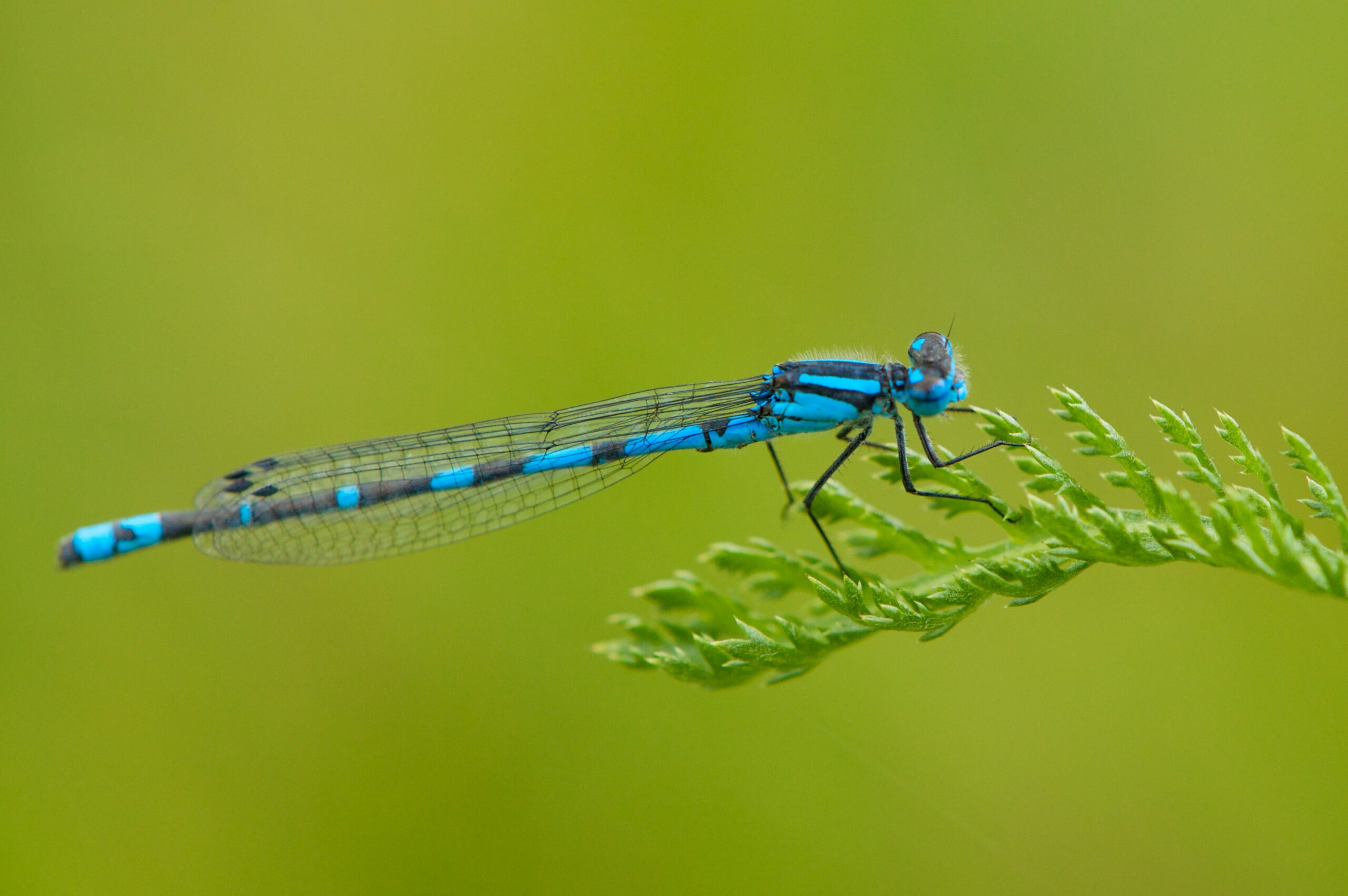
Blue damselfly of 31 to 33 millimetres with a blue thorax and an abdomen with black marking. Characteristic is the green: the lower side of the eyes is green, and often the underside of the thorax as well. On segment 2 sits a spearhead- or spade-shaped black figure that is connected to the rear margin; side dashes are usually absent. On the female the pale parts are grass-green and the rear margin of the pronotum meets in the middle in a point, in two straight lines.
Where do you see this species in the Netherlands?
The south-east of Noord-Brabant, Twente and the Achterhoek.
Habitat: Very weakly buffered moorland pools and raised bog: woodland pools, heathland pools and raised bog.
When is the best time?
Green = present · orange = peak period. The bar is generated from our database.
Best period: Early May to late July, but the main flight season is short: the second half of May and early June.
Best time of day: The sunny hours in the middle of the day.
Recent sightings
👁️ Where has this species been seen recently?
Check the current sightings on Waarneming.nl. A useful addition to our own verified information.
Current sightings on Waarneming.nl →
Note: for sensitive species the source already blurs or withholds sightings. We do not reproduce exact locations.
How to improve your chances
- Go on a warm, windless day between about ten and four, when they are active.
- Look for the place rather than the animal: flowery edges for butterflies, banks and open water for dragonflies.
- Move slowly and keep your shadow off the animal. It notices that before it notices you.
- Early in the morning they are still cold and motionless on a leaf. That is when you can get closest.
🎒 What you need for this
Binoculars with a short focusing distance. Blue damselflies are separated on the marking of segment 2, and that is only a few millimetres across.
Photography
Stay on the path around a pool. The shore zone with bog moss and encroaching vegetation is exactly where the larvae are, and that vegetation is slow to recover from being walked on.
🌿 Watching responsibly
Keep your distance, stay on the paths, and never lure animals with food or sound. Leave as soon as an animal becomes uneasy. This is a sensitive species. We deliberately give no exact locations. If an area is named below, that is because the site manager publishes the species there themselves, and the source is given with it. That way we do our bit for the protection of the species.
Status: Verified · Last checked: 2026-08-07