
Where to see the Banded Darter in the Netherlands
With luck 🪰 Dragonfly
Where and when do you see a Banded Darter? With some luck you can see this species, from June to October.
How do you recognise a Banded Darter?
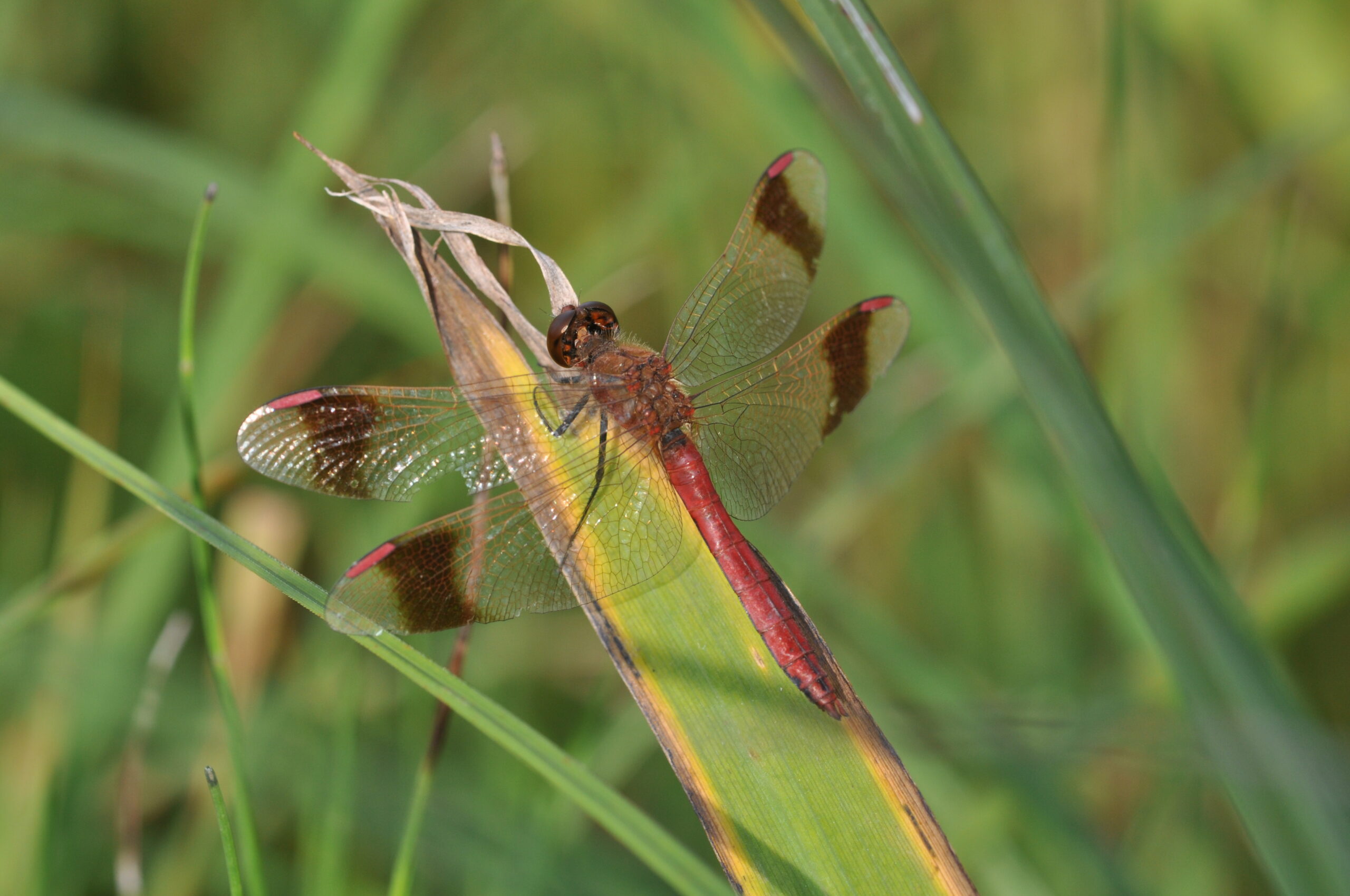
Length 28 to 35 millimetres, with entirely black legs. The decisive feature is in the wings: a dark brown crossband runs through the upper half of each wing. No other European dragonfly has that. The male has an elliptically widened abdomen and turns deep red when fully coloured, with red pterostigmas; the female has a yellow, later brownish abdomen with strikingly cream-coloured pterostigmas.
Where do you see this species in the Netherlands?
Traditionally the Kempen, central Limburg, Salland and the south of Drenthe. In recent years it has spread to the Veluwe, Zuid-Holland, Flevoland, Friesland and Groningen.
Habitat: Slow-flowing and standing waters that lie fully in the sun: small streams, ditches, seepage marshes and pools. Seepage water is almost always present and the breeding spots have a pioneer character.
This is a common, widespread species: you can come across it in far more places than the areas listed below. Treat that list as a starting point rather than a full survey.
Habitat: Slow-flowing and standing waters that lie fully in the sun: small streams, ditches, seepage marshes and pools. Seepage water is almost always present and the breeding spots have a pioneer character.
We have not yet recorded any areas for this species with enough evidence behind them, so we name the habitat type instead.
When is the best time?
Green = present · orange = peak period. The bar is generated from our database.
Best period: Mid-June to mid-October, with the flight peak from late July to early September.
Best time of day: The sunny hours in the middle of the day.
Recent sightings
👁️ Where has this species been seen recently?
Check the current sightings on Waarneming.nl. A useful addition to our own verified information.
How to improve your chances
- Go on a warm, windless day between about ten and four, when they are active.
- Look for the place rather than the animal: flowery edges for butterflies, banks and open water for dragonflies.
- Move slowly and keep your shadow off the animal. It notices that before it notices you.
- Early in the morning they are still cold and motionless on a leaf. That is when you can get closest.
🎒 What you need for this
Binoculars. The wing bands can be seen from a few metres away — for once identification is not a problem here.
Photography
Photograph it against a dark background or in backlight: the brown crossbands in the wings then come out best. Against a light, busy background they disappear.
🌿 Watching responsibly
Keep your distance, stay on the paths, and never lure animals with food or sound. Leave as soon as an animal becomes uneasy.
Status: Verified · Last checked: 2026-08-07