
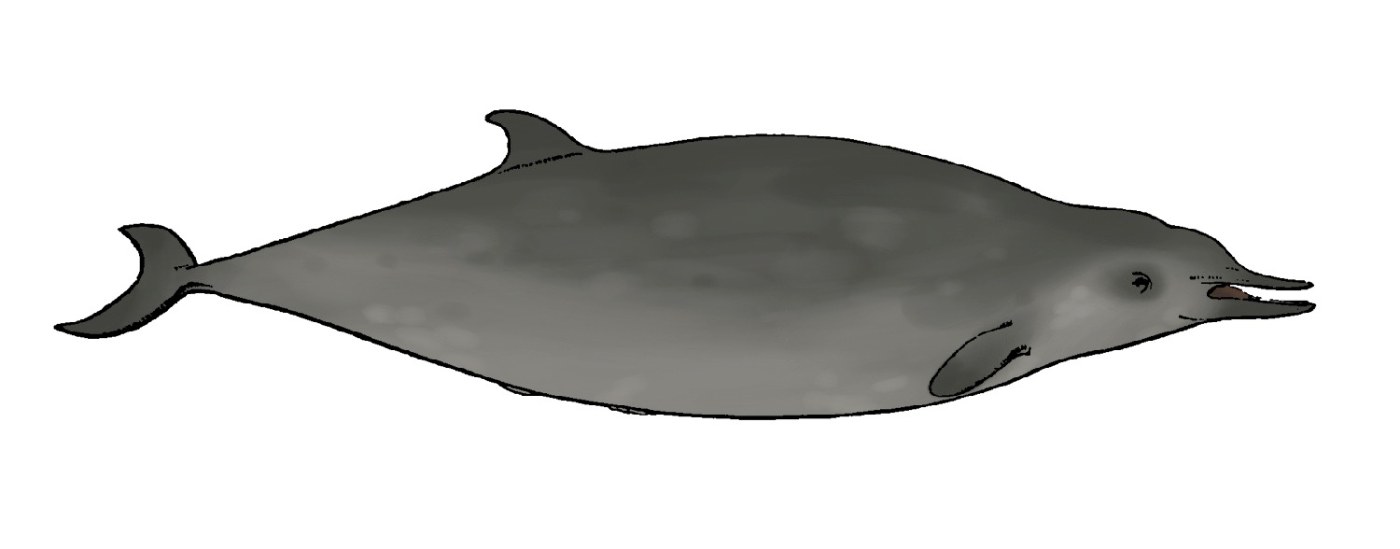
Where to see the Sowerby’s beaked whale in the Netherlands
Very rare 🦭 Marine mammal
Where and when do you see a Sowerby’s beaked whale? This species is very rarely seen, all year round.
How do you recognise a Sowerby’s beaked whale?
Sowerby's beaked whale grows to about 5 m. Adults are characterised by a very long, narrow beak. Within the genus *Mesoplodon* the position of the tusk is decisive: the more or less triangular tusk sits about a third of the way along the lower jaw, measured from the tip. We have found no Dutch-language description of the colour pattern, fin shape or blow.
What can you confuse a Sowerby’s beaked whale with?
Looks like: Northern bottlenose whale
- Northern bottlenose whale: much larger, seven to eight metres against about five, with a high bulbous forehead.
- Other beaked whales: identification goes by the position of the tusk in the lower jaw; the Netherlands also has records of Gray's beaked whale and Blainville's beaked whale.
- Dolphins: have a clear dorsal fin in the middle of the back and a much shorter beak.
Where do you see this species in the Netherlands?
The species lives in the temperate waters of the northern Atlantic and is a rare visitor to the North Sea. Stray animals sometimes reach the sea arms: several of these oceanic animals had strayed far into the Oosterschelde and Westerschelde. Of the twenty Dutch strandings up to 2015, nineteen are sufficiently documented, and all but three of the strandings fell in the months July to September.
Habitat: Deep water of the northern Atlantic. Its food is thought to consist largely of fish living close to the sea floor.
This is a common, widespread species: you can come across it in far more places than the areas listed below. Treat that list as a starting point rather than a full survey.
Habitat: Deep water of the northern Atlantic. Its food is thought to consist largely of fish living close to the sea floor.
We have not yet recorded any areas for this species with enough evidence behind them, so we name the habitat type instead.
When is the best time?
Green = present · orange = peak period. The bar is generated from our database.
Best period: The Dutch strandings fall predominantly in July to September.
Best time of day: Not applicable: there are no at-sea records of the species in the Netherlands.
Recent sightings
👁️ Where has this species been seen recently?
Check the current sightings on Waarneming.nl. A useful addition to our own verified information.
How to improve your chances
- Keep the wind in your face. Most mammals will smell you long before they see you.
- Arrive before sunrise and then stay put. Sitting still beats walking about.
- Wear muted colours, skip the scent, and put your phone on silent.
- Be patient. Expect to come back more than once before it works.
🎒 What you need for this
None — at a stranding, keep your distance and call the strandings organisation
Photography
Photograph the lower jaw from the side. With the beaked whales the position of the tusk is the identification feature, and that is exactly where things have gone wrong here before: an animal from 1927 at Loosduinen turned out afterwards to be a Gray's beaked whale.
🌿 Watching responsibly
Keep your distance, stay on the paths, and never lure animals with food or sound. Leave as soon as an animal becomes uneasy.
Status: Verified · Last checked: 2026-10-28