
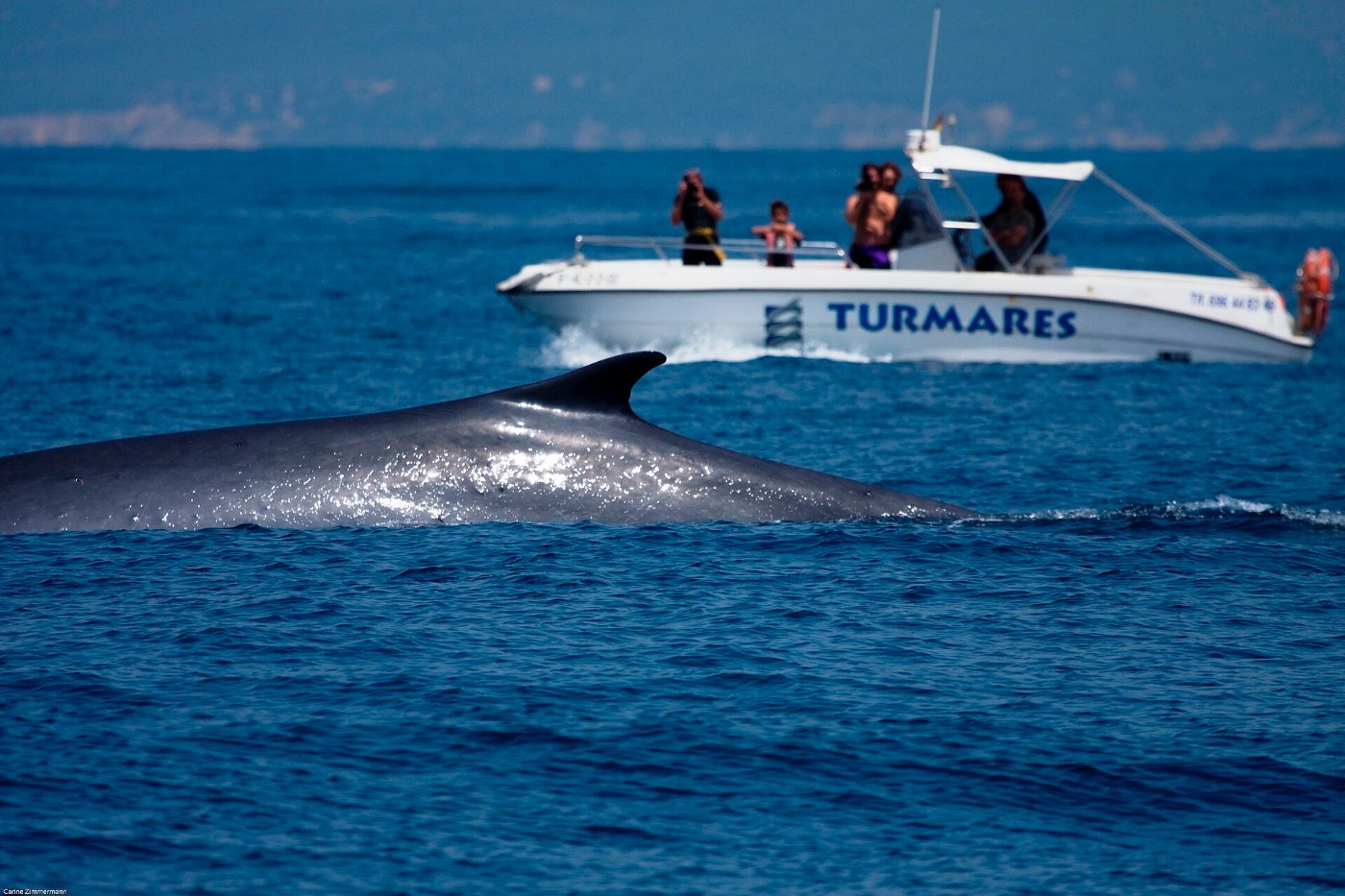
Where to see the fin whale in the Netherlands
Very rare 🦭 Marine mammal
Where and when do you see a fin whale? This species is very rarely seen, all year round.
How do you recognise a fin whale?
Up to about 24 m long, slenderly built, with a prominent, curved dorsal fin and a sharply V-shaped upper jaw. The decisive feature is in the jaw: the left lower jaw is dark-coloured, the right lower jaw white. At sea: the species can often be recognised at a great distance by its large, straight blow, and that blow is usually not visible at the same time as the dorsal fin.
What can you confuse a fin whale with?
Looks like: Humpback whale, Minke whale
- Humpback whale: knobs on head and chin, very long white pectoral fins, and shows the tail fluke when diving.
- Minke whale: much smaller, with a white band across the pectoral fin and a blow you barely see.
- Blue whale: larger still and blue-grey mottled; a Dutch find from 1840 was only recognised later as a blue whale.
Where do you see this species in the Netherlands?
In the southern North Sea and the western Baltic the species is rare; in general it lives in deep water. The Dutch records are almost all dead animals. There is, though, a recent cluster: the species is still a rare sight here, although seven dead individuals were found in the years 2011 to 2015.
Habitat: Deep water beyond the continental shelf. The shallow southern North Sea is not habitat.
This is a common, widespread species: you can come across it in far more places than the areas listed below. Treat that list as a starting point rather than a full survey.
Habitat: Deep water beyond the continental shelf. The shallow southern North Sea is not habitat.
We have not yet recorded any areas for this species with enough evidence behind them, so we name the habitat type instead.
When is the best time?
Green = present · orange = peak period. The bar is generated from our database.
Best period: The Dutch records fall between June and January: all the strandings took place between June and January and the peak, with 6 individuals, falls in August.
Best time of day: Not applicable; in the Netherlands this is almost exclusively a stranding species.
Recent sightings
👁️ Where has this species been seen recently?
Check the current sightings on Waarneming.nl. A useful addition to our own verified information.
How to improve your chances
- Keep the wind in your face. Most mammals will smell you long before they see you.
- Arrive before sunrise and then stay put. Sitting still beats walking about.
- Wear muted colours, skip the scent, and put your phone on silent.
- Be patient. Expect to come back more than once before it works.
🎒 What you need for this
Binoculars or a telescope; in practice this is not a species to go out for
Photography
If a stranded animal is lying there, photograph both sides of the lower jaw. The asymmetry — dark on the left, white on the right — is the feature that makes the identification stick, and that is exactly what often goes wrong with older finds.
🌿 Watching responsibly
Keep your distance, stay on the paths, and never lure animals with food or sound. Leave as soon as an animal becomes uneasy.
Status: Verified · Last checked: 2026-10-28