
Where to see the bottlenose dolphin in the Netherlands
Very rare 🦭 Marine mammal
Where and when do you see a bottlenose dolphin? This species is very rarely seen, all year round.
How do you recognise a bottlenose dolphin?
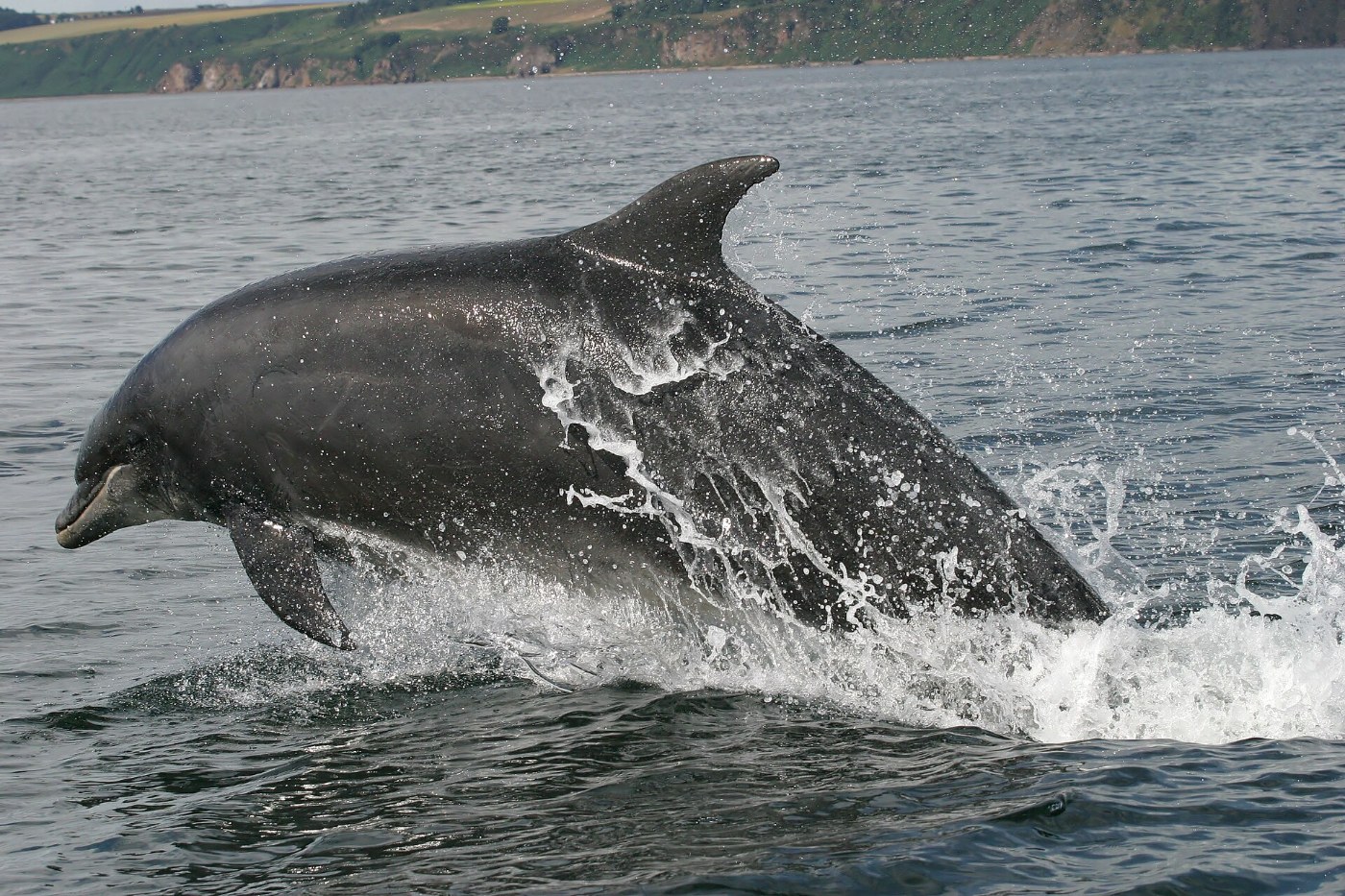
A dolphin up to almost 4 m long, mostly brownish grey in colour, with a fairly short, blunt beak and a curved fin in the middle of the back (Atlas van de Nederlandse zoogdieren). Even in colour, without the marked flank pattern of the common and striped dolphin.
What can you confuse a bottlenose dolphin with?
Looks like: Harbour porpoise, White-beaked dolphin
- Harbour porpoise: much smaller, with a short triangular dorsal fin, and rolls through the water like a "turning wheel"; the bottlenose dolphin has a tall, curved fin in the middle of the back.
- White-beaked dolphin: has a whitish grey saddle behind the dorsal fin and a pale beak; the bottlenose dolphin is an even brownish grey.
- Common dolphin: a long pointed beak and an ochre-yellow hourglass pattern on the flank, where the bottlenose dolphin has a short blunt beak and is evenly coloured.
Where do you see this species in the Netherlands?
Coastal: the bottlenose dolphin occurs mainly in shallow waters and lives close inshore, into tidal areas and river mouths. In the Netherlands it has all but disappeared. Between 1933 and 1939 J. Verwey recorded about 865 animals in the Marsdiep, in groups of 30 to 40. In 2004 a group of 50 to 100 was seen there once more. The atlas: it is still too early to speak of a return of the bottlenose dolphin to our waters.
Habitat: Shallow coastal water, tidal areas and river mouths — of all the North Sea dolphins the species that lives closest inshore.
This is a common, widespread species: you can come across it in far more places than the areas listed below. Treat that list as a starting point rather than a full survey.
Habitat: Shallow coastal water, tidal areas and river mouths — of all the North Sea dolphins the species that lives closest inshore.
We have not yet recorded any areas for this species with enough evidence behind them, so we name the habitat type instead.
When is the best time?
Green = present · orange = peak period. The bar is generated from our database.
Best period: There is no usable season left. Historically most strandings fell between May and September, with a peak in July and August, but that picture dates from 1900 to 1945, when the species was still common here.
Best time of day: By day, from a pier, dyke or ferry. A bottlenose dolphin gives itself away by the tall, curved dorsal fin of a fast-swimming animal.
Recent sightings
👁️ Where has this species been seen recently?
Check the current sightings on Waarneming.nl. A useful addition to our own verified information.
How to improve your chances
- Keep the wind in your face. Most mammals will smell you long before they see you.
- Arrive before sunrise and then stay put. Sitting still beats walking about.
- Wear muted colours, skip the scent, and put your phone on silent.
- Be patient. Expect to come back more than once before it works.
🎒 What you need for this
Binoculars; a telephoto lens if you want to capture the dorsal fin
Photography
Photograph the beak and the dorsal fin, not the leap. A short blunt beak and a curved fin in the middle of the back separate the bottlenose dolphin from everything else that swims here.
🌿 Watching responsibly
Keep your distance, stay on the paths, and never lure animals with food or sound. Leave as soon as an animal becomes uneasy.
Status: Verified · Last checked: 2026-10-28