
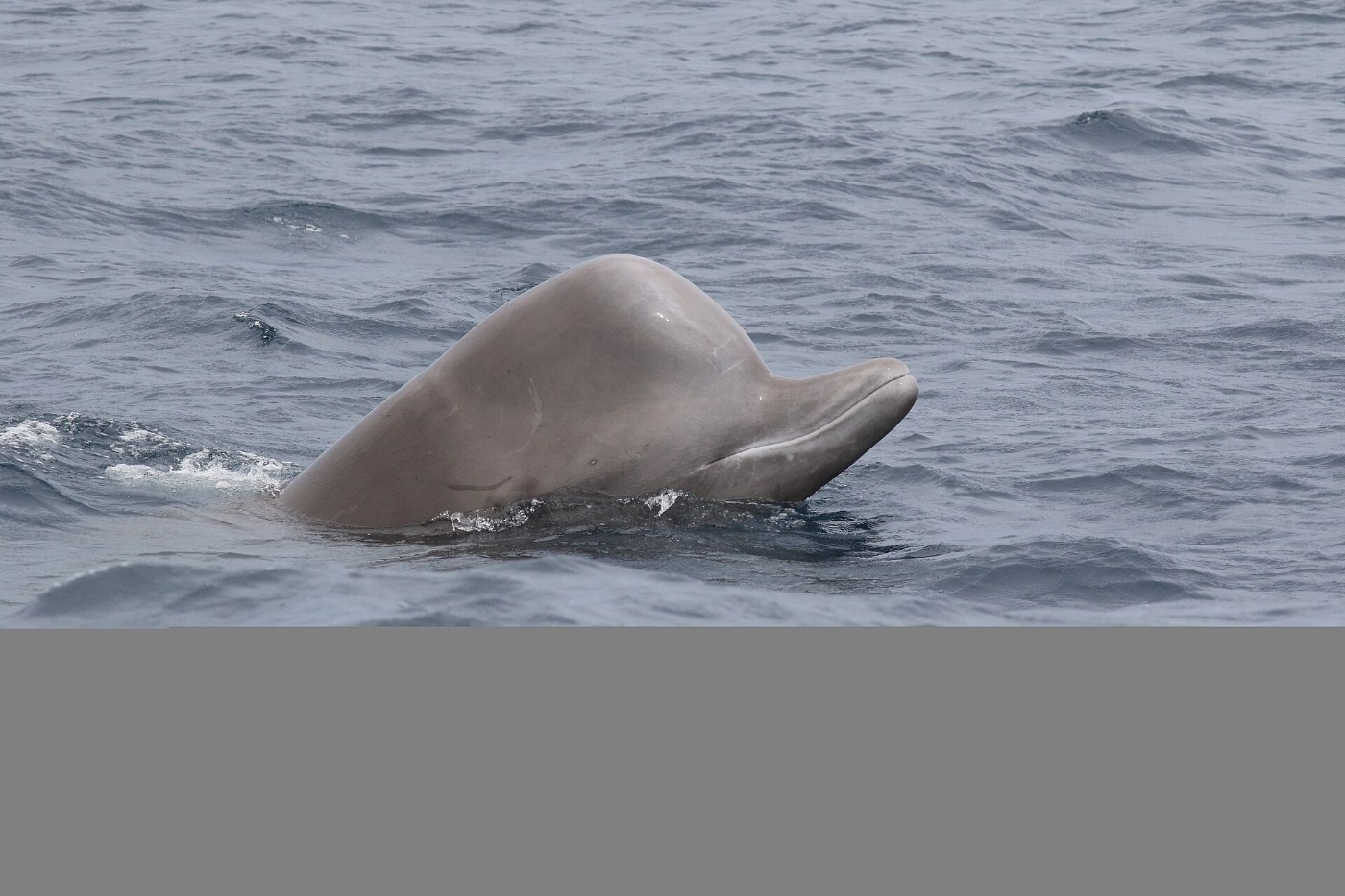
Where to see the northern bottlenose whale in the Netherlands
Very rare 🦭 Marine mammal
Where and when do you see a northern bottlenose whale? This species is very rarely seen, all year round.
How do you recognise a northern bottlenose whale?
A hefty beaked whale with a high, bulbous forehead above a short beak. The two animals that stranded in Zeeland in 2020 were two adult females of about seven and eight metres. In the Netherlands that size is the practical distinction from Sowerby's beaked whale, which grows to about five metres. We have not been able to find a Dutch-language description of the colour, the fin shape or the blow, so that is not given here.
What can you confuse a northern bottlenose whale with?
Looks like: Sowerby’s beaked whale, Sperm whale, Long-finned pilot whale
- Sowerby's beaked whale: the other beaked whale on the Dutch list, but at about five metres clearly smaller than the seven to eight metres of a bottlenose whale.
- Sperm whale: much larger, with a block-shaped head instead of a bulbous forehead, and a blow angled forwards.
- Long-finned pilot whale: also a bulbous head, but entirely black and with a low, broad dorsal fin.
Where do you see this species in the Netherlands?
A deep-sea species that ends up here by straying. The sequence in 2020 shows the route: the animals were first reported alive in the Oosterschelde (20 to 23 August), then on the Westerschelde (6 September), and on 7 and 8 September they were found dead near Terneuzen and Borssele. Dutch records fall strikingly often in August to November.
Habitat: Very deep water. The animals also live in very deep water, where they hunt squid at great depth — and by great depth read 500 to 2,000 metres.
This is a common, widespread species: you can come across it in far more places than the areas listed below. Treat that list as a starting point rather than a full survey.
Habitat: Very deep water. The animals also live in very deep water, where they hunt squid at great depth — and by great depth read 500 to 2,000 metres.
We have not yet recorded any areas for this species with enough evidence behind them, so we name the habitat type instead.
When is the best time?
Green = present · orange = peak period. The bar is generated from our database.
Best period: The Dutch records fall strikingly often in August to November, but the number is too small for a real pattern.
Best time of day: Not applicable: this is a species you only encounter in the Netherlands as a stray or a stranding.
Recent sightings
👁️ Where has this species been seen recently?
Check the current sightings on Waarneming.nl. A useful addition to our own verified information.
How to improve your chances
- Keep the wind in your face. Most mammals will smell you long before they see you.
- Arrive before sunrise and then stay put. Sitting still beats walking about.
- Wear muted colours, skip the scent, and put your phone on silent.
- Be patient. Expect to come back more than once before it works.
🎒 What you need for this
None — with a live or dead animal the rule is: keep your distance and call the strandings organisation
Photography
If you see a large whale with a bulbous forehead in a sea arm, photograph the head from the side and call at once. With the bottlenose whales of 2020 the reports from the Oosterschelde were the start of a sequence that ended two weeks later in death; a quick report matters more here than a fine photo.
🌿 Watching responsibly
Keep your distance, stay on the paths, and never lure animals with food or sound. Leave as soon as an animal becomes uneasy.
Status: Verified · Last checked: 2026-10-28