
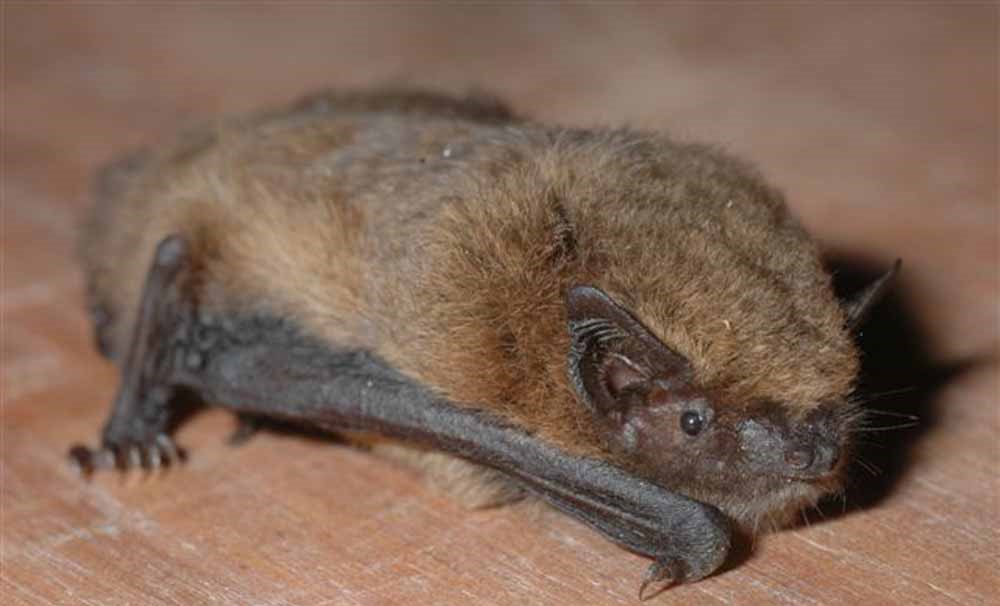
Where to see the soprano pipistrelle in the Netherlands
Rare 🦇 Mammal (bat) Sensitive species · R2
🛡️ No exact locations, on purpose
This is a sensitive species. We deliberately show no resting places such as setts, burrows or winter roosts, and no photographs in which such a place is recognisable. Why we do that.
Where and when do you see a soprano pipistrelle? This species is rarely seen, from April to October.
How do you recognise a soprano pipistrelle?
Small bat: head and body about 48 millimetres, 4 to 7 grams, wingspan 19 to 23 centimetres and a forearm of 28 to 32 millimetres. The back is brown, often with a red-orange glow, the belly paler. Muzzle and ear bases are fairly light brown, where on the common pipistrelle they are darker. Soprano pipistrelles often have a ridge between the nostrils, which the common and Nathusius' pipistrelles usually lack.
What can you confuse a soprano pipistrelle with?
Looks like: Common pipistrelle, Nathusius' pipistrelle
- Common pipistrelle: Darker-furred, with a dark muzzle and a dark area around the eye; the soprano pipistrelle by contrast has a strikingly short, pale muzzle, pale ears and a lighter coat. Beyond that the two are barely separable in the field without a bat detector — the peak frequency of the sonar is more reliable than appearance.
- Nathusius' pipistrelle: Nathusius' pipistrelle is larger, with a longer, shaggier coat and broader wings.
What does a soprano pipistrelle sound like?
Recording: Keoka, CC BY 3.0, via Wikimedia Commons
What tracks does a soprano pipistrelle leave?
Droppings: up to a good 2 mm across, 5 to 10 mm long. In practice this is the only sign a bat leaves behind, and they cannot be identified to species: Zodion calls bat droppings very hard to put a name to. Because bats eat nothing but insects, the droppings consist entirely of insect remains and not of plant material, and that is how you tell them from mouse droppings of the same size. Anyone who wants to know which species is flying gets further with sound than with signs.
Where do you see this species in the Netherlands?
Rare. The first Dutch record dates from 2007 and only two roosts have been established, in 2011 and 2020.
Habitat: Wetland areas such as river valleys and marshes, and damp, wooded country. It hunts along woodland edges and hedgerows.
We have not yet recorded any areas for this species with enough evidence behind them, so we name the habitat type instead.
When is the best time?
Green = present · orange = peak period. The bar is generated from our database.
Best period: April to October; in winter it hibernates.
Best time of day: A good half hour after sunset.
Recent sightings
👁️ Where has this species been seen recently?
Check the current sightings on Waarneming.nl. A useful addition to our own verified information.
Current sightings on Waarneming.nl →
Note: for sensitive species the source already blurs or withholds sightings. We do not reproduce exact locations.
How to improve your chances
- Keep the wind in your face. Most mammals will smell you long before they see you.
- Arrive before sunrise and then stay put. Sitting still beats walking about.
- Wear muted colours, skip the scent, and put your phone on silent.
- Be patient. Expect to come back more than once before it works.
🎒 What you need for this
Bat detector. This is the only practical way to tell it from the common pipistrelle.
Photography
There is little point in photographing this one: it is a species you hear rather than see. Set your detector to 55 kHz and listen along a woodland edge by the water, half an hour after sunset.
🌿 Watching responsibly
Keep your distance, stay on the paths, and never lure animals with food or sound. Leave as soon as an animal becomes uneasy. This is a sensitive species. We deliberately show no resting places such as setts, burrows or winter roosts, and no photographs in which such a place is recognisable.
Status: Verified · Last checked: 2026-10-20