
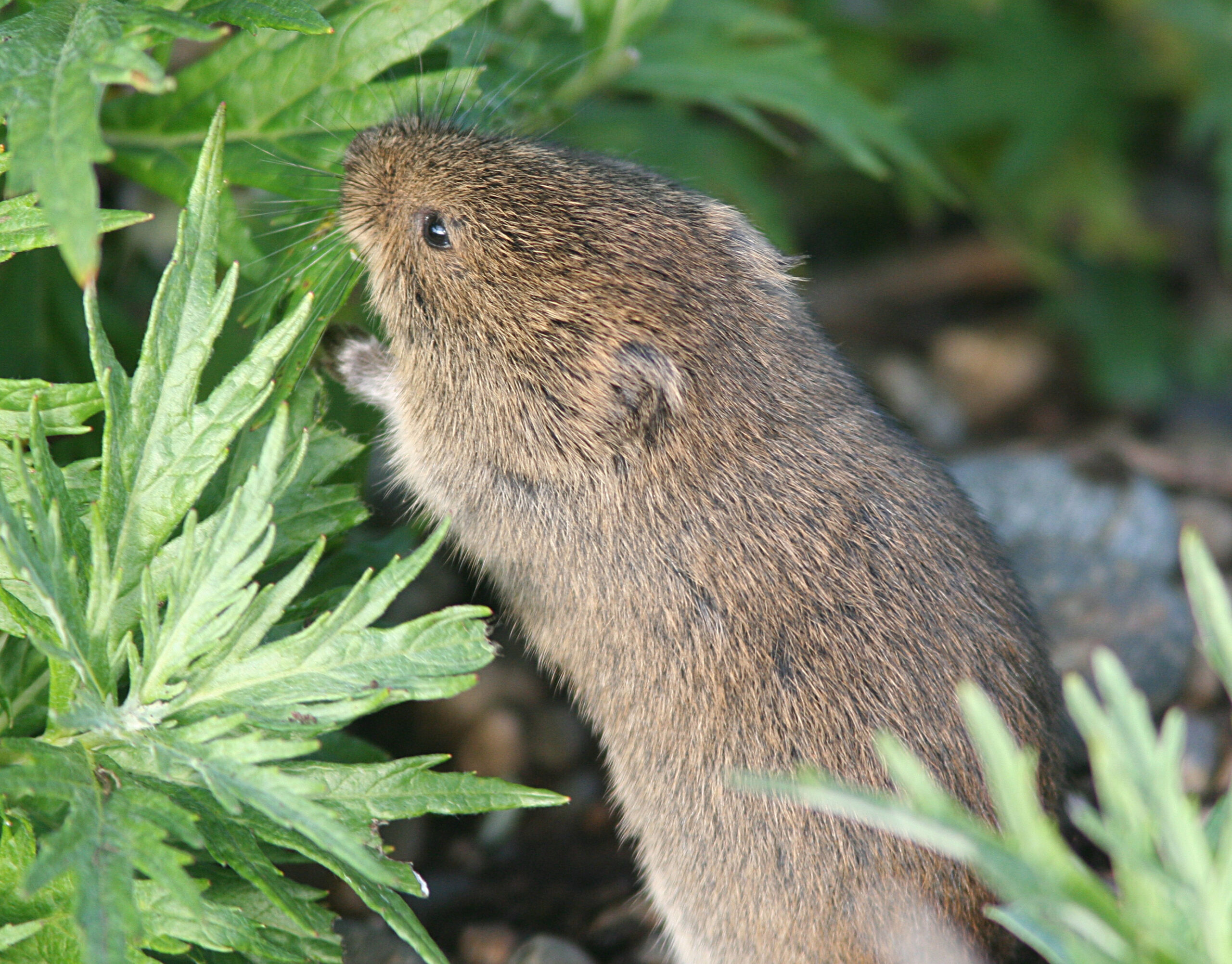
Where to see the root vole in the Netherlands
Rare 🦫 Mammal (land/water)
Where and when do you see a root vole? This species is rarely seen, all year round.
How do you recognise a root vole?
A relatively large vole with a broad head, small eyes and ears and a relatively long tail — about forty per cent of the head and body length. The coat is dark brown on the back and dark grey on the belly and looks glossy. Striking are the fairly large, dark-coloured hind feet with contrasting white claws. Head and body 95 to 161 millimetres, tail 24 to 77 millimetres, 15 to 65 grams.
What tracks does a root vole leave?
Print: this species cannot be established from the footprint alone. Zodion is firm about that: the prints look too much like those of other voles. What you do find: tunnels 4 to 5 cm across with earth heaps of 10 to 20 cm beside them, and in the tunnels and store chambers remains of herbs and grasses. Feeding signs: stems of rushes gnawed down to sticks the size of a match, as with the Field vole. Droppings: small and cylindrical with blunt ends, bright to dark green after green plant parts and heather brown after bark and roots, greyish green when dried out.
Where do you see this species in the Netherlands?
Five separate areas: Texel, Friesland, North Holland above the North Sea Canal, the Utrecht and Holland peat meadow district and the Delta area in Zeeland, South Holland and Brabant.
Habitat: Tall vegetation with mainly grass-like plants: reedbed, marsh, boggy hay meadows, damp dune slacks and periodically flooded areas.
This is a common, widespread species: you can come across it in far more places than the areas listed below. Treat that list as a starting point rather than a full survey.
📍 Nationaal Park Duinen van Texel
presence reportedThese links come straight from our database, with the chance, the source and the evidence level for each area.
When is the best time?
Green = present · orange = peak period. The bar is generated from our database.
Best period: Active all year; breeding runs from April to October.
Best time of day: In summer at night, in winter more by day.
Recent sightings
👁️ Where has this species been seen recently?
Check the current sightings on Waarneming.nl. A useful addition to our own verified information.
How to improve your chances
- Keep the wind in your face. Most mammals will smell you long before they see you.
- Arrive before sunrise and then stay put. Sitting still beats walking about.
- Wear muted colours, skip the scent, and put your phone on silent.
- Be patient. Expect to come back more than once before it works.
🎒 What you need for this
Binoculars. Watch for the small mole-like heaps of ten to twenty centimetres across that it makes while digging.
Photography
Look along the edge of a reedbed or a boggy hay meadow and watch for movement in the vegetation. It is an excellent swimmer and even dives, so a photo in the water is not unthinkable.
🌿 Watching responsibly
Keep your distance, stay on the paths, and never lure animals with food or sound. Leave as soon as an animal becomes uneasy.
Status: Verified · Last checked: 2026-08-08