
Where to see the Rock Dove in the Netherlands
Easy 🦅 Bird
Where and when do you see a Rock Dove? This species is easy to see, all year round.
How do you recognise a Rock Dove?
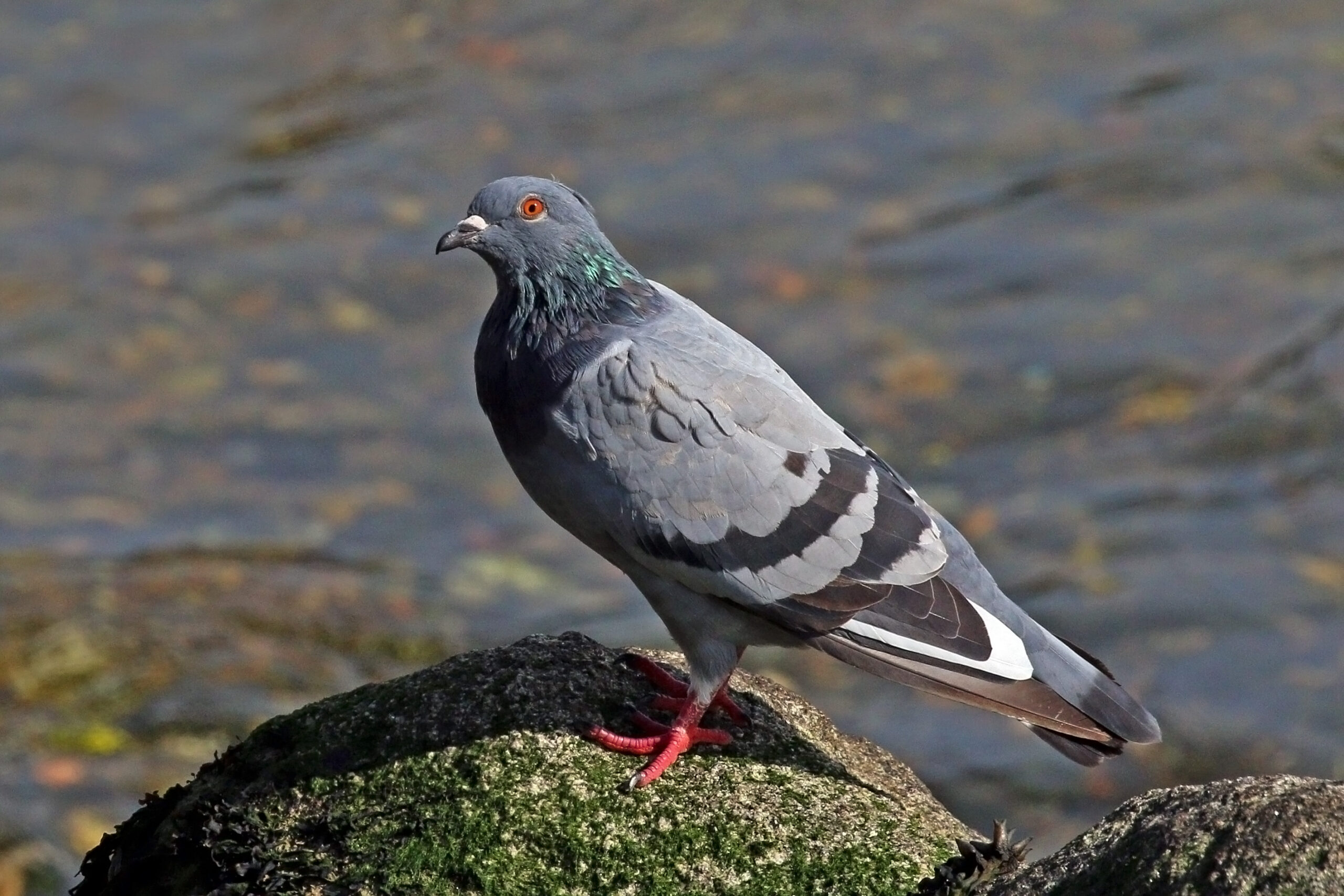
A pigeon of 30 to 35 cm. The original rock dove plumage is blue-grey with two black wing bars, a white rump and a green-purple gloss on the neck. In the feral form the plumage varies enormously: some birds look almost exactly like the wild ancestor, others are entirely white, black, reddish brown or a glossy grey-green. The sound is a very low, rhythmic cooing somewhat like that of the Stock Dove.
Wingspan: 69 cm an indication from Wikidata; it varies by individual, sex and subspecies · compare all birds (in Dutch)
What does a Rock Dove sound like?
Recording: Marie-Lan Taÿ Pamart, CC BY-SA 4.0, via Wikimedia Commons
Where do you see this species in the Netherlands?
The wild rock dove does not occur in the Netherlands. What you see here are feral domestic pigeons, descendants of domesticated rock doves and escaped racing pigeons. Of those, 9,000 to 18,000 pairs breed (2018 to 2020), with 25,000 to 75,000 wintering.
Habitat: Originally rocky coasts and cliffs; in the Netherlands buildings, which serve the same purpose. It breeds on window ledges, in attics, on balconies and under viaducts, with a preference for dark places. It forages up to a few kilometres outside the city. It prefers seeds, supplemented in town with litter such as bread and chips.
This is a common, widespread species: you can come across it in far more places than the areas listed below. Treat that list as a starting point rather than a full survey.
Habitat: Originally rocky coasts and cliffs; in the Netherlands buildings, which serve the same purpose. It breeds on window ledges, in attics, on balconies and under viaducts, with a preference for dark places. It forages up to a few kilometres outside the city. It prefers seeds, supplemented in town with litter such as bread and chips.
We have not yet recorded any areas for this species with enough evidence behind them, so we name the habitat type instead.
When is the best time?
Green = present · orange = peak period. The bar is generated from our database.
Best period: A resident, present all year. It breeds almost year-round, with two to four clutches a year.
Best time of day: All year and all day; more interesting is looking for birds with a pure original plumage.
Recent sightings
👁️ Where has this species been seen recently?
Check the current sightings on Waarneming.nl. A useful addition to our own verified information.
How to improve your chances
- Learn the calls first. You will hear most birds before you see them.
- Go in the first hour after sunrise, when the song is at its peak and the wind is still down.
- Use a hide or natural cover. Sitting still gets you more than walking closer.
- Keep the sun behind you. Against the light you see a silhouette and no colour.
🎒 What you need for this
Nothing special. For a good photo a short telephoto lens and a town square with nice light are enough.
Photography
In a large flock of town pigeons, look for the individuals with the pure rock dove plumage: blue-grey, two sharp black wing bars, a white rump. Photograph with side light so that the green-purple neck gloss lights up. There is no need to flush a flock for an action shot; they take off by themselves.
🌿 Watching responsibly
Keep your distance, stay on the paths, and never lure animals with food or sound. Leave as soon as an animal becomes uneasy.
Status: Verified · Last checked: 2026-08-08