
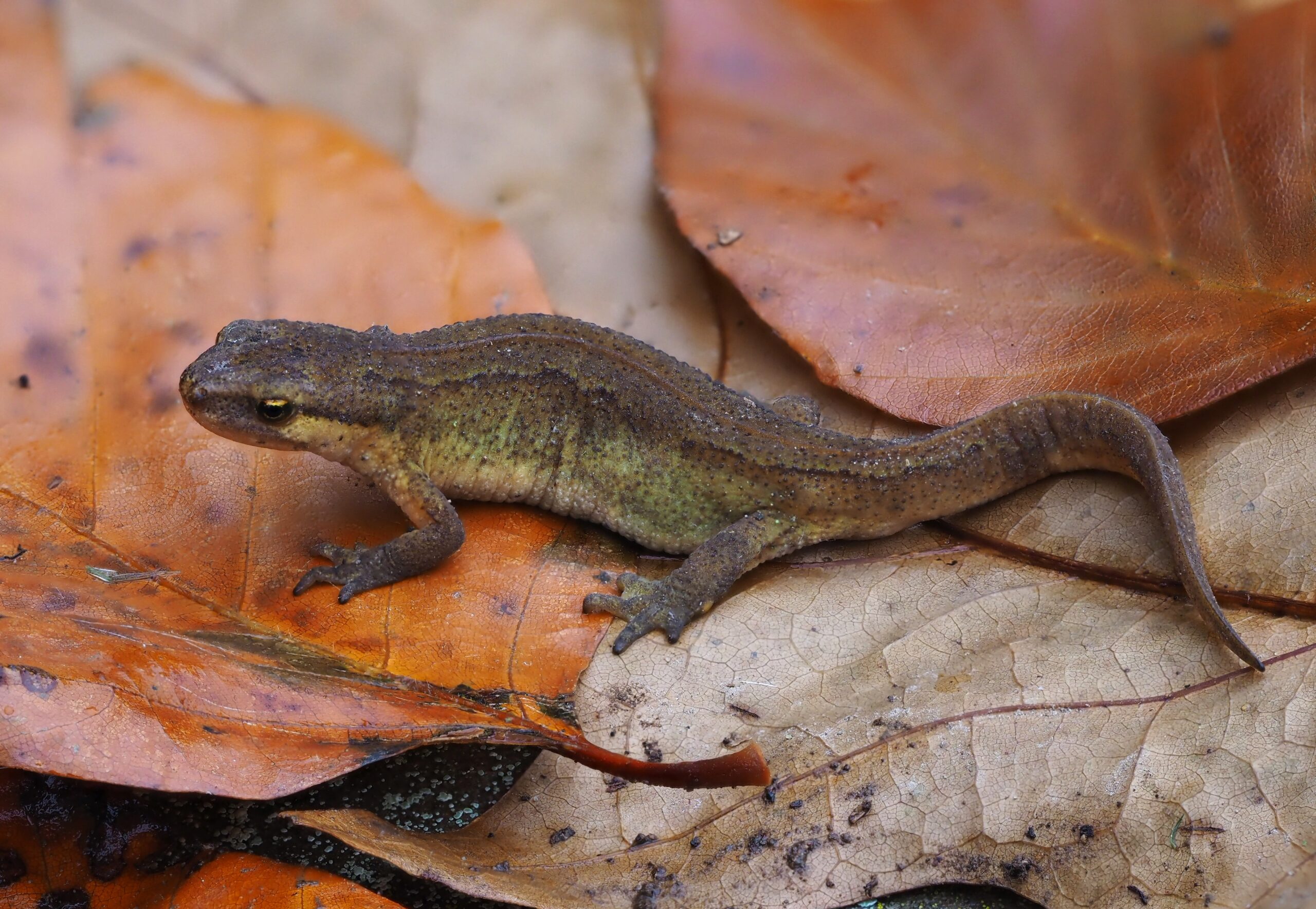
Where to see the palmate newt in the Netherlands
With luck 🐸 Amphibian
Where and when do you see a palmate newt? With some luck you can see this species, from March to July.
How do you recognise a palmate newt?
A small newt of at most 9 centimetres. In the breeding season the male has black webs between the toes of the hind feet, a thread-like tail tip and a ridge along the transition from back to flank. Females are dark brown to olive with paler flanks, dark spots and a pale belly with an orange-yellow central stripe.
Where do you see this species in the Netherlands?
Naturally only in North Brabant and Limburg: about sixty per cent of the occupied kilometre squares lie in North Brabant, forty per cent in Limburg. The strongholds are in West Brabant and around the Meinweg.
📍 Nationaal Park De Meinweg
With luck presence reported📍 Nationaal Park Zuid-Limburg (in formation)
presence reported📍 Nationaal Park De Maasduinen
presence reported📍 Kampina & Oisterwijkse Vennen
presence reported📍 De Maashorst
presence reportedThese links come straight from our database, with the chance, the source and the evidence level for each area.
When is the best time?
Green = present · orange = peak period. The bar is generated from our database.
Best period: Mid-April to mid-June is the breeding season; the animals are then in the water and the males carry their webbed feet.
Best time of day: Late afternoon to dusk.
Recent sightings
👁️ Where has this species been seen recently?
Check the current sightings on Waarneming.nl. A useful addition to our own verified information.
How to improve your chances
- Go after dark in mild, wet weather, when amphibians are at their most active.
- Follow the chorus. In spring you can hear the calling males from a long way off.
- Shine your torch along the bank rather than into it, and keep the light brief.
- Stay on the bank and touch nothing. Amphibian skin is sensitive to whatever is on your hands.
🎒 What you need for this
Polarising sunglasses to see through the water surface, and a torch for dusk. You do not need a dip net, and without a permit you are not allowed to use one either.
Photography
Photograph from the bank through the water surface, with a polarising filter. The webbed feet and the tail thread of the male are the distinguishing detail — aim for those.
🌿 Watching responsibly
Keep your distance, stay on the paths, and never lure animals with food or sound. Leave as soon as an animal becomes uneasy.
Status: Verified · Last checked: 2026-08-07
More photos
