
Where to see the ide in the Netherlands
With luck 🐟 Fish
Where and when do you see an ide? With some luck you can see this species, all year round.
How do you recognise an ide?
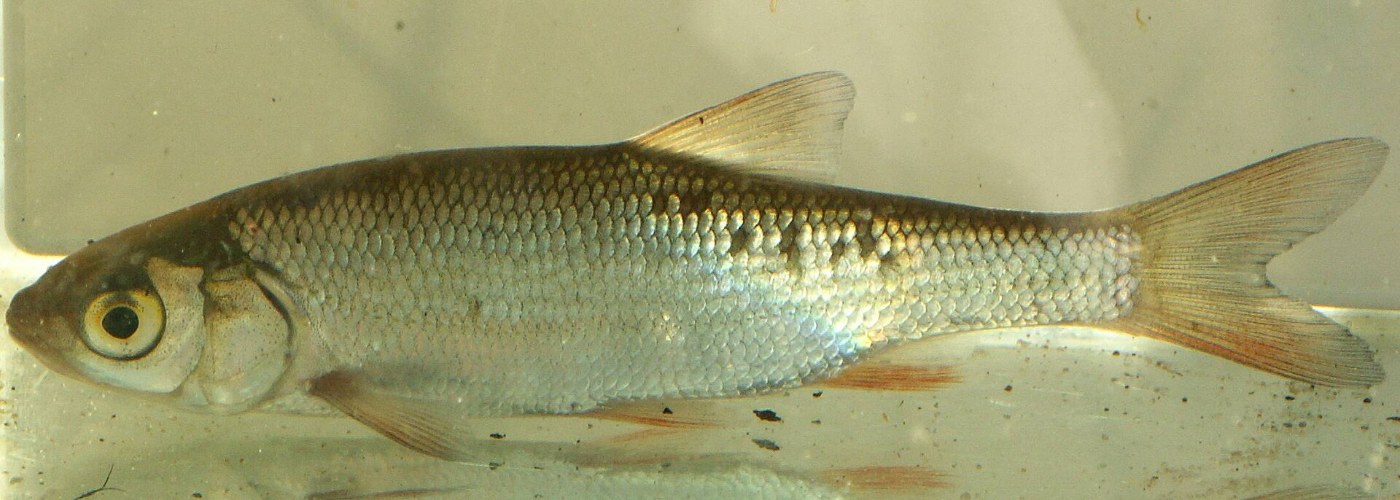
An elongated, laterally flattened body with silver flanks and a relatively small terminal mouth; older fish turn dark grey to greenish brown, with reddish breast, belly and anal fins. RAVON gives about 70 centimetres as the maximum, Sportvisserij Nederland around 80 — the sources do not agree here.
What can you confuse an ide with?
Looks like: Common roach, Chub, Common dace, Common nase
- Common roach: the distinction goes by the number of scales on the lateral line — ide 55 to 61, roach 39 to 48.
- Chub: has a convex anal fin, where the ide's is straight to slightly concave, and much larger scales.
- Common dace and Common nase: have an underslung mouth; the nase also has a fleshy snout.
- Roofblei: a large upturned mouth with a pointed lower jaw.
Where do you see this species in the Netherlands?
Fairly common in the large rivers and the waters connected to them. In the Dutch lower reaches the ide can make up a large part of the biomass in the bankside zone; further upstream the chub takes its place.
📍 Grevelingenmeer
presence reported📍 IJssel-uiterwaarden
presence reported📍 Haringvliet & Hollands Diep
presence reported📍 Gelderse Poort & Millingerwaard
presence reported📍 Nationaal Park De Biesbosch
presence reported📍 Blauwe Kamer
presence reported📍 Zouweboezem
presence reported📍 Ilperveld
presence reported📍 Haringvlietsluizen
presence reportedThese links come straight from our database, with the chance, the source and the evidence level for each area.
When is the best time?
Green = present · orange = peak period. The bar is generated from our database.
Best period: The spawning run goes from March to May. The fish then move to flowing bankside zones and, at high water, to flooded floodplain grassland — covering more than a hundred kilometres to get there.
Best time of day: By day, from a quay or a bridge over flowing water.
Recent sightings
👁️ Where has this species been seen recently?
Check the current sightings on Waarneming.nl. A useful addition to our own verified information.
How to improve your chances
- Look for clear, shallow water and watch from a bridge, a jetty or a high bank.
- Polarising sunglasses take the reflection off the surface and show you what is swimming underneath.
- Stay low and move slowly. Fish are very good at seeing movement above the water.
- Early morning gives the calmest water and the best visibility.
🎒 What you need for this
Polarising glasses; watching from a bridge or quay over the river
Photography
Photograph the anal fin from the side. Straight to slightly concave means ide, convex means chub — and with these two that is the only feature that works from a distance.
🌿 Watching responsibly
Keep your distance, stay on the paths, and never lure animals with food or sound. Leave as soon as an animal becomes uneasy.
Status: Verified · Last checked: 2026-10-28