
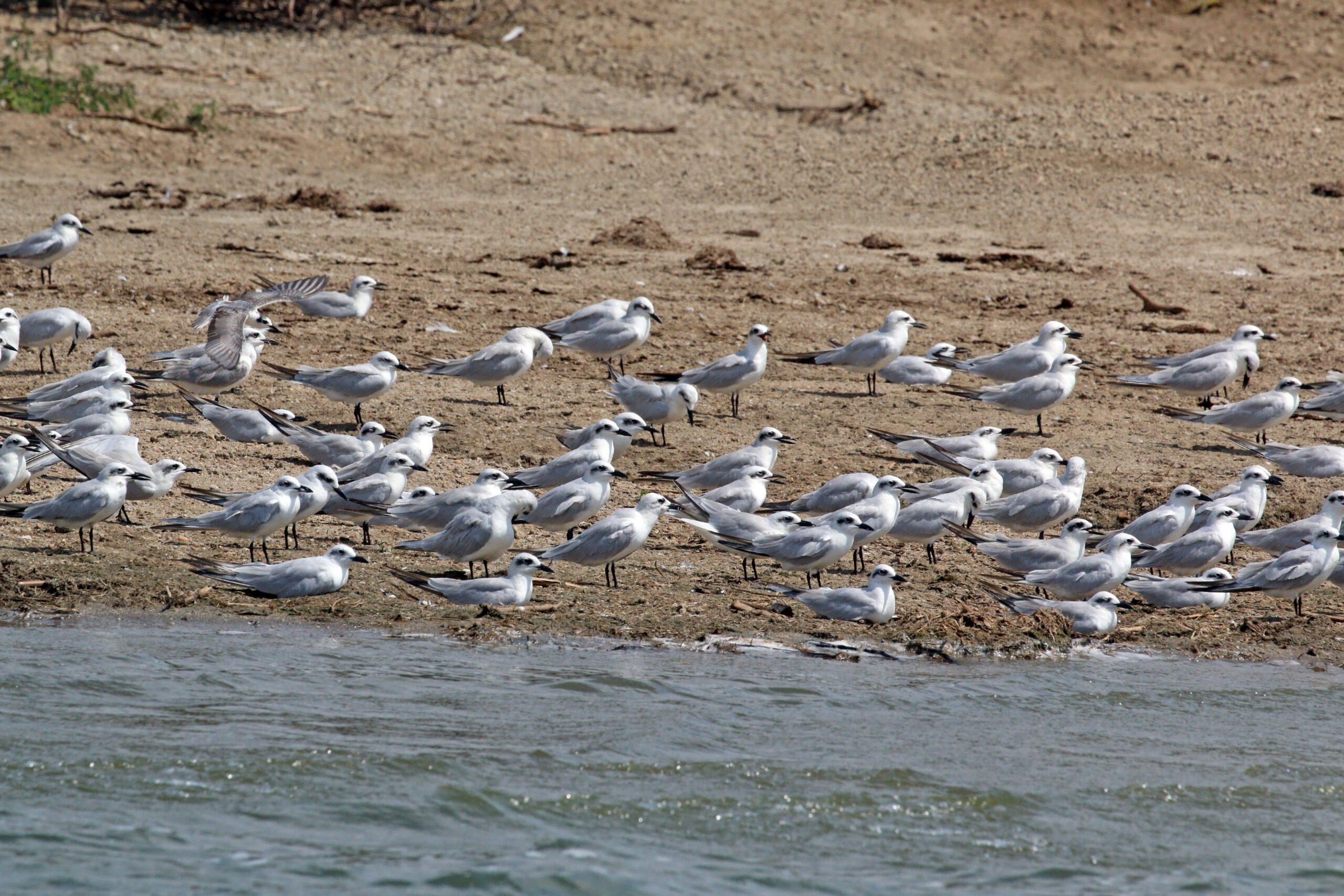
Where to see the Gull-billed Tern in the Netherlands
Rare 🦅 Bird Sensitive species · R3
🛡️ No exact locations, on purpose
This is a sensitive species. We deliberately show no nest sites, and during the breeding season (March to July) we are extra careful about exact spots. Why we do that.
Where and when do you see a Gull-billed Tern? This species is rarely seen, from May to September.
How do you recognise a Gull-billed Tern?
A sturdy tern of 33 to 43 cm with a wingspan of 85 to 103 cm. The best feature is the thick, entirely black bill with no yellow tip — heavier and shorter than on any other white tern. The upperparts are pale grey, including the rump; Sandwich Terns are white there. The underparts are white and in flight the dark outer primaries stand out. In summer plumage a black cap, in winter plumage only a black ear patch. The flight is slow and gull-like.
What does a Gull-billed Tern sound like?
Recording: Joost van Bruggen, CC BY-SA 4.0, via Wikimedia Commons
Where do you see this species in the Netherlands?
Gone as a breeding bird since 1958, with one unexpected nesting attempt in 2005. Now a rare to scarce passage migrant with 17 to 50 birds in July and August.
📍 Onlanden & Leekstermeer
Very rare chance per sourceThese links come straight from our database, with the chance, the source and the evidence level for each area.
When is the best time?
Green = present · orange = peak period. The bar is generated from our database.
Best period: Most records fall in July and August; breeding takes place in Europe in May and June.
Best time of day: The afternoon, when insects are active and the bird hunts low over grassland.
Recent sightings
👁️ Where has this species been seen recently?
Check the current sightings on Waarneming.nl. A useful addition to our own verified information.
Current sightings on Waarneming.nl →
Note: for sensitive species the source already blurs or withholds sightings. We do not reproduce exact locations.
How to improve your chances
- Learn the calls first. You will hear most birds before you see them.
- Go in the first hour after sunrise, when the song is at its peak and the wind is still down.
- Use a hide or natural cover. Sitting still gets you more than walking closer.
- Keep the sun behind you. Against the light you see a silhouette and no colour.
🎒 What you need for this
Binoculars and a telescope. Watch the flight above all: a tern hunting over a meadow instead of over water is almost always this species.
Photography
Photograph over grassland or a flooded field, not over the sea. The slow, gull-like flight is a gift for flight photos: you have far more time than with a Common Tern. Work at 1/1600 or shorter and follow the bird from the edge of the field onwards.
🌿 Watching responsibly
Keep your distance, stay on the paths, and never lure animals with food or sound. Leave as soon as an animal becomes uneasy. This is a sensitive species. We deliberately show no nest sites, and during the breeding season (March to July) we are extra careful about exact spots.
Status: Verified · Last checked: 2026-08-08