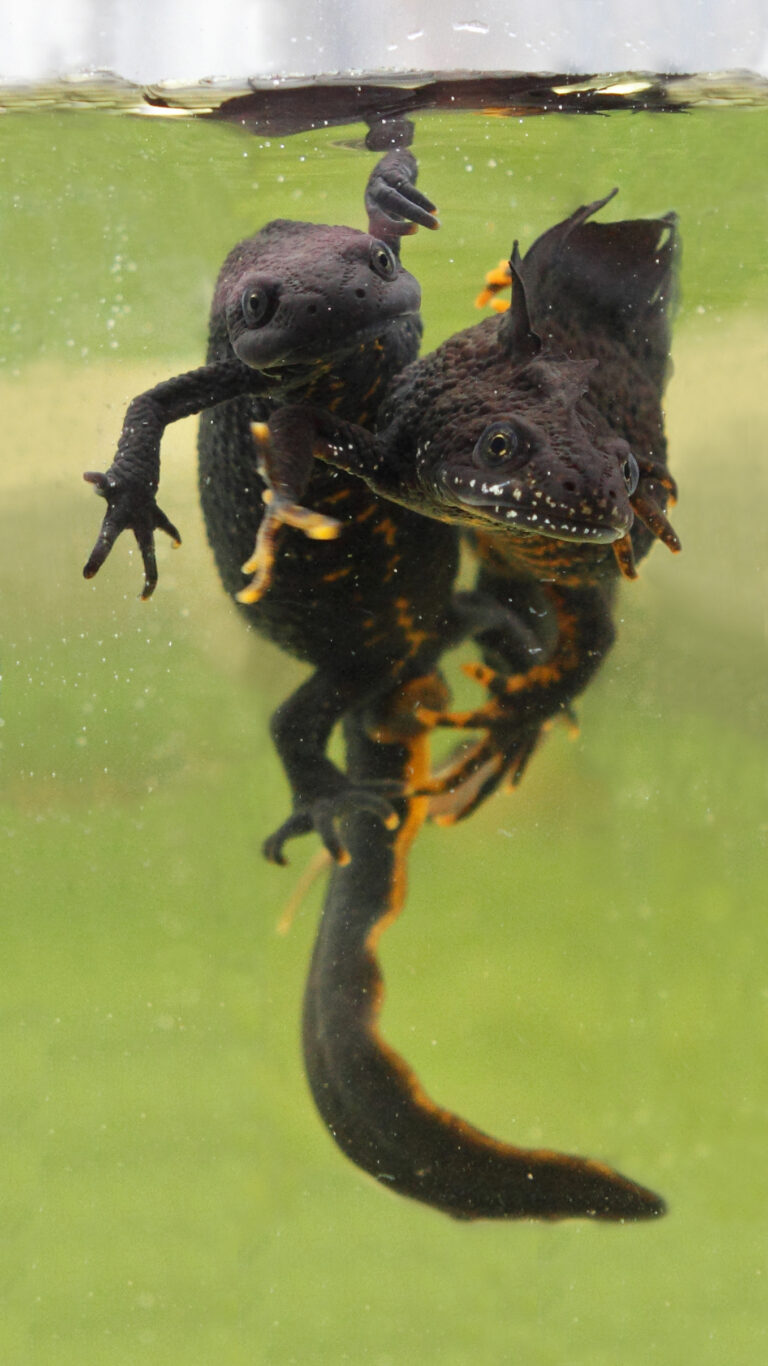
Where to see the great crested newt in the Netherlands
Rare 🐸 Amphibian Sensitive species · R1
🛡️ No exact locations, on purpose
This is a sensitive species. We deliberately give no exact locations. If an area is named below, that is because the site manager publishes the species there themselves, and the source is given with it. That way we do our bit for the protection of the species. Why we do that.
Where and when do you see a great crested newt? This species is rarely seen, from March to June.
How do you recognise a great crested newt?
Our largest water newt, up to sixteen centimetres, dark with a finely granular skin and a bright orange belly with black blotches. In spring the male carries a tall, jagged crest along its back and a silver stripe on the tail — one of the most striking sights in Dutch pools.
Where do you see this species in the Netherlands?
Pools and small waters in the east and south of the country. We deliberately name only the region: the species is vulnerable and the data are supplied blurred.
Habitat: Sunny, fish-free pools with plenty of water plants, surrounded by woodland, hedgerows or rough vegetation where the animals spend the rest of the year on land.
When is the best time?
Green = present · orange = peak period. The bar is generated from our database.
Best period: March to June is the aquatic phase, when the animals stay in the pool and the male carries his crest. After that they leave the water and live hidden on land.
Best time of day: Dusk and the night. With a torch along the edge of a pool you sometimes see them hovering in the water.
Recent sightings
👁️ Where has this species been seen recently?
Check the current sightings on Waarneming.nl. A useful addition to our own verified information.
Current sightings on Waarneming.nl →
Note: for sensitive species the source already blurs or withholds sightings. We do not reproduce exact locations.
How to improve your chances
- Go after dark in mild, wet weather, when amphibians are at their most active.
- Follow the chorus. In spring you can hear the calling males from a long way off.
- Shine your torch along the bank rather than into it, and keep the light brief.
- Stay on the bank and touch nothing. Amphibian skin is sensitive to whatever is on your hands.
🎒 What you need for this
Torch; pools
🌿 Watching responsibly
Keep your distance, stay on the paths, and never lure animals with food or sound. Leave as soon as an animal becomes uneasy. This is a sensitive species. We deliberately give no exact locations. If an area is named below, that is because the site manager publishes the species there themselves, and the source is given with it. That way we do our bit for the protection of the species.
Status: Verified · Last checked: 2026-08-08
More photos