
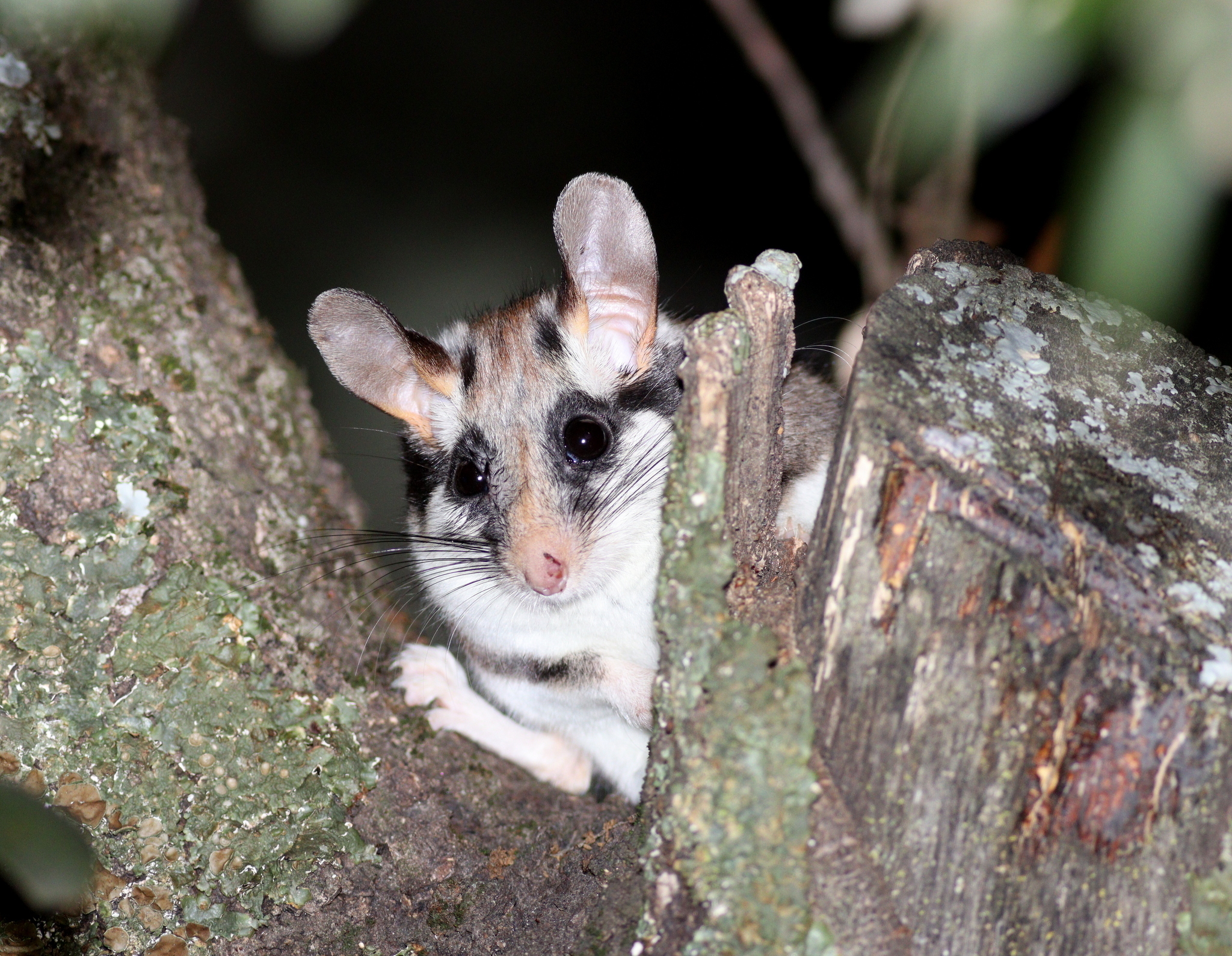
Where to see the garden dormouse in the Netherlands
Very rare 🦌 Mammal (land) Sensitive species · R2
🛡️ No exact locations, on purpose
This is a sensitive species. We deliberately show no resting places such as setts, burrows or winter roosts, and no photographs in which such a place is recognisable. Why we do that.
Where and when do you see a garden dormouse? This species is very rarely seen, from April to October.
How do you recognise a garden dormouse?
Unmistakable through the striking black markings on the face — the mask. The tail is two-toned, long and plume-shaped: brown on top, black at the tip and white underneath. Besides that, fairly large oval ears, large black bead eyes and a pointed nose. Head and body 100 to 170 millimetres, tail 90 to 150 millimetres, 40 to 120 grams.
What does a garden dormouse sound like?
Recording: Nahefoto, CC BY-SA 4.0, via Wikimedia Commons
What tracks does a garden dormouse leave?
Print: the fore foot is 10 to 15 mm long with four toes, the hind foot 20 to 28 mm with five. There is no claw print, and that is exactly what tells it from a brown rat; sometimes a tail drag runs through them. Droppings: 2 to 4 mm thick and 7 to a good 15 mm long, glossy yellowish to blackish brown when fresh and a dull greyish black when old, deposited scattered. Feeding signs: on apples and cherries cut surfaces of 2 to 6 mm, the width of two incisors together.
Where do you see this species in the Netherlands?
Formerly common in South Limburg, but much reduced since the nineteen-seventies. At present only in the Savelsbos; in 2017 a population was reintroduced on the Bemelerberg.
📍 Nationaal Park Zuid-Limburg (in formation)
Very rare chance per sourceThese links come straight from our database, with the chance, the source and the evidence level for each area.
When is the best time?
Green = present · orange = peak period. The bar is generated from our database.
Best period: Active from April to October; hibernating after that until April.
Best time of day: Night.
Recent sightings
👁️ Where has this species been seen recently?
Check the current sightings on Waarneming.nl. A useful addition to our own verified information.
Current sightings on Waarneming.nl →
Note: for sensitive species the source already blurs or withholds sightings. We do not reproduce exact locations.
How to improve your chances
- Keep the wind in your face. Most mammals will smell you long before they see you.
- Arrive before sunrise and then stay put. Sitting still beats walking about.
- Wear muted colours, skip the scent, and put your phone on silent.
- Be patient. Expect to come back more than once before it works.
🎒 What you need for this
A trail camera. It is strictly nocturnal and hardly ever leaves the shrub layer, so watching by day gets you nowhere.
Photography
Set a trail camera by a hedge or the edge of scrub in lime-rich slope woodland, at about a metre up. It jumps from branch to branch like a squirrel and seldom comes to the ground.
🌿 Watching responsibly
Keep your distance, stay on the paths, and never lure animals with food or sound. Leave as soon as an animal becomes uneasy. This is a sensitive species. We deliberately show no resting places such as setts, burrows or winter roosts, and no photographs in which such a place is recognisable.
Status: Verified · Last checked: 2026-08-08