
Where to see the bicoloured shrew in the Netherlands
Very rare 🦌 Mammal (land)
Where and when do you see a bicoloured shrew? This species is very rarely seen, all year round.
How do you recognise a bicoloured shrew?
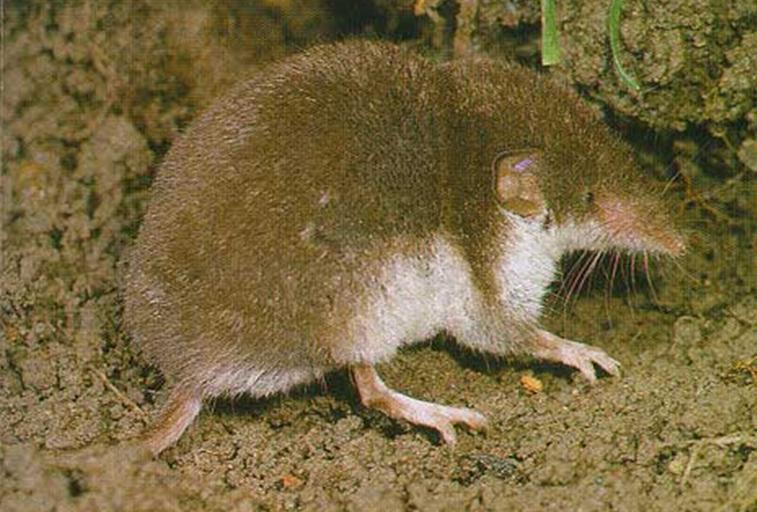
The upper body is brown to blackish brown and contrasts sharply with the white to grey underside. Characteristic is that sharp dividing line, which runs down along the legs so that the back colour continues onto the foot. The tail is relatively short with silvery white hairs, the ears are visible and the snout is pointed with long whiskers. The molars and teeth are entirely white. Head and body 60 to 90 millimetres, tail 27 to 43 millimetres, 7 to 14 grams.
What can you confuse a bicoloured shrew with?
Looks like: Greater white-toothed shrew
- Greater white-toothed shrew: both have white teeth and silvery white tail hairs; the bicoloured shrew has a sharply defined boundary between dark back and white belly that continues onto the feet.
What tracks does a bicoloured shrew leave?
Print: the fore foot is up to 9 mm long and wide, the hind foot up to 12 mm, with five toes on both feet. Because the animal is so light, it leaves barely visible tracks. Droppings: 2 to 4 mm long and 1 to 2 mm thick, pointed at one end, dark brown to black and made up almost entirely of insect remains. Where to look: at the entrances of small burrows, and in owl pellets, because those give the most reliable identification.
Where do you see this species in the Netherlands?
Only in Zeeuws-Vlaanderen and the far east of Overijssel.
📍 Zwin & Zeeuws-Vlaanderen
presence reportedThese links come straight from our database, with the chance, the source and the evidence level for each area.
When is the best time?
Green = present · orange = peak period. The bar is generated from our database.
Best period: Active all year; breeding runs from April to September.
Best time of day: Mainly at night.
Recent sightings
👁️ Where has this species been seen recently?
Check the current sightings on Waarneming.nl. A useful addition to our own verified information.
How to improve your chances
- Keep the wind in your face. Most mammals will smell you long before they see you.
- Arrive before sunrise and then stay put. Sitting still beats walking about.
- Wear muted colours, skip the scent, and put your phone on silent.
- Be patient. Expect to come back more than once before it works.
🎒 What you need for this
A camera with a macro lens. It moves more calmly and is less shy than other shrews, so a photo is more feasible than with its relatives.
Photography
Watch the feet: in this species the dark back colour runs down onto the foot, while on the Greater white-toothed shrew the division stays higher. So photograph from the side and make sure the foot is in frame.
🌿 Watching responsibly
Keep your distance, stay on the paths, and never lure animals with food or sound. Leave as soon as an animal becomes uneasy.
Status: Verified · Last checked: 2026-08-08