
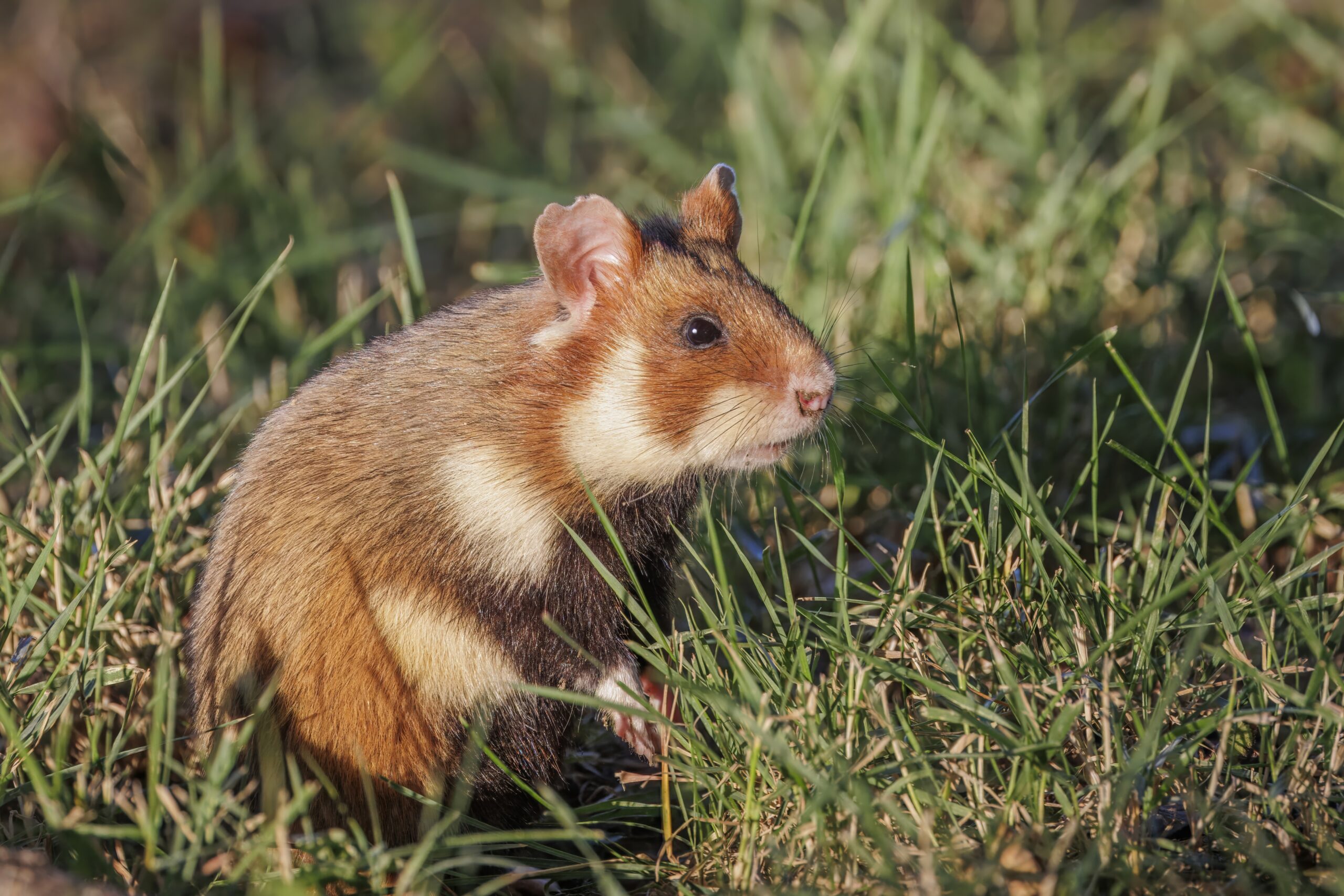
Where to see the European hamster in the Netherlands
Very rare 🦌 Mammal (land) Sensitive species · R2
🛡️ No exact locations, on purpose
This is a sensitive species. We deliberately show no resting places such as setts, burrows or winter roosts, and no photographs in which such a place is recognisable. Why we do that.
Where and when do you see a European hamster? This species is very rarely seen, from April to October.
How do you recognise a European hamster?
A hefty rodent, the size of a rat, with an orange-brown coat and white patches on head, throat and nape. Striking is the black belly with white patches — the reverse of what you see on most mammals. The feet are white and the tail is short, less than twenty per cent of the body length. Black eyes, large ears and long white whiskers. Head and body 200 to 270 millimetres, tail 40 to 70 millimetres, 220 to 460 grams.
What tracks does a European hamster leave?
Print: the fore foot is 15 to 20 mm long and 10 to 16 mm wide with four visible toes, the hind foot 20 to 25 mm long and 15 to 20 mm wide with five toes of which four often register; on both the claws show clearly in the print. Droppings: 10 to 15 mm long and 5 mm wide, compact with blunt ends, yellowish brown to black and sometimes with a thin layer of sand around them. Feeding signs: bitten-off cereal stems, chaff awns and scattered grains. This species is extremely rare in the Netherlands; we do not name sites here.
Where do you see this species in the Netherlands?
Almost extinct through intensive agriculture. Since 2002 hamsters have been released in special arable reserves in South Limburg. Releases take place every year with animals bred at GaiaZOO. After initial success the numbers fell again between 2016 and 2020.
📍 Nationaal Park Zuid-Limburg (in formation)
presence reportedThese links come straight from our database, with the chance, the source and the evidence level for each area.
When is the best time?
Green = present · orange = peak period. The bar is generated from our database.
Best period: Active from early April to late October; hibernating after that.
Best time of day: Night and dusk.
Recent sightings
👁️ Where has this species been seen recently?
Check the current sightings on Waarneming.nl. A useful addition to our own verified information.
Current sightings on Waarneming.nl →
Note: for sensitive species the source already blurs or withholds sightings. We do not reproduce exact locations.
How to improve your chances
- Keep the wind in your face. Most mammals will smell you long before they see you.
- Arrive before sunrise and then stay put. Sitting still beats walking about.
- Wear muted colours, skip the scent, and put your phone on silent.
- Be patient. Expect to come back more than once before it works.
🎒 What you need for this
Binoculars, and respect for the cordon around an arable reserve. Never enter one.
Photography
Photograph only from the public road or the path alongside an arable reserve, with a telephoto lens. The burrows lie in the field itself and entering is not only forbidden but immediately harmful.
🌿 Watching responsibly
Keep your distance, stay on the paths, and never lure animals with food or sound. Leave as soon as an animal becomes uneasy. This is a sensitive species. We deliberately show no resting places such as setts, burrows or winter roosts, and no photographs in which such a place is recognisable.
Status: Verified · Last checked: 2026-08-08