
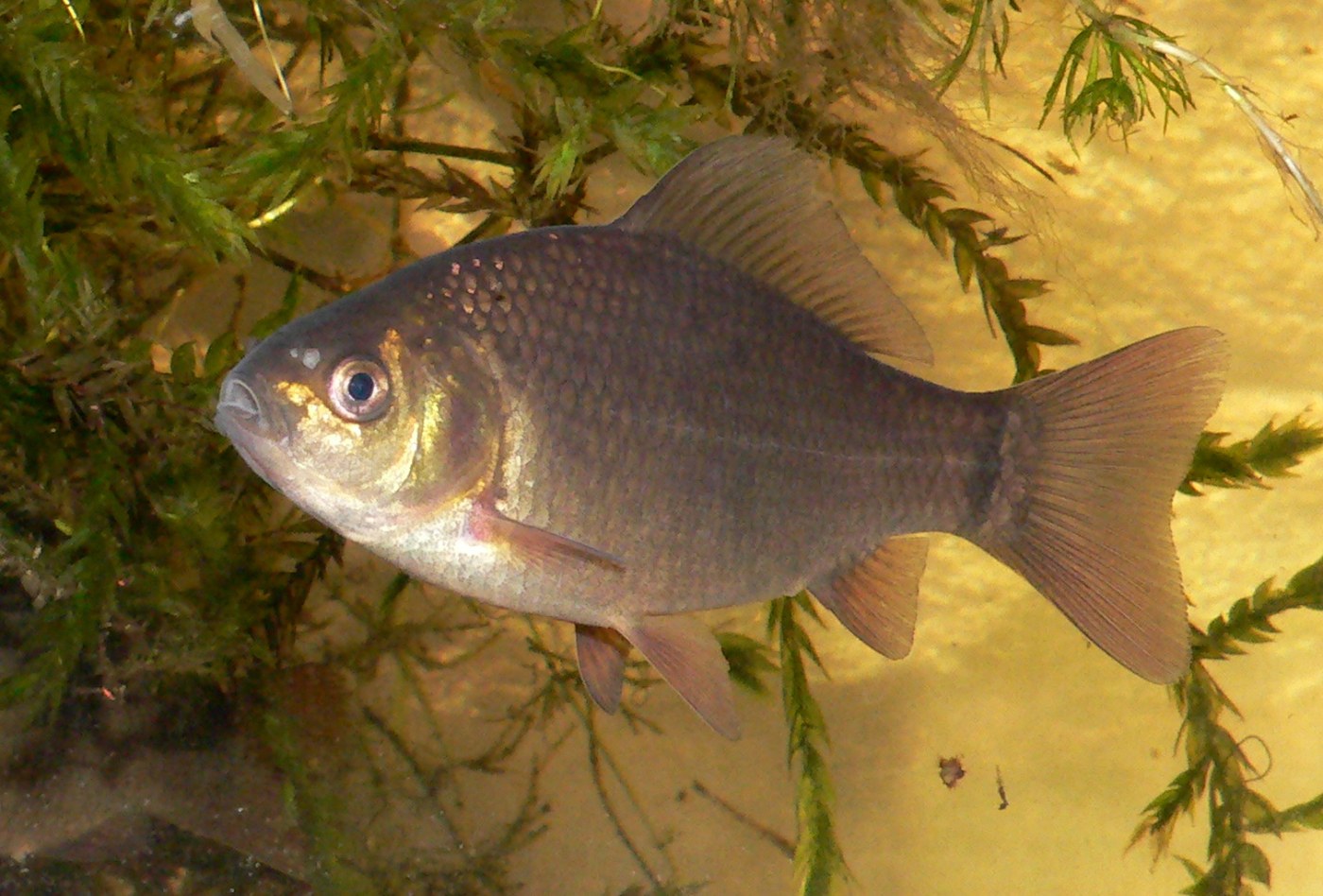
Where to see the crucian carp in the Netherlands
Rare 🐟 Fish
Where and when do you see a crucian carp? This species is rarely seen, all year round.
How do you recognise a crucian carp?
A deep-bodied, laterally flattened member of the carp family with bronze to yellowish flanks, up to about 55 centimetres. The key feature is the dorsal fin: on the crucian carp the edge is convex, on the giebel concave. Besides that, 33 to 36 scales on the lateral line, and young fish up to about five centimetres have a dark spot at the base of the tail.
What can you confuse a crucian carp with?
Looks like: Common carp, Tench
- Giebel: the hardest one. The giebel has 27 to 32 scales on the lateral line and a concave dorsal fin; young giebel lack the dark tail spot.
- Common carp: has barbels, which the crucian carp does not.
- Tench: very small scales and a short dorsal fin with 12 to 13 rays.
Where do you see this species in the Netherlands?
Fairly rare; its core area is South Holland, North Holland and Utrecht. Much reduced because small plant-rich waters have disappeared, and threatened by hybridisation with Common carp and giebel.
📍 Oostelijke Vechtplassen
presence reported📍 Ilperveld
presence reportedThese links come straight from our database, with the chance, the source and the evidence level for each area.
When is the best time?
Green = present · orange = peak period. The bar is generated from our database.
Best period: Breeding takes place between late May and mid-June in shallow plant-rich places.
Best time of day: By day, in shallow plant-rich water.
Recent sightings
👁️ Where has this species been seen recently?
Check the current sightings on Waarneming.nl. A useful addition to our own verified information.
How to improve your chances
- Look for clear, shallow water and watch from a bridge, a jetty or a high bank.
- Polarising sunglasses take the reflection off the surface and show you what is swimming underneath.
- Stay low and move slowly. Fish are very good at seeing movement above the water.
- Early morning gives the calmest water and the best visibility.
🎒 What you need for this
A dip net; count the scales on the lateral line and look at the edge of the dorsal fin
Photography
Photograph the dorsal fin from the side, against a pale background. Convex means crucian carp, concave means giebel — and at any other angle that difference cannot be seen.
🌿 Watching responsibly
Keep your distance, stay on the paths, and never lure animals with food or sound. Leave as soon as an animal becomes uneasy.
Status: Verified · Last checked: 2026-10-28