
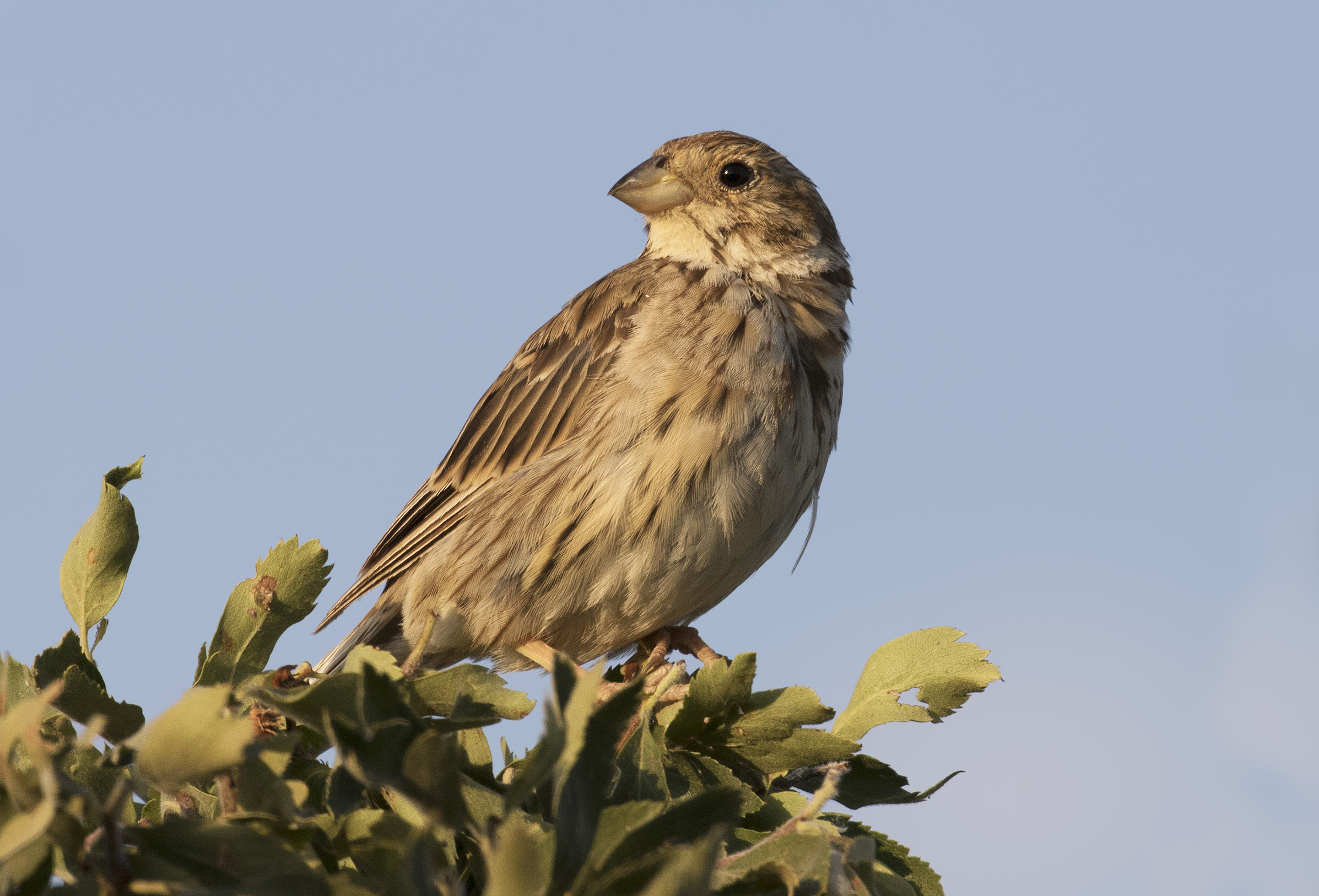
Where to see the Corn Bunting in the Netherlands
Very rare 🦅 Bird
Where and when do you see a Corn Bunting? This species is very rarely seen, all year round.
How do you recognise a Corn Bunting?
A large, heavy bunting of 16 to 19 cm with strikingly unremarkable brown markings. The upperparts are streaked greyish brown, the underparts beige-white with dark streaks. Characteristic are the pale eye-ring and the pink-yellow bill. Unlike all other buntings the corn bunting has no white in the outer tail feathers. It often flies with dangling legs.
Wingspan: 29 cm an indication from Wikidata; it varies by individual, sex and subspecies · compare all birds (in Dutch)
What does a Corn Bunting sound like?
Recording: British Library, CC BY-SA 4.0, via Wikimedia Commons
Where do you see this species in the Netherlands?
A critically endangered breeding bird with only 2 to 3 pairs left in 2025, against thousands in the last century. In winter 75 to 125 birds. North-west European populations are largely resident; in a cold spell they wander a little.
Habitat: Open farmland, grassland and waste ground. Formerly tied to grain stacks on farmyards, now dependent on seed-rich, weedy cereal stubble, extensively used grassland and rough ground in open terrain. In the breeding season it eats small invertebrates, otherwise cereals and weed seeds.
This is a common, widespread species: you can come across it in far more places than the areas listed below. Treat that list as a starting point rather than a full survey.
Habitat: Open farmland, grassland and waste ground. Formerly tied to grain stacks on farmyards, now dependent on seed-rich, weedy cereal stubble, extensively used grassland and rough ground in open terrain. In the breeding season it eats small invertebrates, otherwise cereals and weed seeds.
We have not yet recorded any areas for this species with enough evidence behind them, so we name the habitat type instead.
When is the best time?
Green = present · orange = peak period. The bar is generated from our database.
Best period: A resident, present all year. Song from April to July, winter records from November to March.
Best time of day: The morning in May and June, when the male sings from a post or a wire.
Recent sightings
👁️ Where has this species been seen recently?
Check the current sightings on Waarneming.nl. A useful addition to our own verified information.
How to improve your chances
- Learn the calls first. You will hear most birds before you see them.
- Go in the first hour after sunrise, when the song is at its peak and the wind is still down.
- Use a hide or natural cover. Sitting still gets you more than walking closer.
- Keep the sun behind you. Against the light you see a silhouette and no colour.
🎒 What you need for this
Binoculars and a knowledge of the song: it sounds like a rattling bunch of keys and is audible at a great distance.
Photography
Singing males choose a fixed high song post — a post, a wire, a thistle. Wait at that post instead of following the bird. Photograph early, with the sun low, so that the streaking on the breast stays visible.
🌿 Watching responsibly
Keep your distance, stay on the paths, and never lure animals with food or sound. Leave as soon as an animal becomes uneasy.
Status: Verified · Last checked: 2026-08-08