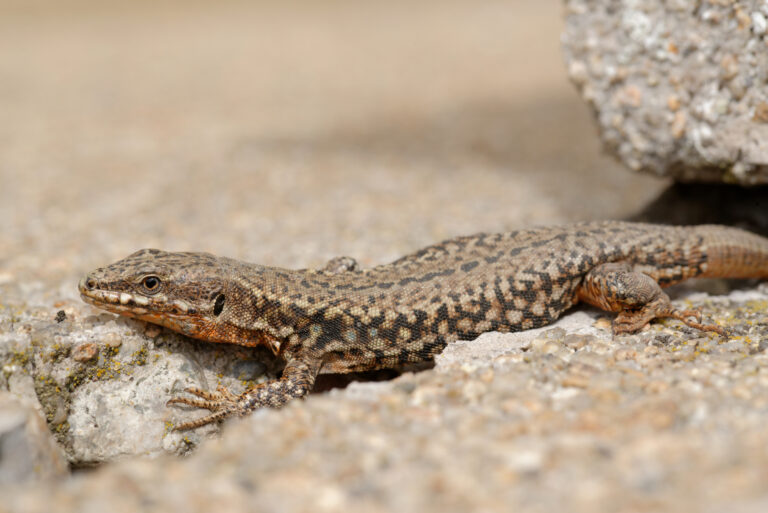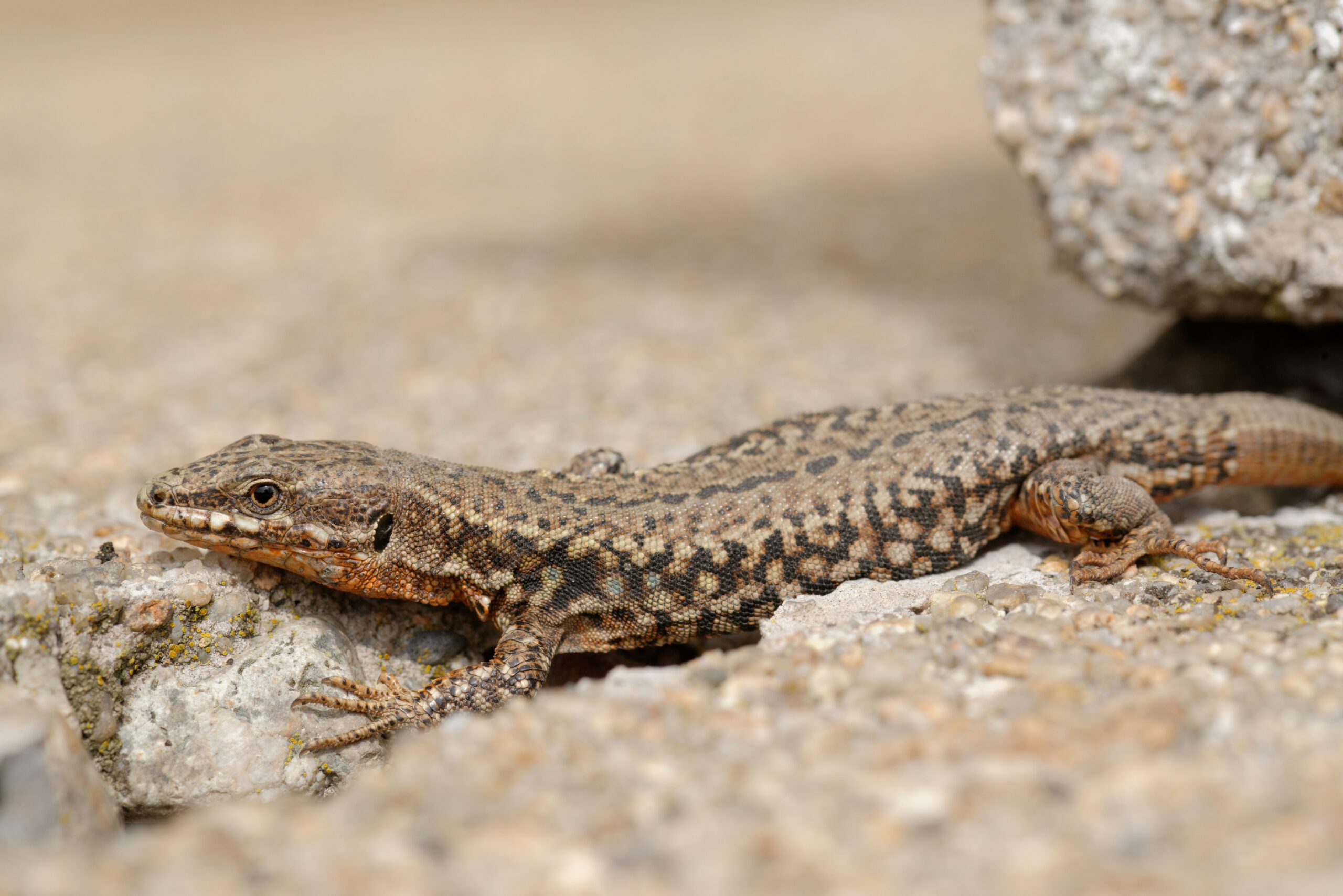
Where to see the common wall lizard in the Netherlands
Rare 🦎 Reptile Sensitive species · R1
🛡️ No exact locations, on purpose
This is a sensitive species. We deliberately give no exact locations. If an area is named below, that is because the site manager publishes the species there themselves, and the source is given with it. That way we do our bit for the protection of the species. Why we do that.
Where and when do you see a common wall lizard? This species is rarely seen, from March to September.
How do you recognise a common wall lizard?
Slender lizard that reaches about 19 centimetres including the tail, with a narrow, flat head, strong legs and long toes. The rear margin of the collar is smooth and not toothed, and the scales are barely keeled — that is how you tell it from our other lizards.
Where do you see this species in the Netherlands?
The south of Limburg. This is a single, entirely isolated population of a few hundred animals on old, south-facing masonry; the species occurs nowhere else in the Netherlands.
Habitat: Warm, stony places. Originally rock faces; in the Netherlands old masonry and railway embankments, where the stones take up heat during the day and give it off again in the evening.
When is the best time?
Green = present · orange = peak period. The bar is generated from our database.
Best period: March through September. The best moment is a sunny morning in April or May, when the animals have to warm up and stay put for a long time.
Best time of day: Morning, as soon as the sun is on the wall.
Recent sightings
👁️ Where has this species been seen recently?
Check the current sightings on Waarneming.nl. A useful addition to our own verified information.
Current sightings on Waarneming.nl →
Note: for sensitive species the source already blurs or withholds sightings. We do not reproduce exact locations.
How to improve your chances
- Go on a sunny morning, while they are warming up and still slow.
- Look for the edges: woodland margins, heath paths, log piles, south-facing slopes.
- Walk quietly. Reptiles feel vibration through the ground before they see you.
- Look but do not touch. Picking one up is disturbance, and with protected species it is not allowed.
🎒 What you need for this
Binoculars with a short focusing distance. On a wall you are quickly too close for ordinary binoculars, and coming too close drives the animals away.
Photography
Get low and wait rather than approach. A wall lizard that does not feel threatened comes back by itself to the same warm stone. Frame your shot so that the wall is not recognisable in the picture.
🌿 Watching responsibly
Keep your distance, stay on the paths, and never lure animals with food or sound. Leave as soon as an animal becomes uneasy. This is a sensitive species. We deliberately give no exact locations. If an area is named below, that is because the site manager publishes the species there themselves, and the source is given with it. That way we do our bit for the protection of the species.
Status: Verified · Last checked: 2026-08-07
More photos