
Where to see the Bog Hawker in the Netherlands
Very rare 🪰 Dragonfly Sensitive species · R1
🛡️ No exact locations, on purpose
This is a sensitive species. We deliberately give no exact locations. If an area is named below, that is because the site manager publishes the species there themselves, and the source is given with it. That way we do our bit for the protection of the species. Why we do that.
Where and when do you see a Bog Hawker? This species is very rarely seen, from July to October.
How do you recognise a Bog Hawker?
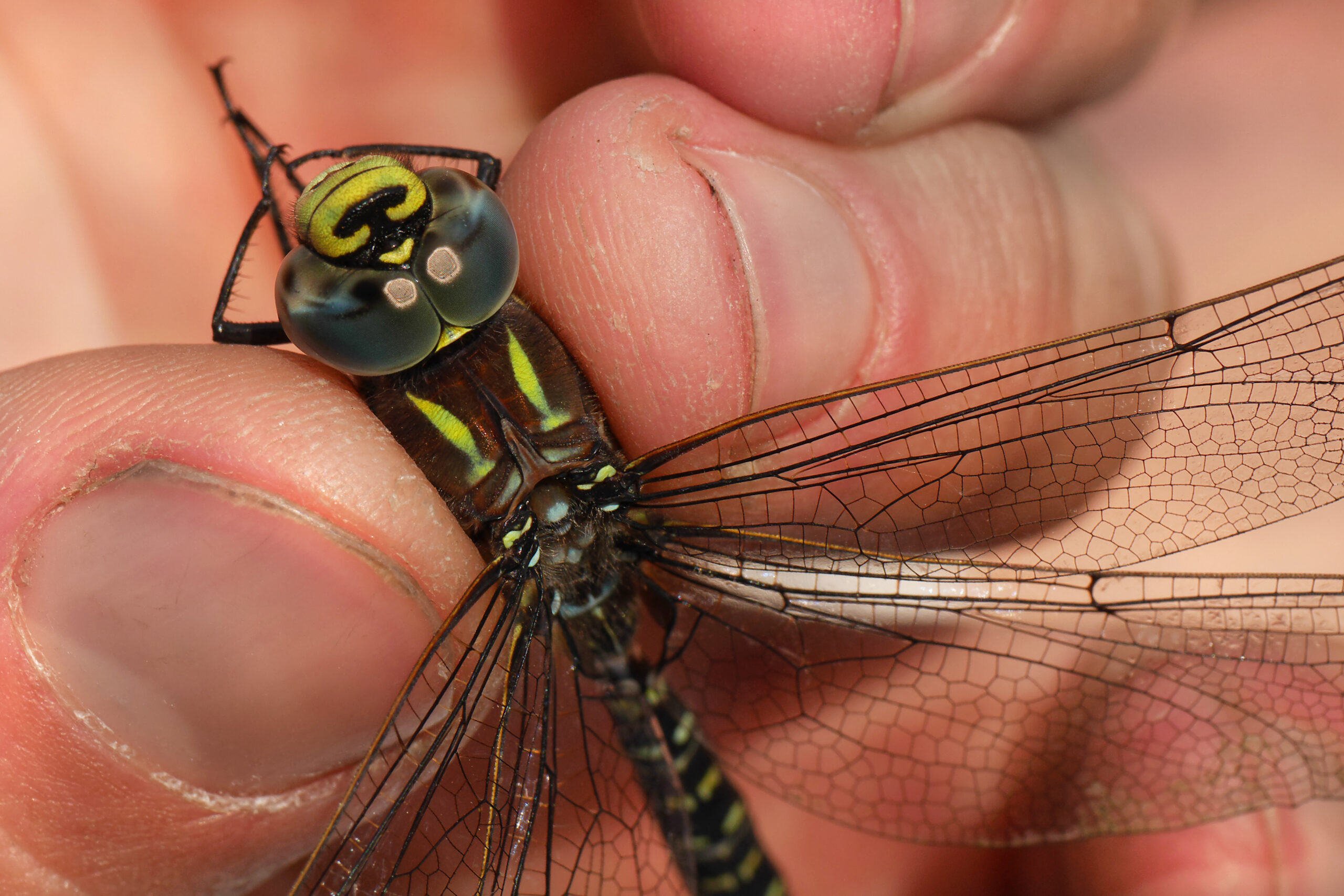
Hawker of 70 to 76 millimetres with a dark abdomen and a mosaic pattern of pale spots. The side of the thorax carries two broad yellow bands, often tinted blue on males. Characteristic is the black line between the forehead and the frons: it is not narrowed at the eye margin, and is sometimes even broadened there.
Where do you see this species in the Netherlands?
Raised-bog pools in Drenthe, adjoining Friesland and very locally in Overijssel. Formerly also in Noord-Brabant and Limburg.
Habitat: Raised bog and moorland pools with bog development. The condition is a dense bog-moss vegetation, usually with both floating and hummock-forming bog-moss mats.
When is the best time?
Green = present · orange = peak period. The bar is generated from our database.
Best period: Mid-July to October, with the main flight season from mid-August to early September.
Best time of day: Morning, at the water.
Recent sightings
👁️ Where has this species been seen recently?
Check the current sightings on Waarneming.nl. A useful addition to our own verified information.
Current sightings on Waarneming.nl →
Note: for sensitive species the source already blurs or withholds sightings. We do not reproduce exact locations.
How to improve your chances
- Go on a warm, windless day between about ten and four, when they are active.
- Look for the place rather than the animal: flowery edges for butterflies, banks and open water for dragonflies.
- Move slowly and keep your shadow off the animal. It notices that before it notices you.
- Early in the morning they are still cold and motionless on a leaf. That is when you can get closest.
🎒 What you need for this
Binoculars. To separate it from the common hawker you have to be able to see the head from the front, and that only works on a perched animal.
Photography
Come in the morning: unlike the common hawker this species is active at the water above all in the morning and withdraws to heathland and woodland edges in the afternoon. Keep off the bog moss — that is the larval habitat.
🌿 Watching responsibly
Keep your distance, stay on the paths, and never lure animals with food or sound. Leave as soon as an animal becomes uneasy. This is a sensitive species. We deliberately give no exact locations. If an area is named below, that is because the site manager publishes the species there themselves, and the source is given with it. That way we do our bit for the protection of the species.
Status: Verified · Last checked: 2026-08-07