
Recognising woodland birds by sound: five species you hear but don’t see
Woodland birds are nearly always heard before they are seen. In a beech wood in October you can walk for half an hour, hear six species and get none of them in view. That isn’t your binoculars: it is exactly how these birds live. They sit in cover, they are small, they move little, and the only thing they give away of themselves is sound. This article covers five species present in virtually every Dutch wood — Eurasian Wren, European Robin, Marsh Tit, Short-toed Treecreeper and Eurasian Jay — and for each the same four questions: what you hear, where it is, why you don’t see it, and what to do to see it after all.
Why the wood makes sound again in September
Anyone going into the wood in July or August hears little. That is not imagination. Vogelbescherming Nederland explains that most songbirds moult after the breeding season, and that singing is then “not only unwise, but also unnecessary”: with young flying around independently a territory no longer serves a purpose, and a moulting bird is vulnerable. So the silence of high summer is not emptiness, but a pause.
That pause runs out. From early September sound returns, but with a different meaning: it is no longer about mates, it is about space for the winter. That makes autumn a curiously good time to learn to listen — there is sound again, but far less than in May, so you can tell the species apart instead of drowning in a chorus. And over the course of October the wood also opens up literally: once the leaves fall you can see straight through a beech wood. Sound returning and cover disappearing — together that is why this is the best season to get to know woodland birds.
Finding woodland birds: listen first, then look
The order most people use — look, and only listen once they see something — works against you in a wood. The reverse does work:
- Stop and stay still for two minutes. Most woodland birds fall silent as you pass; two minutes later they start again.
- Count the species you hear first. Usually that is four to eight. Then pick one to locate.
- Establish the height, not the direction. Shrub layer, halfway up the trunk or canopy? That cuts three-quarters of the searching and is easier than working out direction.
- Look for movement, not for a bird. A trembling leaf gives away a wren sooner than the bird itself.
- Listen to the sounds at home beforehand. Every species page on this site has a recording. Five minutes of preparation saves an hour in the field.
The European Robin: the song that returns in autumn
If you hear something singing in October, melodious but with long silences in between, it is almost certainly a European Robin. Vogelbescherming describes the song as watery and quick, with “pauses of 3 to 4 seconds between the rippling phrases”. It also has a ticking call like two pebbles struck together — in a winter wood the sound you hear most often.
The remarkable thing is that it sings in autumn at all. From mid-July, Vogelbescherming writes, “a period begins in which the robin seems to have vanished from the face of the earth”; the birds are then moulting and lead “a secretive life”. And then, “around the beginning of September”, the song returns — with a different message: it is “anything but a love song, but a way of telling others of its kind: I live here, this is my private patch of ground for autumn and winter”. You can hear the difference too: the autumn song “differs somewhat from that in spring because it is delivered more calmly, the phrases are longer” and therefore sounds more melancholy.
Something else that virtually no other Dutch songbird does: the females sing too. Vogelbescherming: “Remarkably, both males and females defend a territory against every robin, regardless of sex.”
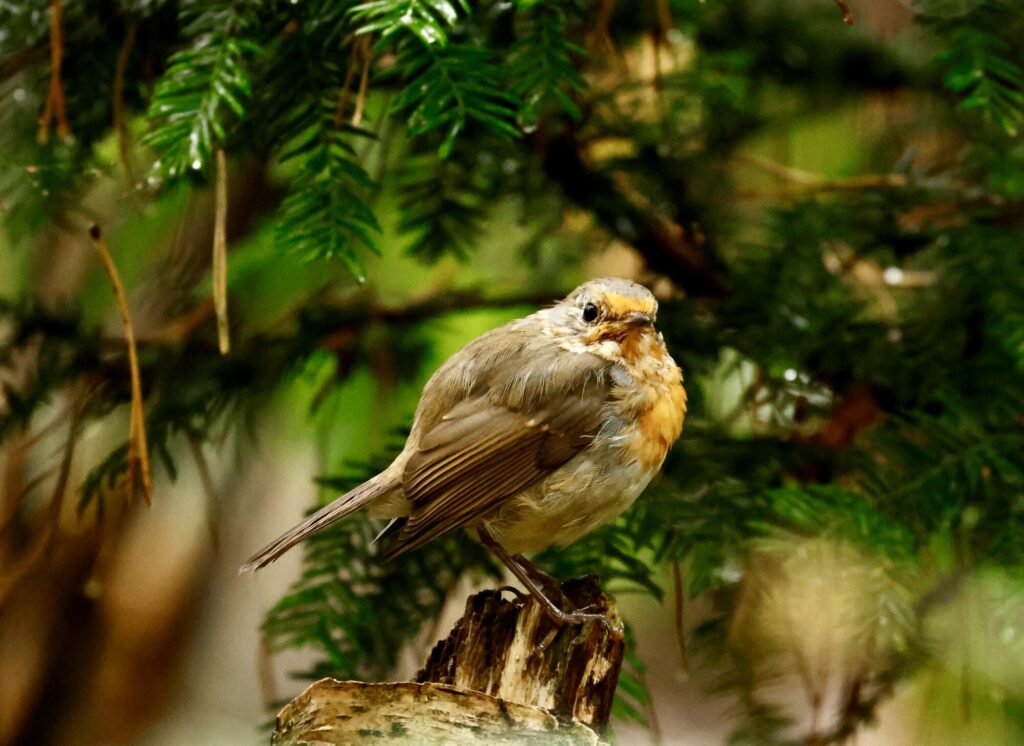
One confusion that is common in September: a robin-like little bird with no red breast, brown and mottled. That is a juvenile robin. The juvenile plumage is not camouflage against predators but safety among its own kind — adult robins react fiercely to the colour red and attack birds with a red breast. Over the course of autumn the breast turns orange after all.
Why you don’t see it: it sits low, often in brambles or under bushes, and sings with its back to you. What to do: stay where you are. The robin is the least shy of the five; if you stay still, it comes to you. In a wood where work is going on it often follows the people, because churned-up ground yields food.
The Eurasian Wren: the loudest sound in the wood
At 9 to 10.5 centimetres the Eurasian Wren is one of the smallest birds in the Netherlands and makes the most noise of all five. Vogelbescherming describes the song as “loud and explosive, a combination of trills and clear notes”. It also has a rattling alarm call like a wind-up mechanism, which it deploys as soon as you come too close to its bush. In practice that is the sound by which you find it.
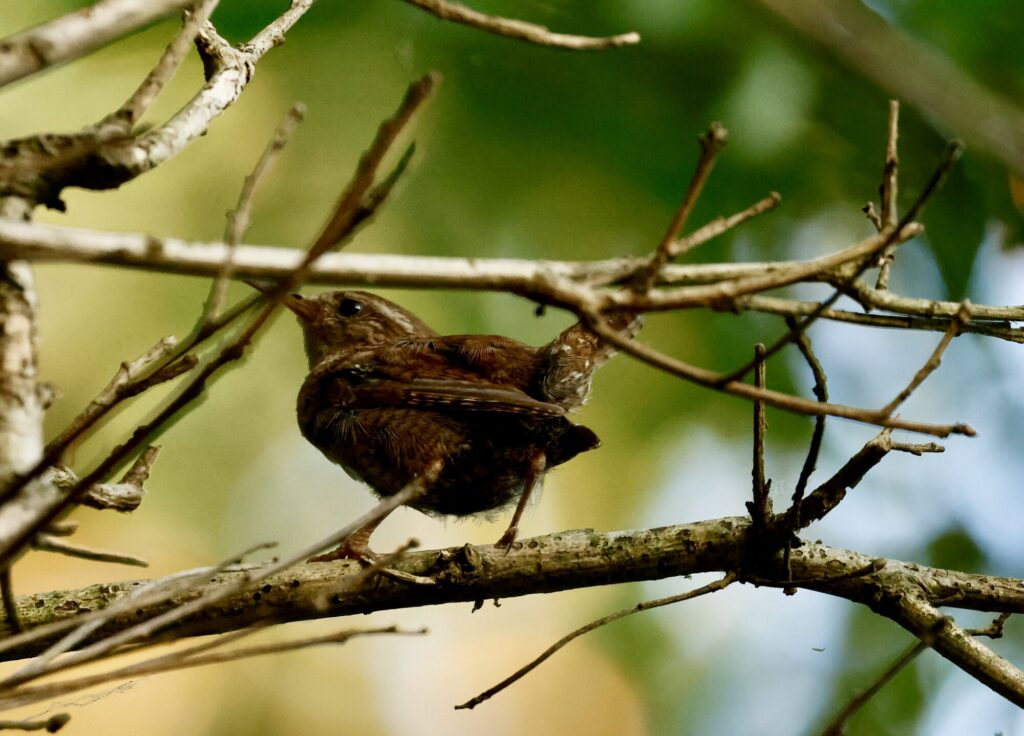
It is also one of the country’s most numerous birds: 410,000 to 630,000 breeding pairs in 2018–2020, and an estimated one to two million individuals in winter. Dutch wrens are resident; they stay in the same area all year.
That makes it vulnerable, and therein lies the joke in its Dutch name (winterkoning, “winter king”). Vogelbescherming notes drily that the wren is “despite its name not resistant to cold winters”. It eats almost nothing but insects, and in frost staying warm is a problem: “Mass mortality therefore occurs during severe winters.” Each time an equally striking recovery follows — males build half a dozen nests and can have several females. The numbers therefore fluctuate more strongly than for any other species here.
Why you don’t see it: it lives in the bottom half-metre of the wood, among root plates, brash piles and brambles, and moves like a mouse. What to do: search along the messy edges — fallen trees, ditch banks, brash piles. A tidy woodland floor has no wrens; a chaotic one does.
The Marsh Tit: the laser in the deciduous wood
The Marsh Tit is the hardest of the five to see and the easiest to hear, provided you know what to listen for. Vogelbescherming describes the song as a metallic tiu-tiu-tiu-tiu-tiu reminiscent of a laser gun from a science-fiction film — a description that sounds odd until you hear it, and then never lets go. The call is an explosive pstee-tchuh.
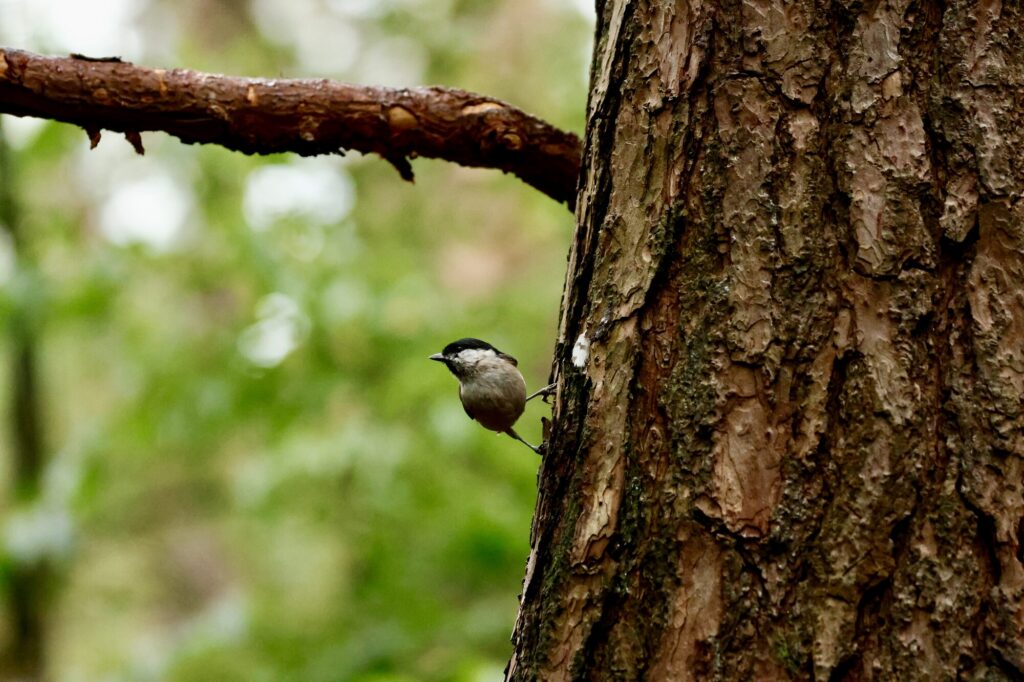
Common it is not: 14,000 to 17,000 breeding pairs in 2018–2020, against hundreds of thousands of robins and wrens. It is also choosy — Vogelbescherming: “The Marsh Tit breeds in somewhat older deciduous woodland of at least 4 hectares.” So a young copse or a tree line along a field will virtually never produce a Marsh Tit. And it stays: Marsh Tits winter where they breed. A Marsh Tit in October means there was one there in May too.
Marsh Tit or Willow Tit? Four features and one call
This is one of the trickiest species pairs in the Netherlands. The most-repeated rule of thumb — “the Marsh Tit has a glossy cap, the Willow Tit a dull one” — is precisely the rule Vogelbescherming itself hedges: Willow Tits can look glossy too. What Vogelbescherming does give as distinguishing:
- The bill base is the most reliable. Marsh Tits have “really always a clear pale patch at the base of the upper mandible”; on the Willow Tit it is usually absent.
- The bib. On the Willow Tit larger and broader towards the bottom, on the Marsh Tit “usually smaller, of even width and more sharply defined”.
- The wing panel. The Willow Tit often has “a conspicuously pale panel on the wings”; on the Marsh Tit that is “barely visible and usually even absent”.
- The cap — glossier on the Marsh Tit, but therefore not usable as the only feature.
And the call, which counts for more in the field than the whole plumage put together: the Willow Tit has “a somewhat whining and nasal dehh-dehh-dehh”, the Marsh Tit “an explosive, sneezing and strongly falling pstee-tchoo”. In case of doubt the sound decides, not the photograph. The habitat helps too: according to Vogelbescherming the Willow Tit has “a broader taste, from marsh to conifer woodland”, while the Marsh Tit is more often in deciduous woodland.
There is reason to be extra careful here: the Willow Tit is declining fast. Sovon Vogelonderzoek Nederland gives for the breeding trend since 1990 a “significant decrease, <5% per year” and over the last twelve years a “significant decrease, >5% per year” — in Sovon’s own words at least a halving in fifteen years. The species is on the Red List, with 7,500 to 12,000 breeding pairs in 2018–2020: fewer than the Marsh Tit. So a Willow Tit record is worth submitting.
The Short-toed Treecreeper: the sound just above your hearing
With 135,000 to 180,000 breeding pairs (2018–2020) the Short-toed Treecreeper is far commoner than most people think, and is probably present in every park and every old avenue near you. That almost nobody knows it is down to its sound: high and thin. Vogelbescherming: “Song high, accelerating and ending in a trill. Call explosive: tseet.”
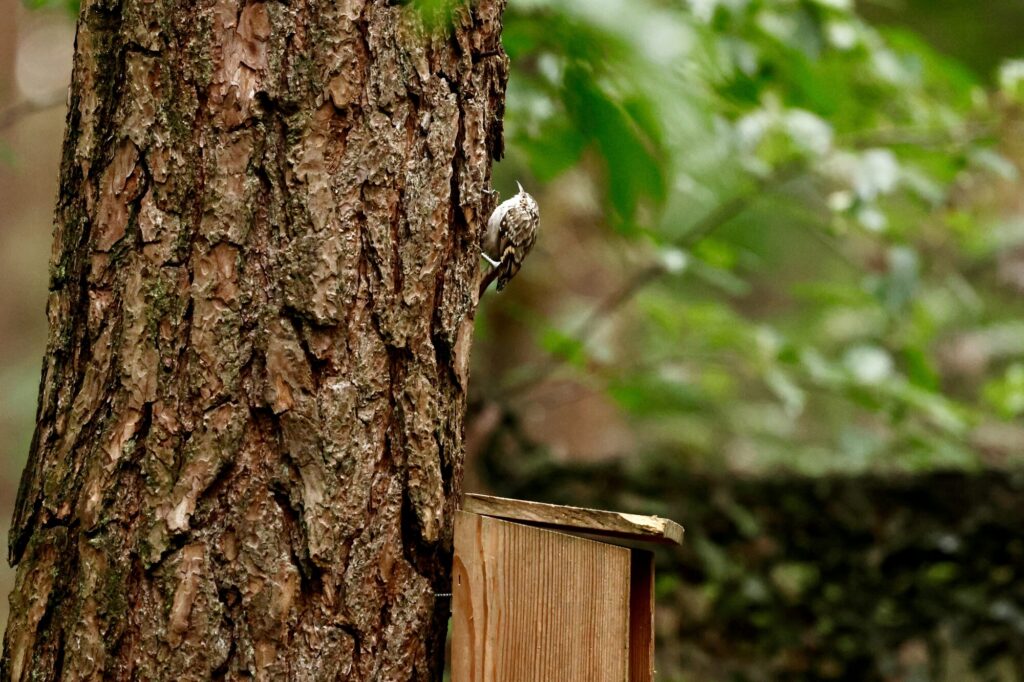
An honest warning belongs here: for many people over forty that high tseet sits at the edge of what they can still hear. If you walk with someone who points out the treecreeper while you hear nothing, that is more often a matter of hearing range than of attentiveness. The treecreeper is a resident too, and one of the few that keeps running almost entirely on insects in winter — it takes them from the crevices in the bark, where they remain even in frost.
Treecreeper or nuthatch: hopping or walking
The difference from the Eurasian Nuthatch is the easiest identification difference in this article, because you only have to look at the direction of movement. Vogelbescherming: the nuthatch “can easily walk up and down the trunk; it shuffles in all directions”. The treecreeper, by contrast, “hops (so does not cling) – in a spiral – up the trunk” and “flies to the foot of the next tree and starts again from bottom to top”.
If you see a bird walking down a trunk head first, it isn’t a treecreeper. Vogelbescherming’s mnemonic for the plumage is just as simple, in the Dutch: “KLever has KLeur” (colour) — blue-grey with rusty orange, against the brown and white of the treecreeper. The winter food differs visibly too: treecreepers stay almost entirely on insects, while nuthatches switch to seeds and nuts and hoard them. So a bird walking along a trunk with a nut in its bill in November is a nuthatch.
A third climber that causes confusion is the Great Spotted Woodpecker, which props itself on its tail on the trunk and moves up in fits and starts; anyone wanting to tell the woodpeckers apart by drum and call will find that in our article Which woodpecker is this?. And for completeness: according to Vogelbescherming the Short-toed Treecreeper resembles “confusingly closely the scarcer Eurasian Treecreeper (not a breeding bird) and the short-billed treecreeper”, which have a more conspicuous brow stripe, are whiter below and sing differently. In the Dutch lowlands the Short-toed Treecreeper is the standard species.
The Eurasian Jay: the screech you already knew
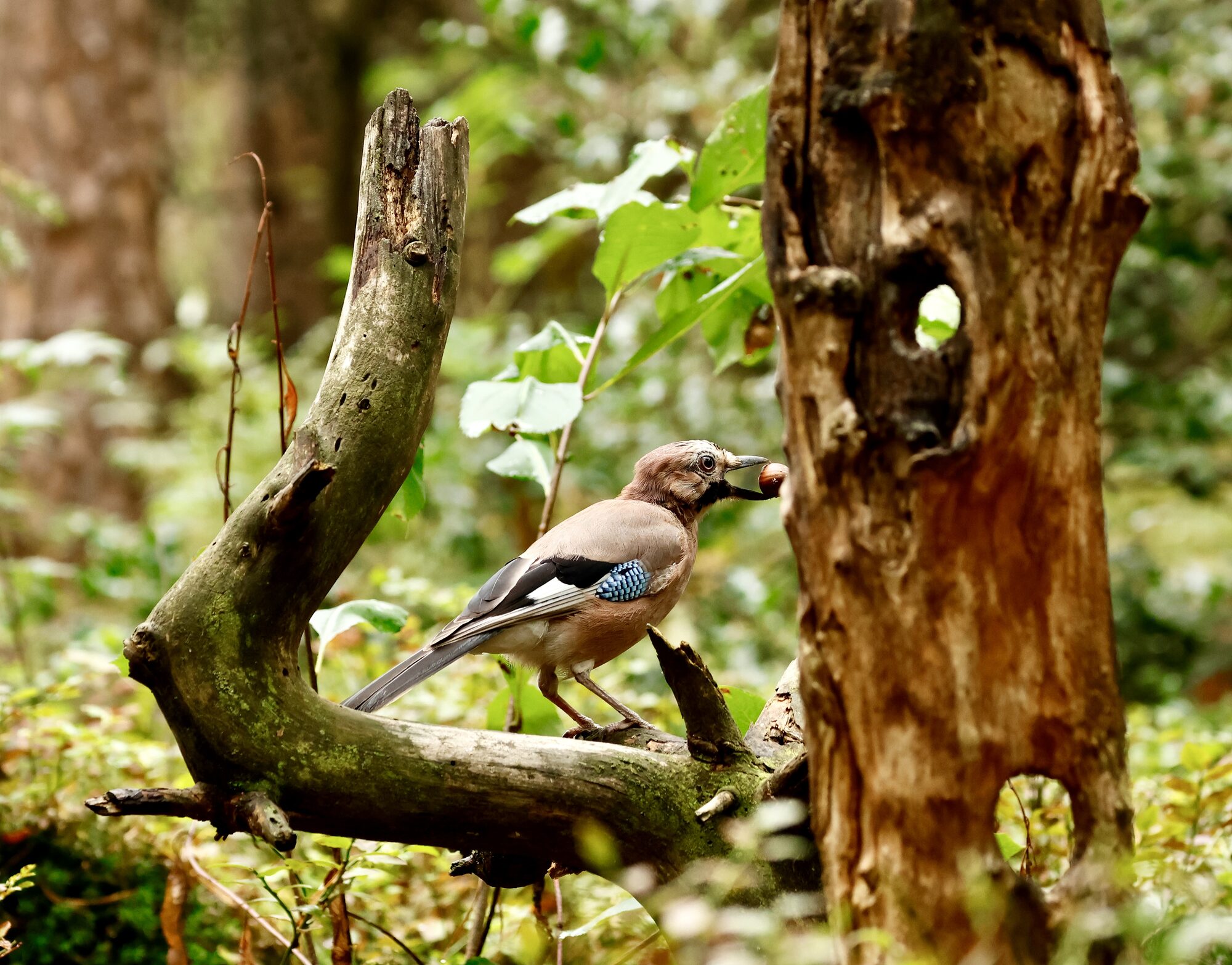
The Eurasian Jay is the odd one out in this list: 32 to 36 centimetres, wingspan 50 to 60 centimetres, and far from inconspicuous. Even so it belongs here, because nine times out of ten you hear it without seeing it. Vogelbescherming describes the call as “hoarse, screeching”. It is the sound every woodland walker knows without knowing whose it is: a grating screech, usually three or four times, usually while the bird is already flying off.
What virtually nobody knows is its soft song. Vogelbescherming describes how, besides screeching and squawking, the jay also produces “a sweet, soft and intimate little song”, which is “more a kind of muttering” and which it can keep up “for a good half hour” — with melodies that are “almost a hundred per cent stolen from other songbirds”. Anyone listening at length to a jumble of bird sounds that makes no sense anywhere is probably listening to one jay. Those imitations are a trap too: if you hear a bird of prey calling that you can’t find anywhere, reckon on a jay.
Five thousand acorns, and the oaks that grow from them
September is the month the jay is most conspicuous, and that has one reason. Vogelbescherming: “As early as September the jay starts its seasonal labour: collecting acorns.” The quantities are impressive — per season “each jay some 5,000” acorns. The transport is efficient: “Per harvesting trip 3 to 5 go into the throat pouch, the largest stays in the bill.”
Finding them again works surprisingly well. Experiments showed, according to Vogelbescherming, “that the jay makes use of visual landmarks to find the fruits again”, and it usually locates them “even under a layer of snow”. But not everything is found again, and it is precisely those forgotten acorns that earned it the nickname great forester: the store germinates in spring, and that is how an oak wood moves.
In practice this means that in September and October you should watch for acorns rather than for birds. A group of oaks with fruit falling is the best jay lookout there is: birds fly back and forth all day, each time in the same direction.
The jay is otherwise a resident, with one exception: on average about once every eight years, autumn invasions of high numbers of jays from eastern, central or northern Europe reach our country, in small groups. If you see ten or twenty jays in October flying one after another in the same direction, you are not looking at local birds. We cover that kind of autumn phenomenon in our article on bird migration in September as well.
Where best to look for these woodland birds
The rule of thumb: old deciduous woodland with plenty of dead wood yields the most, and the Marsh Tit sets the heaviest requirement — older deciduous woodland from about four hectares. Three areas on this site that meet it:
- Leuvenumse Bossen — beech wood on drift sand with plenty of dead wood and a stream valley running through it. The wren above was photographed in precisely this area.
- Deelerwoud — old woodland on the Veluwe. Note: here you may walk only on the designated paths, stricter than in most other areas.
- Veluwezoom National Park — a large area of old deciduous woodland, and in autumn the deer story within the same walk.
For the jay there is an extra criterion independent of woodland age: there must be oaks. In September and October that is where it is and nowhere else.
When: the hour and the season
The first hour after sunrise is by far the best, and that difference is greater in autumn than in spring. From about ten o’clock it becomes noticeably quieter; after midday you mainly hear calls and alarm, no song.
- September — the robin starts singing again, the jay starts on acorns. The leaves are still on, so you hear more than you see.
- October — Vogelbescherming writes that from late September, “but above all in October”, the Netherlands fills up with robins, and at the same time the leaves start to fall. The best month of the year for woodland birds. If you want to see something else in the same weeks as dusk falls: that is also when the starling roosts are building up.
- November to February — bare wood, little song but plenty of calls, and mixed tit flocks moving through the wood. Those often contain Great Tits, Marsh Tits and a treecreeper all at once; follow one flock and you see more species in ten minutes than in an hour of walking alone.
- March to June — plenty of song, but so much at once that telling it apart is harder.
Practicalities: what to take and what not to do
You need less than you think. Binoculars with a short close-focus range matter more than high magnification: woodland birds are often at five metres, and a pair that only focuses from seven metres is then worthless. An 8× is more pleasant in woodland than a 10×. Beyond that: muted clothing, no rustling jacket, and shoes you can walk quietly in. You can leave the tripod at home, and the urge to walk far too — two hours in one hectare yields more than two hours of walking.
One thing we advise against, and in autumn with an extra reason: playing sound to lure birds in. The song you hear now is about territory for the winter; the bird that responds is defending the space it will get its food from in the coming months, and making it turn out for that costs it energy in the season when that counts most. So use recordings at home to learn, not in the field to lure. How we handle this is on responsible wildlife watching. The same goes for nest sites and cavities: we don’t name those on this site, not even for species without a formal restriction.
Frequently asked questions
Which woodland bird do I hear most often in winter?
Almost certainly the robin or the wren. The robin has a ticking call and goes on singing in autumn and winter; the wren has a loud rattle and an explosive song. Both are resident and sit low, so you hear them at eye level.
Do robins really sing in autumn?
Yes. According to Vogelbescherming the song starts again “around the beginning of September”, after a quiet period from mid-July in which the birds moult. It is not courtship song but territorial song for the winter, and it sounds calmer and with longer phrases than in spring.
How do I tell a Marsh Tit from a Willow Tit?
The most reliable feature is the clear pale patch at the base of the upper mandible, which the Marsh Tit virtually always has and the Willow Tit usually does not. The often-cited “glossy versus dull cap” is less reliable than people think. In case of doubt the call decides: nasal and whining dehh-dehh-dehh for the Willow Tit, explosive and falling pstee-tchoo for the Marsh Tit.
Is it a treecreeper or a nuthatch?
Look at the direction of travel. The nuthatch also walks down the trunk and shuffles in all directions; the treecreeper hops up in a spiral and then flies to the foot of the next tree to start again. Colour helps too: the nuthatch is blue-grey with rusty orange, the treecreeper brown and white.
Why does that young robin have no red breast?
Juvenile robins are brown and mottled. Adult robins react aggressively to the colour red and attack others of their kind with a red breast; a juvenile without red is left alone. Over the course of autumn the breast turns orange after all.
How many acorns does a jay hide?
According to Vogelbescherming some 5,000 per season, from September onwards, three to five per flight in the throat pouch plus the largest in the bill. It finds them again via visual landmarks, usually even under snow — but not all of them, and the forgotten acorns germinate.
Further reading at the source
- Vogelbescherming Nederland — Roodborsten bezetten winterterritoria: influx from late September, territorial defence by both sexes, autumn song. vogelbescherming.nl. In Dutch.
- Vogelbescherming Nederland — De roodborst op zomerreces: the quiet period from mid-July and the resumption of song around early September. vogelbescherming.nl. In Dutch.
- Vogelbescherming Nederland — Stille vogels zijn in de rui: why songbirds fall silent after the breeding season. vogelbescherming.nl. In Dutch.
- Vogelbescherming Nederland — De flamboyante gaai: 5,000 acorns per season, three to five per flight in the throat pouch, visual landmarks, and the muttered song with imitated melodies. vogelbescherming.nl. In Dutch.
- Vogelbescherming Nederland — Matkop vs. glanskop en v.v.: bib, wing panel, bill base and the two calls. vogelbescherming.nl. In Dutch.
- Vogelbescherming Nederland — Boomklever of -kruiper: wie is wie?: climbing behaviour, colour and winter food. vogelbescherming.nl. In Dutch.
- Vogelbescherming Nederland — Bevolkingsexplosie van winterkoningen na kou: mortality in severe winters and the recovery afterwards. vogelbescherming.nl. In Dutch.
- Vogelbescherming Nederland — bird guide species pages winterkoning, roodborst, glanskop, matkop, boomkruiper and gaai: measurements, numbers, song, call, habitat and migratory behaviour. In Dutch.
- Sovon Vogelonderzoek Nederland — Willow Tit trend page: breeding trend since 1990 and over the last twelve years, from the Breeding Bird Monitoring Scheme (BMP, MUS, MAS). stats.sovon.nl. In Dutch.
- Which woodpecker is this? Identify all six by drum and call — the other group you find mainly by sound.
- Bird migration in September — what flies over the wood in the same weeks.
- Seeing a starling murmuration in the Netherlands — the other autumn spectacle, at the end of the day instead of the beginning.
- Species pages with sound recordings: European Robin, Eurasian Wren, Marsh Tit, Willow Tit, Short-toed Treecreeper, Eurasian Nuthatch, Eurasian Jay, Great Tit and Common Chaffinch.
- Areas with old deciduous woodland: Leuvenumse Bossen, Deelerwoud and Veluwezoom National Park.
- Responsible wildlife watching — why we don’t play sound to lure birds in.