
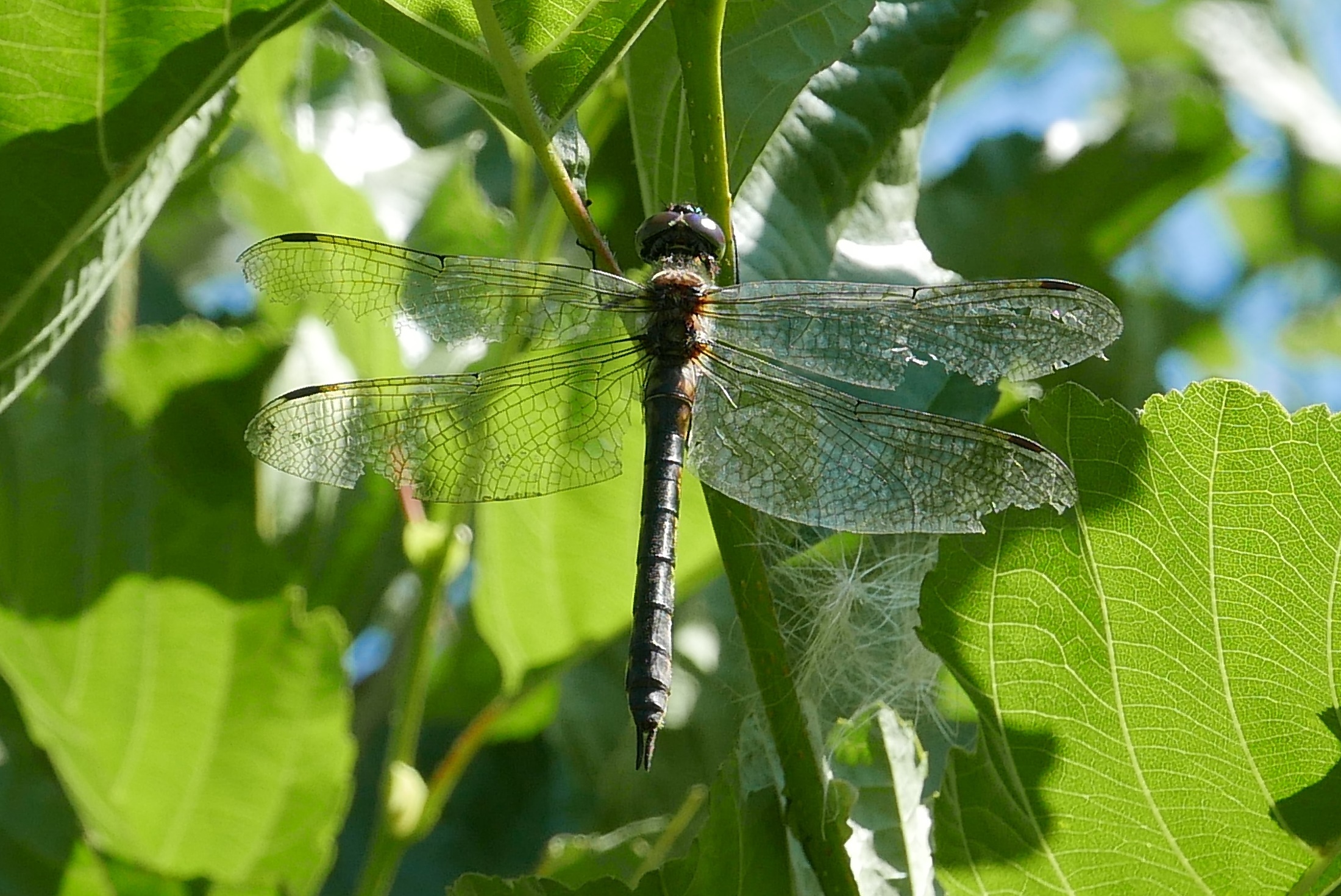
Where to see the Yellow-spotted Emerald in the Netherlands
Rare 🪰 Dragonfly
Where and when do you see a Yellow-spotted Emerald? This species is rarely seen, from April to August.
How do you recognise a Yellow-spotted Emerald?
Length 45 to 54 millimetres. The abdomen is a very dark glossy green and looks almost black, the thorax metallic green with a golden sheen. The decisive feature is a row of yellow spots along the side of the abdomen. In females those side spots are large and conspicuous.
Where do you see this species in the Netherlands?
Mainly in the lowland peat areas of the northern Netherlands, the Kempen in North Brabant and central Limburg. Recently also records in the dunes and the Achterhoek.
Habitat: Heavily silted-up heath pools, peat cuttings and swamp woodland, possibly also vegetation-rich ditches.
This is a common, widespread species: you can come across it in far more places than the areas listed below. Treat that list as a starting point rather than a full survey.
📍 Nationaal Park De Meinweg
presence reported📍 Nationaal Park Weerribben-Wieden
presence reportedThese links come straight from our database, with the chance, the source and the evidence level for each area.
When is the best time?
Green = present · orange = peak period. The bar is generated from our database.
Best period: Late April to late August, with the highest numbers in June and July.
Best time of day: The sunny hours in the middle of the day.
Recent sightings
👁️ Where has this species been seen recently?
Check the current sightings on Waarneming.nl. A useful addition to our own verified information.
How to improve your chances
- Go on a warm, windless day between about ten and four, when they are active.
- Look for the place rather than the animal: flowery edges for butterflies, banks and open water for dragonflies.
- Move slowly and keep your shadow off the animal. It notices that before it notices you.
- Early in the morning they are still cold and motionless on a leaf. That is when you can get closest.
🎒 What you need for this
Binoculars. The yellow side spots are the proof, and you only see them on a settled animal or in a sharp side view.
Photography
Look along woodland edges and in clearings rather than at the waterside — that is where it hunts. Photograph from the side, because the row of yellow spots is on the flank of the abdomen.
🌿 Watching responsibly
Keep your distance, stay on the paths, and never lure animals with food or sound. Leave as soon as an animal becomes uneasy.
Status: Verified · Last checked: 2026-08-08