
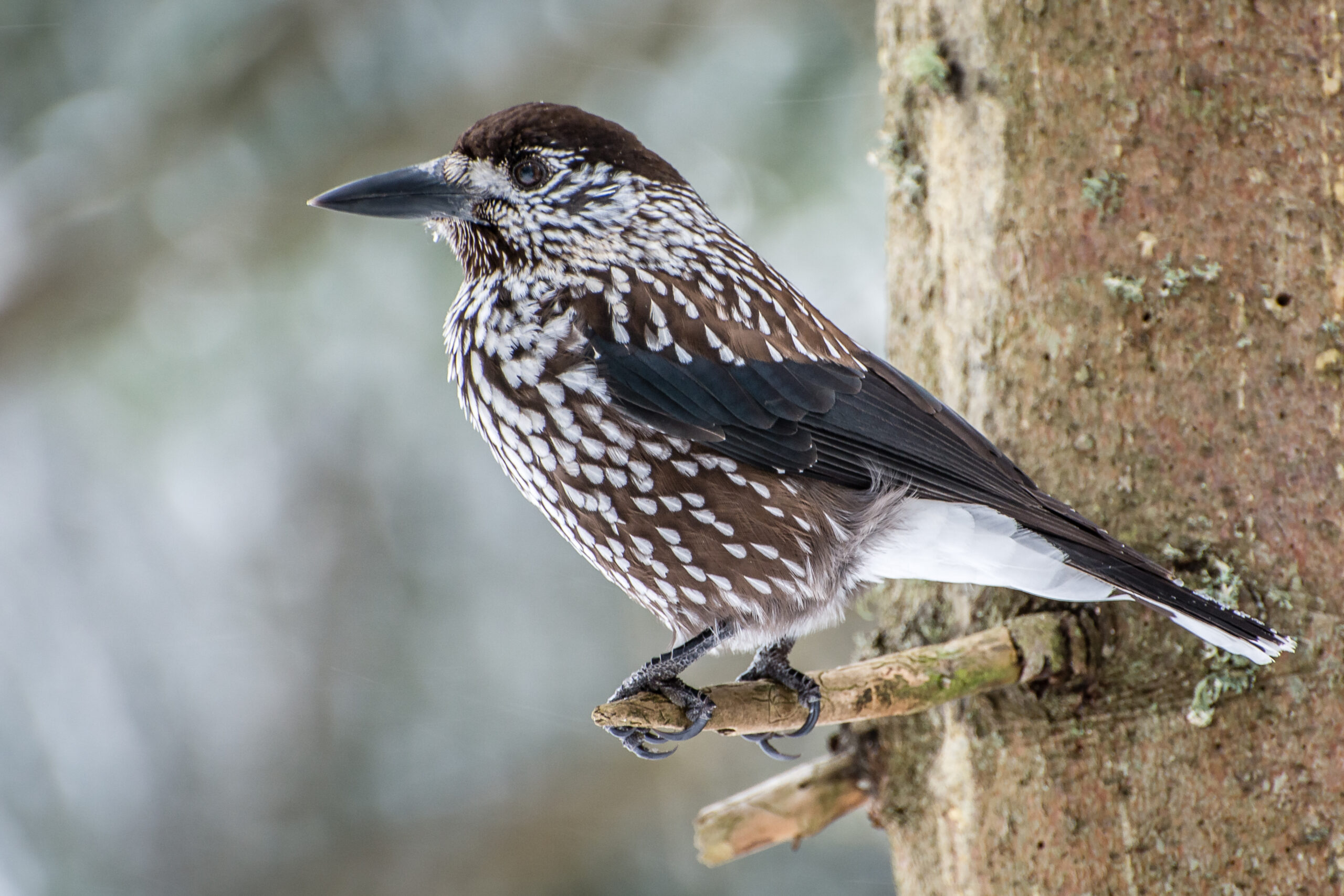
Where to see the Spotted Nutcracker in the Netherlands
Very rare 🦅 Bird
Where and when do you see a Spotted Nutcracker? This species is very rarely seen, from September to February.
How do you recognise a Spotted Nutcracker?
A member of the crow family of 32 to 34 cm with a wingspan of 49 to 53 cm, about the size of a jackdaw. The plumage is dark brown and strewn all over the body with white drops, as if paint had been splashed on it. The crown and wing coverts are, by contrast, an even dark brown without spots. The undertail coverts are bright white and the tail is black and white from below. The bill is long, straight and powerful.
What does a Spotted Nutcracker sound like?
Recording: Alexander Kürthy, CC BY-SA 4.0, via Wikimedia Commons
Where do you see this species in the Netherlands?
No established breeding population. In the winters of 2012/13 to 2014/15 it involved nil to one wintering bird; the number of passage migrants lay between 1 and 100 a year. In invasion years there can be considerably more.
Habitat: It breeds in spruce forest with hazel in mountain regions and in the taiga. During invasions it turns up in gardens and parks, where it looks for nuts and seeds in the shrub layer. Hazelnuts are of great importance as winter food; the bird caches thousands of them in the ground each year, and finds them again later under the snow.
This is a common, widespread species: you can come across it in far more places than the areas listed below. Treat that list as a starting point rather than a full survey.
Habitat: It breeds in spruce forest with hazel in mountain regions and in the taiga. During invasions it turns up in gardens and parks, where it looks for nuts and seeds in the shrub layer. Hazelnuts are of great importance as winter food; the bird caches thousands of them in the ground each year, and finds them again later under the snow.
We have not yet recorded any areas for this species with enough evidence behind them, so we name the habitat type instead.
When is the best time?
Green = present · orange = peak period. The bar is generated from our database.
Best period: Mainly in October and November, when invasions reach their peak.
Best time of day: By day, often early in the morning at a productive hazel or nut tree.
Recent sightings
👁️ Where has this species been seen recently?
Check the current sightings on Waarneming.nl. A useful addition to our own verified information.
How to improve your chances
- Learn the calls first. You will hear most birds before you see them.
- Go in the first hour after sunrise, when the song is at its peak and the wind is still down.
- Use a hide or natural cover. Sitting still gets you more than walking closer.
- Keep the sun behind you. Against the light you see a silhouette and no colour.
🎒 What you need for this
Binoculars and patience at a hazel or walnut tree. A knowledge of the sound helps: a nasal rattle, krrrairrh.
Photography
Nutcrackers during invasions are strikingly unshy and often stay at the same nut tree for days. Take a fixed position at a distance, let the bird get used to you and photograph the moment it hacks a nut open.
🌿 Watching responsibly
Keep your distance, stay on the paths, and never lure animals with food or sound. Leave as soon as an animal becomes uneasy.
Status: Verified · Last checked: 2026-10-11