
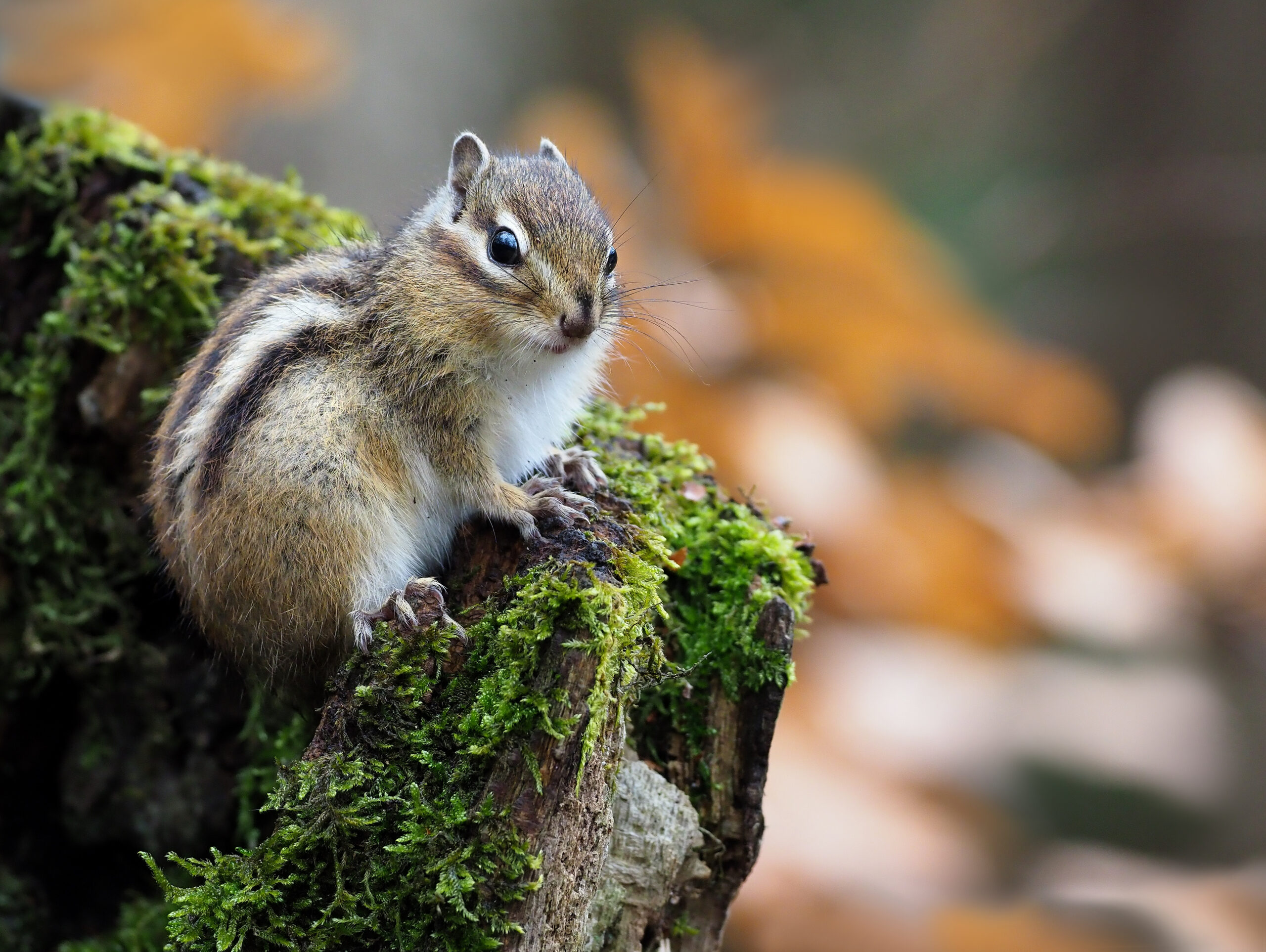
Where to see the Siberian chipmunk in the Netherlands
Very rare 🦌 Mammal (land)
Where and when do you see a Siberian chipmunk? This species is very rarely seen, from March to October.
How do you recognise a Siberian chipmunk?
Considerably smaller than a squirrel. The upperside is brownish grey, ochre or sandy with five blackish brown lengthwise stripes: one from the back of the head to the tail root and four that start at the shoulder blades and neck. The lower belly is whitish grey. The long plume-like tail is grey with three blackish brown stripes. Short front feet with four toes, strong hind feet with five, and large cheek pouches. Head and body 120 to 170 millimetres, tail 80 to 115 millimetres, 50 to 120 grams.
What tracks does a Siberian chipmunk leave?
Print: smaller than that of the Red squirrel, and the hind feet do not point outwards; Zodion gives no measurements of its own. Droppings: 4 mm thick and up to 8 mm long, short-cylindrical with a coarse texture and blunt or pointed ends. Feeding signs: the gnawing pattern on hazelnuts is roughly toothed, rougher than with the Red squirrel.
Where do you see this species in the Netherlands?
Animals escaped and released from captivity at a few places, such as near Tilburg and Weert. In the Netherlands mainly on the higher sandy soils.
Habitat: Woodland with undergrowth. Its original range lies in the coniferous forest zone of European and Asian Russia and covers large parts of Siberia, China, Korea, Japan, Mongolia and Kazakhstan.
This is a common, widespread species: you can come across it in far more places than the areas listed below. Treat that list as a starting point rather than a full survey.
Habitat: Woodland with undergrowth. Its original range lies in the coniferous forest zone of European and Asian Russia and covers large parts of Siberia, China, Korea, Japan, Mongolia and Kazakhstan.
We have not yet recorded any areas for this species with enough evidence behind them, so we name the habitat type instead.
When is the best time?
Green = present · orange = peak period. The bar is generated from our database.
Best period: Mainly from March to October; in winter it takes an interrupted winter rest.
Best time of day: During the day.
Recent sightings
👁️ Where has this species been seen recently?
Check the current sightings on Waarneming.nl. A useful addition to our own verified information.
How to improve your chances
- Keep the wind in your face. Most mammals will smell you long before they see you.
- Arrive before sunrise and then stay put. Sitting still beats walking about.
- Wear muted colours, skip the scent, and put your phone on silent.
- Be patient. Expect to come back more than once before it works.
🎒 What you need for this
A camera. It is day-active and relatively unshy, so photographing it often works.
Photography
Count the stripes: five dark lengthwise stripes on the back, plus three on the tail. No native Dutch mammal has those markings, so one sharp photo of the back is evidence enough. Report your record.
🌿 Watching responsibly
Keep your distance, stay on the paths, and never lure animals with food or sound. Leave as soon as an animal becomes uneasy.
Status: Verified · Last checked: 2026-08-08