
Where to see the Reeves's muntjac in the Netherlands
Very rare 🦌 Mammal (land)
Where and when do you see a Reeves's muntjac? This species is very rarely seen, all year round.
How do you recognise a Reeves's muntjac?
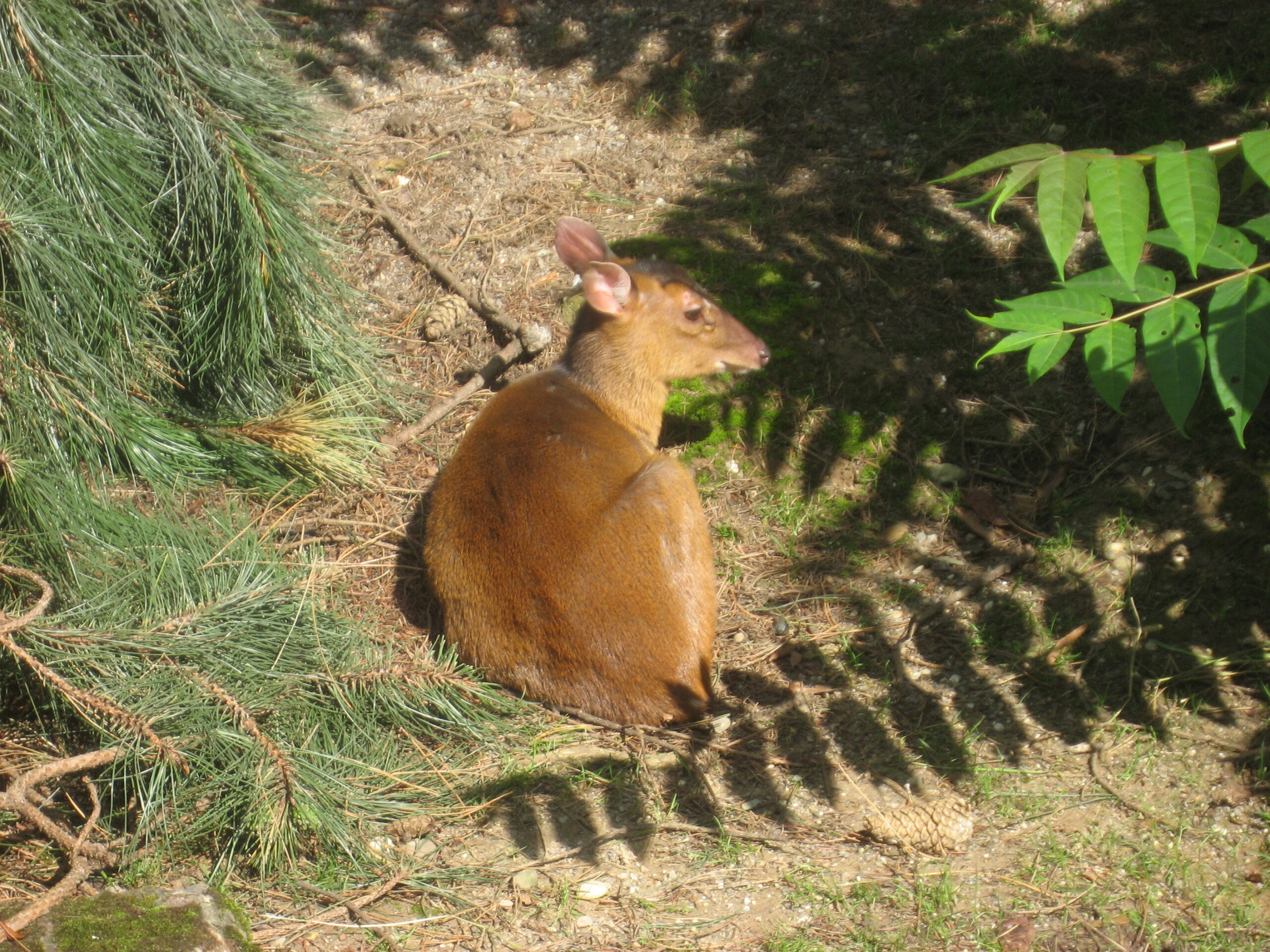
The smallest free-living deer in Europe: a sturdy body on short legs, with canine teeth that protrude outside the lips. The coat is chestnut brown in summer and dark brown in winter. Striking are the scent glands on the forehead and at the corners of the eyes. Head and body 80 to 90 centimetres, shoulder height 43 to 52 centimetres, tail 9 to 17 centimetres, 9 to 18 kilograms.
What does a Reeves's muntjac sound like?
Recording: Jidanni, CC BY-SA 4.0, via Wikimedia Commons
What tracks does a Reeves's muntjac leave?
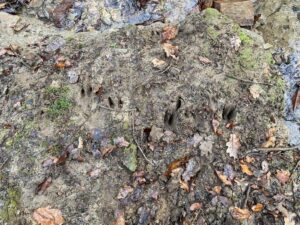
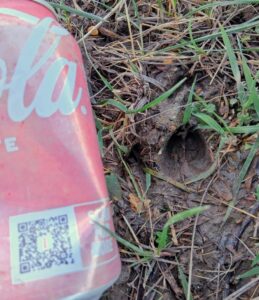
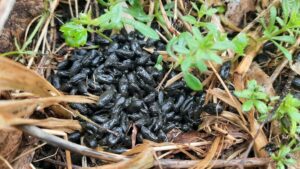
Print: small, about 2.5 cm long, making it the smallest hoof print in the Netherlands. The two halves of the hoof are slightly asymmetrical, with the outer one a little longer and more curved, although that is by no means always visible in the print. Trail: the paths are narrower than a roe deer's, and males scrape the ground with their hooves along territory boundaries; those drag marks are sometimes a metre long and a few centimetres deep. Droppings: smooth and dark with no visible fibres, round to elongated and varying greatly in size, deposited scattered along the route and barely distinguishable from roe deer droppings. Feeding signs: young plants rubbed away at 10 to 40 cm height, with the bark left hanging in shreds because the animal has no upper teeth.
Where do you see this species in the Netherlands?
First reported in 1997 to 1998 on the Veluwe and in the Achterhoek. Since then scattered records, mainly in the southern half of the country with the emphasis on North Brabant. There are no signs of establishment.
Habitat: Woodland with dense undergrowth, but it adapts well to gardens, parks and railway verges.
This is a common, widespread species: you can come across it in far more places than the areas listed below. Treat that list as a starting point rather than a full survey.
Habitat: Woodland with dense undergrowth, but it adapts well to gardens, parks and railway verges.
We have not yet recorded any areas for this species with enough evidence behind them, so we name the habitat type instead.
When is the best time?
Green = present · orange = peak period. The bar is generated from our database.
Best period: All year; unlike other deer there is no fixed rut.
Best time of day: Night; by day it stays in cover.
Recent sightings
👁️ Where has this species been seen recently?
Check the current sightings on Waarneming.nl. A useful addition to our own verified information.
How to improve your chances
- Keep the wind in your face. Most mammals will smell you long before they see you.
- Arrive before sunrise and then stay put. Sitting still beats walking about.
- Wear muted colours, skip the scent, and put your phone on silent.
- Be patient. Expect to come back more than once before it works.
🎒 What you need for this
A trail camera. It is nocturnal and stays in cover by day, so seeing it in daylight is chance.
Photography
Listen for the sound: the muntjac barks, and that barking can go on for minutes. With this species a sound recording is just as usable as evidence as a photo. Report every record, because establishment in the Netherlands has not yet been demonstrated.
🌿 Watching responsibly
Keep your distance, stay on the paths, and never lure animals with food or sound. Leave as soon as an animal becomes uneasy.
Status: Verified · Last checked: 2026-08-08